Algeria
 Egypt
 Libya
 Morocco
 Sudan
 Tunisia
 Benin
 Burkina Faso
 Cabo Verde
 Côte d'Ivoire
 Ghana
 Guinea
 Liberia
 Mali
 Mauritania
 Niger
 Nigeria
 Senegal
 Sierra Leone
 The Gambia
 Togo
 Cameroon
 Central African Republic
 Chad
 DR Congo
 Equatorial Guinea
 Gabon
 Republic of the Congo
 São Tomé and Príncipe
 Burundi
 Comoros
 Djibouti
 Eritrea
 Ethiopia
 Kenya
 Madagascar
 Malawi
 Mauritius
 Mozambique
 Rwanda
 Seychelles
 Somalia
 South Sudan
 Tanzania
 Uganda
 Angola
 Botswana
 Eswatini
 Lesotho
 Namibia
 South Africa
 Zambia
 Zimbabwe
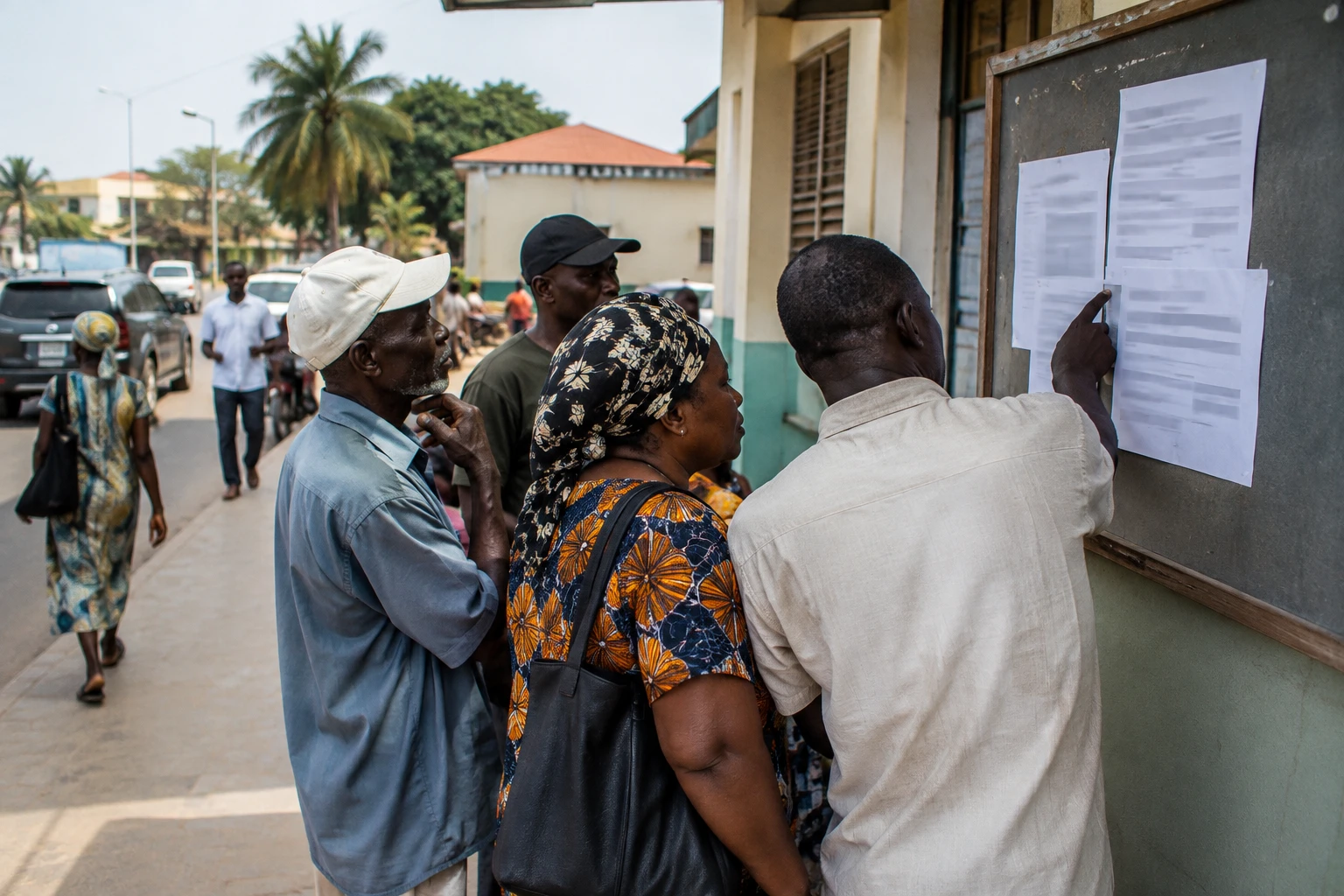
In Bissau, replacing a senior official is more than a change of office. In a military-led transition, every appointment affects both security balances and the promise of a return to civilian rule. The dismissal of Lieutenant-General Sadji Fati comes as the electoral timetable announced by the authorities is already being contested.
A fresh start in the presidential administration
General Horta N’Tam has removed Sadji Fati from his post as head of the civil cabinet of the presidency. The decree, reported on 15 October, provides for the decision to take effect immediately. It does not specify the reason for the move.
A former defence minister and military adviser to former president Umaro Sissoco Embaló, the lieutenant-general held a position at the presidential palace. His career links him to the previous administration, but no public evidence establishes that this connection was the official reason for his removal.
The decision is part of a series of changes within state institutions and the security forces since the military seized power on 26 November 2025. Officials considered close to Embaló have also left their posts, including General Mama Saliu Embalo, a former interior minister, and Maria da Cruz Correia, a former minister for fisheries and the maritime economy. Senegalese news agency APS also reports measures targeting members of the former presidential guard.
A transition born of a halted vote
To understand the significance of these reshuffles, it is necessary to go back to the presidential and parliamentary election of 23 November 2025. Provisional results were due to be announced the day after the coup. The military suspended the process and took control of state institutions. The African Union condemned the breach of constitutional order and reiterated that the National Electoral Commission was the legally mandated authority to proclaim the results.
The electoral crisis was not resolved by the junta’s arrival. The commission later said it could not complete the count after armed men seized documents and electoral materials. The identity of those responsible for the seizure and the precise circumstances remain matters to be attributed to the sources reporting them. The two main candidates had both claimed victory, while official results were never published.
The seizure of power prompted a regional response. ECOWAS, the Economic Community of West African States, and the African Union condemned the coup and called for the restoration of constitutional order. Guinea-Bissau is thus part of a region where breaches of civilian rule have posed a recurring challenge for West African organisations: securing a credible transition without abandoning the principle of electoral legitimacy.
The 6 December timetable under strain
The transitional authorities have announced presidential and parliamentary elections for 6 December 2026. But on 8 October, Prime Minister Ilídio Vieira Té and the first vice-president of the National Electoral Commission said the necessary conditions were not in place. The electoral official cited technical obstacles and said it was for the transitional president to announce any postponement.
This disagreement has a concrete consequence: the date announced by the military authorities does not guarantee that voters will actually be able to cast their ballots that day. An election requires parties able to participate, an operational electoral administration and conditions that allow the results to be verified. Without these safeguards, sticking to a date is not enough to establish confidence in the process.
Political leaders are directly affected by the reshuffles and the rules of the transition. For Guinea-Bissau’s people, the issue goes beyond posts at the palace: it is a question of who sets the timetable, which institutions will be able to oversee the vote and how the results will be determined. In the regions as well as the capital, political uncertainty can also complicate the work of public administrations and the continuity of public services. The sources consulted do not, however, make it possible to measure any specific economic or social impact from this particular dismissal.
Reshuffles do not settle the political question
Removing officials associated with the former president may enable the military authorities to reduce the influence of his circle in the administration. But this reorganisation does not, in itself, answer the questions of legitimacy raised by the interruption of the vote. It clarifies neither the rules for participation in the next election, nor the guarantees offered to parties, nor the role of civilian institutions during the transition.
The national context makes these questions particularly sensitive. Guinea-Bissau has experienced several periods of tension between civilian and military authorities. In December 2023, gunfire in the capital had already been followed by Embaló’s dissolution of parliament. Before the November 2025 coup, the opposition had also disputed the legitimacy of the political timetable. These precedents illustrate the fragility of the institutions, without establishing a single cause for the current crisis.
The former president’s fate adds another element of uncertainty. Umaro Sissoco Embaló is in exile in Morocco and has said he wishes to stand again. APS reports that the transitional authorities have cited security concerns to prevent his return. This situation raises a practical question for the future election: what conditions will apply to candidates, including those outside the country?
A test for regional mediation
ECOWAS has given Senegal a mediating role in the crisis. APS reports that this mediation was mandated at a regional meeting in July 2026. What happens next will depend in particular on the transitional authorities’ ability to clarify the electoral timetable and allow the commission to work without obstruction. The African Union will also remain important, since its principles condemn unconstitutional changes of power.
Sadji Fati’s dismissal alone does not make it possible to conclude that there has been a definitive break between the junta and the former president, or to establish the reasons for it. It does, however, confirm the ongoing reshaping of the state apparatus at a time when the electoral deadline remains uncertain. For the people of Guinea-Bissau and their neighbours, the next milestone will be the official decision on 6 December and the concrete safeguards put in place for the electoral process.