Algeria
 Egypt
 Libya
 Morocco
 Sudan
 Tunisia
 Benin
 Burkina Faso
 Cabo Verde
 Côte d'Ivoire
 Ghana
 Guinea
 Guinea-Bissau
 Liberia
 Mali
 Mauritania
 Niger
 Nigeria
 Senegal
 Sierra Leone
 The Gambia
 Togo
 Cameroon
 Central African Republic
 DR Congo
 Equatorial Guinea
 Gabon
 Republic of the Congo
 São Tomé and Príncipe
 Burundi
 Comoros
 Djibouti
 Eritrea
 Ethiopia
 Kenya
 Madagascar
 Malawi
 Mauritius
 Mozambique
 Rwanda
 Seychelles
 Somalia
 South Sudan
 Tanzania
 Uganda
 Angola
 Botswana
 Eswatini
 Lesotho
 Namibia
 South Africa
 Zambia
 Zimbabwe
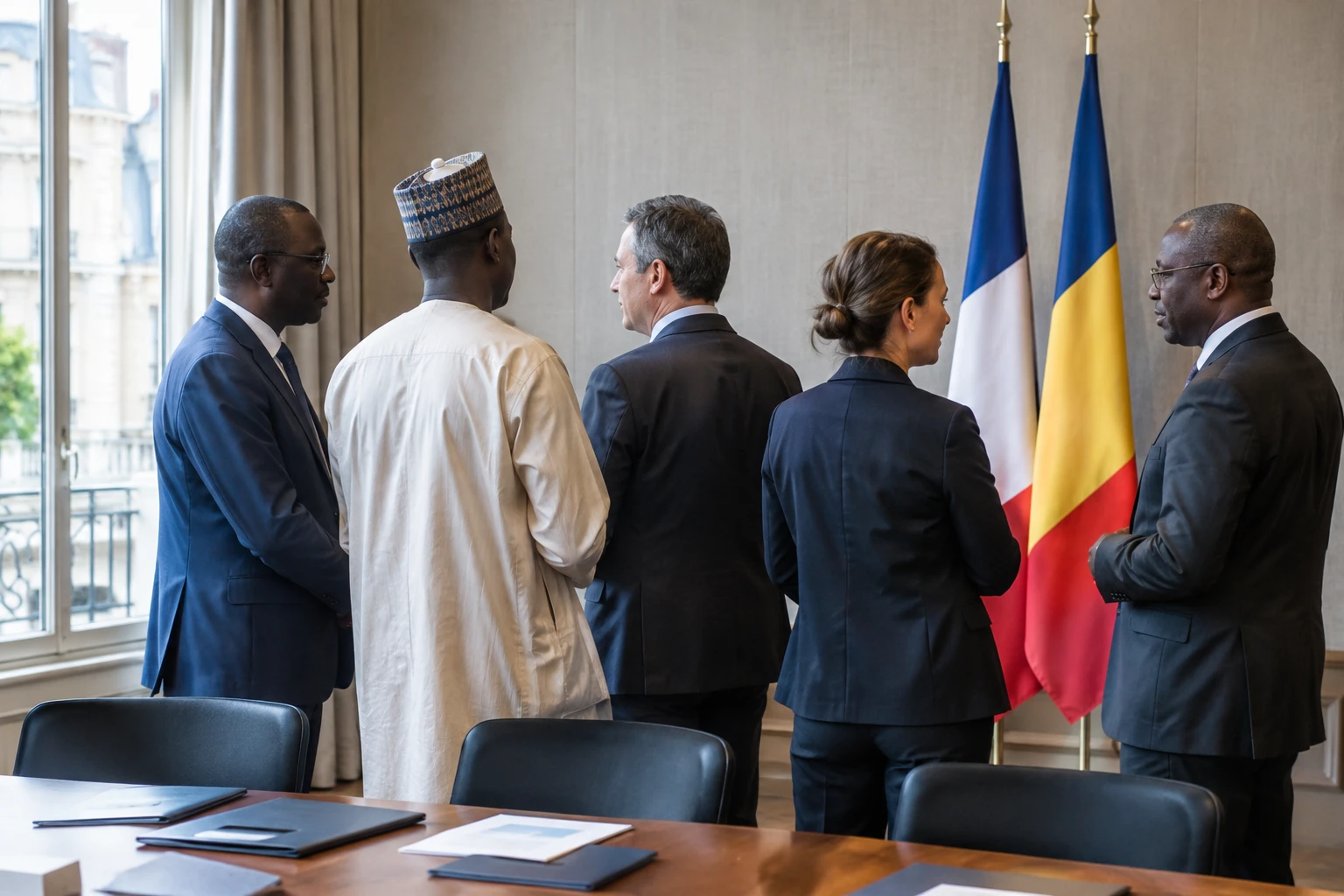
In N’Djamena, the resumption of dialogue with Paris is now measured less by statements than by concrete projects. The economy, regional security and sovereignty are back at the top of the agenda with the working visit announced for Tuesday 13 October, without erasing the turning point represented by France’s military withdrawal.
A relationship to rebuild on new foundations
Chad is a Central African actor and a member of CEMAC, the economic and monetary community comprising six countries in the sub-region. But its challenges extend beyond this framework: its border with Sudan puts it directly in contact with a war that is destabilising the region and causing population displacement.
Ties between N’Djamena and Paris changed in nature after Chad announced its decision to end its defence agreements with France in November 2024. The last French soldiers left the country on 31 January 2025. The withdrawal marked the end of a long-standing military presence, but not of diplomatic relations or shared economic interests.
For the Chadian government, the challenge is to manage this shift without relying on a single partner. For France, it is to maintain relations in a region where traditional frameworks for military cooperation have been called into question. The central issue, therefore, is how these ties will work: which partnerships can continue, in what areas and according to what priorities set by the two states?
From political exchanges to economic commitments
According to Chad’s official portal, Marshal Mahamat Idriss Déby Itno left N’Djamena for Paris on Monday 12 October at the invitation of French President Emmanuel Macron. A meeting is scheduled for 13 October. The two leaders are expected to discuss economic cooperation, as well as regional and international issues. At the time the visit was announced, no public details were available to suggest that these discussions had resulted in agreements.
This step follows their meeting on 29 January 2026 at the Élysée Palace. The joint statement issued after the meeting referred to a desire for a “revitalised partnership”, based on mutual respect and shared interests, with particular attention to the economy. The presidents also discussed Sudan and called for a humanitarian truce to be implemented. The Élysée’s joint statement on the January meeting said that follow-up on the commitments would continue.
The economic dimension was also highlighted at the Africa Forward summit, held in Nairobi on 11 and 12 May 2026 by Kenya and France. An African news agency reported that agreements involving French companies and Chad were signed on the sidelines of the summit, in sectors including infrastructure, health and education. Chad’s official news agency, for its part, said discussions had also covered preparations for a Chad-France business forum in Paris. These announcements point to a direction, but their impact will depend on funding, timelines and implementation. Chad’s official news agency’s report on Africa Forward documents these exchanges.
A Franco-Chadian business forum was subsequently scheduled for 25 September in Paris. The planned meeting between the presidents therefore comes after a period in which business leaders have been urged to play a greater role in bilateral relations. The question is whether this business diplomacy will lead to investment accessible to Chadian companies, beyond announcements and exchanges between officials.
The Sudanese border weighs on the regional agenda
Regional security is not limited to discussions between governments. Since the war in Sudan began in April 2023, Chad has hosted a large number of people fleeing the fighting. As of 25 September 2026, the United Nations High Commissioner for Refugees reported nearly one million arrivals since the conflict began, including more than 55,000 since the start of the year. UNHCR’s update on arrivals in Chad highlights the continuing pressure in the east of the country.
This situation directly affects the Chadian authorities and communities in the east, which must contend with long-term humanitarian needs and pressure on local resources. It also concerns regional and international partners: Chad’s stability matters to Central Africa, while the war in Sudan extends far beyond the borders of its two neighbours. Security cooperation discussed in Paris will therefore need to be assessed against these realities, without conflating assistance to populations, border management and military partnership.
Results are expected, not just renewed dialogue
The 13 October visit comes as the two capitals say they want to renew their relationship, although its terms remain to be defined. For political leaders, it provides a framework for discussion. For businesses, the challenge is to turn protocols and forums into contracts, jobs and lasting exchanges. For the population, particularly in the eastern border regions, diplomatic announcements will have little impact unless they address practical needs relating to security and services.
Follow-up on the commitments announced in January, along with the delivery of projects discussed in Nairobi and at the business forum, will be more reliable indicators than a formula for closer ties. At the regional level, this sequence illustrates a broader shift: African countries’ external partnerships are being redefined, and their credibility depends on the genuine weight given to national priorities, local actors and cooperation between neighbours.