Algeria
 Egypt
 Libya
 Morocco
 Sudan
 Tunisia
 Benin
 Burkina Faso
 Cabo Verde
 Côte d'Ivoire
 Ghana
 Guinea
 Guinea-Bissau
 Liberia
 Mali
 Mauritania
 Niger
 Nigeria
 Senegal
 Sierra Leone
 The Gambia
 Togo
 Cameroon
 Central African Republic
 Chad
 Equatorial Guinea
 Gabon
 Republic of the Congo
 São Tomé and Príncipe
 Burundi
 Comoros
 Djibouti
 Eritrea
 Ethiopia
 Kenya
 Madagascar
 Malawi
 Mauritius
 Mozambique
 Rwanda
 Seychelles
 Somalia
 South Sudan
 Tanzania
 Uganda
 Angola
 Botswana
 Eswatini
 Lesotho
 Namibia
 South Africa
 Zambia
 Zimbabwe
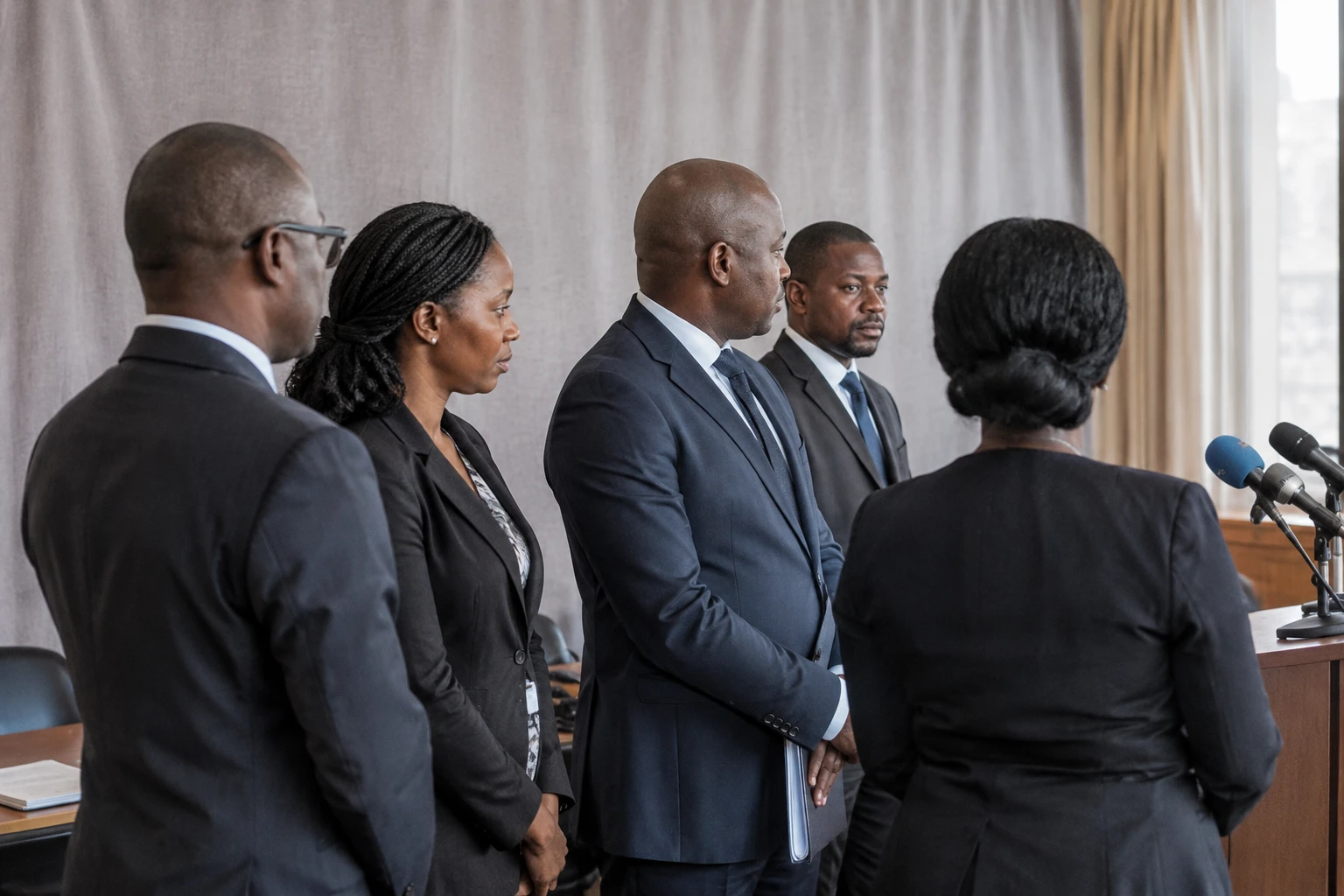
In Goma, the creation of a new politico-military front further blurs the line between political opposition and armed struggle. By placing Joseph Kabila at its head, the Front for the Refoundation of the Nation (FRN) brings together the former president and figures linked to the AFC/M23, a politico-military movement fighting the authorities in Kinshasa.
A new banner in a regionalised conflict
The Democratic Republic of the Congo is experiencing a crisis in which armed clashes, challenges to the government and regional rivalries intersect. Since January 2025, the AFC/M23 has controlled Goma, the capital of North Kivu, and extended its reach across the east of the country. The former president’s presence in this occupied area gives the war a new political dimension.
The conflict is not limited to relations between Kinshasa and armed groups. It also involves the DRC’s neighbours and several diplomatic processes. The country is a member of the Southern African Development Community (SADC) and the East African Community (EAC), two regional organisations concerned with security in the Great Lakes region. The United Nations has also documented the AFC/M23’s territorial expansion and the role of Rwandan forces in operations. Kigali disputes the accusations against it.
Past precedents also weigh on the situation. Since the 1990s, several rebellions in eastern Congo have changed their names, alliances or leadership. The AFC, led by Corneille Nangaa, had already provided a political structure for the M23. The FRN marks a new stage in this realignment, but its contours and workings remain to be established.
Joseph Kabila at the head of the FRN
The coalition was announced in Goma on Monday 12 October. According to accounts of the announcement, Joseph Kabila is taking the helm. The FRN brings together figures associated with the AFC/M23, including Corneille Nangaa and Bertrand Bisimwa, while Major-General Sultani Makenga is presented as chief of staff. This composition directly links the new platform to political and military figures already involved in the conflict.
Claude Ibalanky, presented as an adviser to the coalition, said the FRN intended to co-ordinate forces opposed to the government. He referred to the use of “all means, including force”. This wording places the project beyond a conventional electoral alliance. However, it does not, on its own, reveal the chain of command, precise military objectives or degree of integration of the groups involved.
The FRN has also announced the end of the AFC in its former form, according to the political statement reported by the Congolese media outlet Actualite.cd. This development does not necessarily mean that the AFC/M23’s armed structures or networks are disappearing. It remains to be seen whether the change is institutional or symbolic, or whether it is accompanied by a genuine reorganisation on the ground.
A realignment announced, intentions contested
The rapprochement between Joseph Kabila and AFC/M23 figures is not without precedent. In its report published in June 2026, the UN Group of Experts on the DRC said a restructuring of the movement was being considered, possibly involving a name change and a prominent role for the former president. The announcement of the FRN now gives public form to that possibility, without confirming all the elements anticipated by the experts.
This new banner could serve several purposes. It gives the coalition a figure who led the country from 2001 to 2019 and could attract support beyond M23 ranks. It could also portray the conflict as a confrontation between Congolese people, even as allegations of external support for the movement remain at the heart of diplomatic debate. UN experts have documented the involvement of Rwandan forces alongside the AFC/M23; Rwanda rejects these accusations. The name change therefore does not settle the question of regional responsibility.
For Kinshasa, Kabila’s entry into a coalition that claims it will use force raises the political and security stakes. The Congolese government will have to respond both to an armed opposition in the east and to a challenge led by someone who has held the presidency. For residents of Goma and territories under rebel control, the change of label guarantees neither an end to the fighting nor improvements in administration, security or essential services.
The repercussions also vary by location and livelihood. Residents of front-line areas are directly affected by insecurity and displacement. In Kinshasa, the debate focuses more on state authority, the legitimacy of the government and the political response to the crisis. Traders and producers in the east, meanwhile, depend on roads and markets disrupted by fighting and changes in control. An alliance announced at the top can therefore alter political relations without immediately changing daily life.
Next tests for Kinshasa and the Great Lakes
The central question is now whether the FRN is real: will its leaders exercise a unified command, or will the coalition remain a political structure bringing together actors with distinct interests? Future statements, actual appointments and military developments will help gauge its cohesion. Public declarations alone are not enough to establish its presence on the ground or its ability to impose a single line.
For regional partners, this realignment complicates mediation efforts. SADC and the EAC must contend with a conflict in which political, military and state actors are closely intertwined. Any negotiations will also have to take account of residents of the territories concerned, whose security and representation cannot be reduced to arrangements between leaders.
The FRN does not therefore bring the crisis to an end: it redraws its political landscape. The UN experts’ June 2026 report and the first details of the new coalition can be consulted in the United Nations report on the DRC, as well as in Radio Okapi’s coverage of Kabila’s return to the east and the Associated Press report on the FRN announcement. The point to watch will be the gap between the proclaimed coalition and the facts on the ground: command, territorial control and the place given to a negotiated solution.