Algeria
 Egypt
 Libya
 Morocco
 Sudan
 Tunisia
 Benin
 Burkina Faso
 Cabo Verde
 Côte d'Ivoire
 Ghana
 Guinea
 Guinea-Bissau
 Liberia
 Mali
 Mauritania
 Niger
 Nigeria
 Sierra Leone
 The Gambia
 Togo
 Cameroon
 Central African Republic
 Chad
 DR Congo
 Equatorial Guinea
 Gabon
 Republic of the Congo
 São Tomé and Príncipe
 Burundi
 Comoros
 Djibouti
 Eritrea
 Ethiopia
 Kenya
 Madagascar
 Malawi
 Mauritius
 Mozambique
 Rwanda
 Seychelles
 Somalia
 South Sudan
 Tanzania
 Uganda
 Angola
 Botswana
 Eswatini
 Lesotho
 Namibia
 South Africa
 Zambia
 Zimbabwe
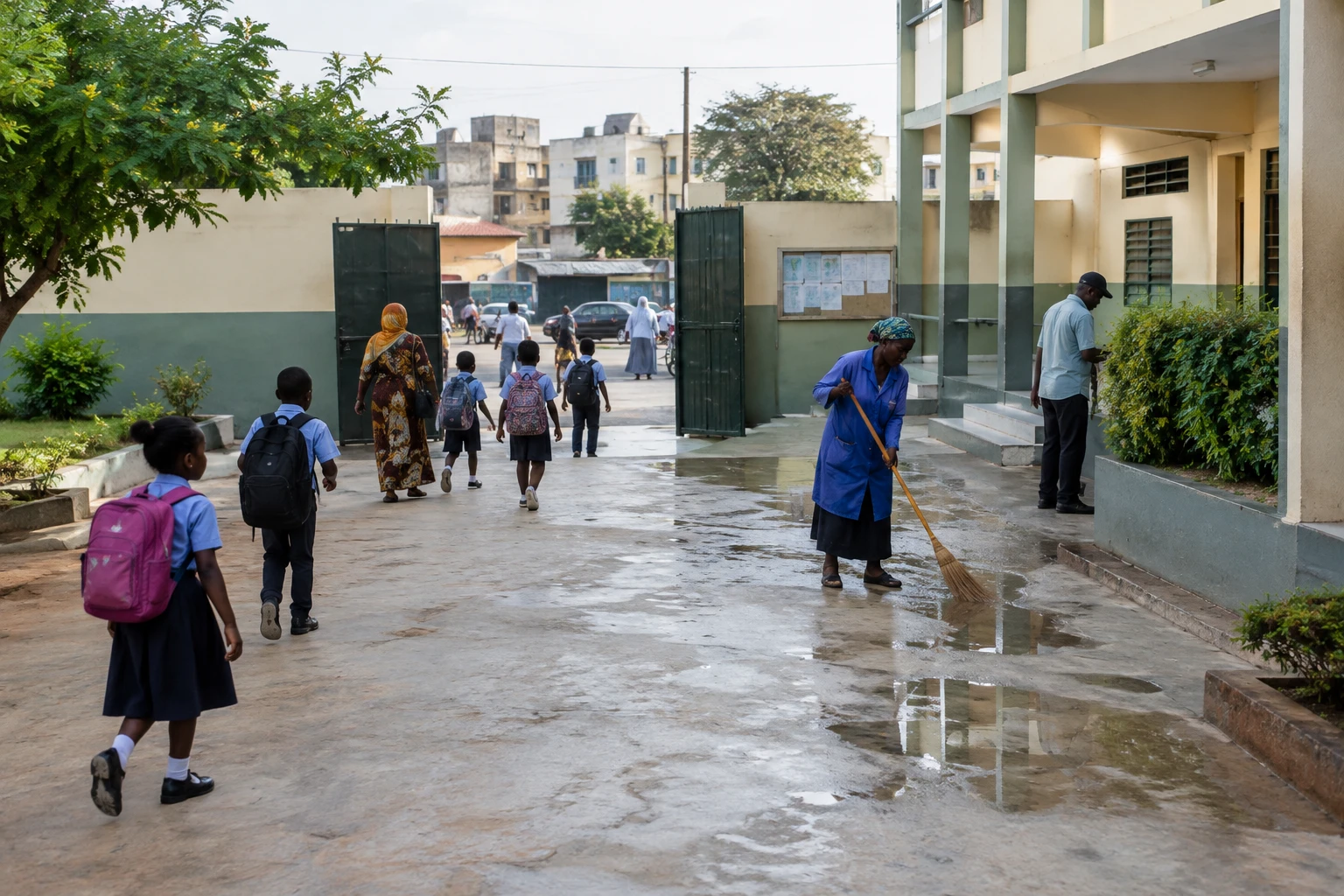
The start of the school year is measured by more than the number of classrooms open. For Senegalese families, the question of the day is also very practical: is their child’s school dry, clean and safe? Classes resumed on Monday 12 October at most schools, but conditions were not the same everywhere.
Nationwide reopening, contrasting local realities
The Ministry of National Education had postponed the return of pupils, initially scheduled for 7 October, until 12 October. It cited heavy rain and the need to clean, sanitise and repair affected schools. The decision applied across Senegal, not just in Dakar.
In Dakar and its suburbs, the effects of the rain were still visible at several schools. In Parcelles Assainies, Gueule Tapée and Cambérène, schoolyards were still flooded or waterlogged. In some buildings, pumping and cleaning continued as pupils returned to class.
The intensity of the rainfall gives an indication of the scale of the challenge. On 4 October, the Dakar-Yoff weather station recorded 137.5 millimetres of rain in 24 hours. The National Agency for Civil Aviation and Meteorology says this was the third-highest daily total recorded at the station since 1981, reports the Senegalese Press Agency on schools affected in Dakar.
The national figures should nevertheless be treated with caution. Initial assessments identified about 644 affected schools, then just over 200 on the eve of the start of term, according to reports by the APS. The ministry had not published a definitive updated count by that date. Meanwhile, Education Minister Moustapha Guirassy said that 7% of schools remained affected by flooding-related problems. That figure, based on data provided by his department, may already have changed as the weather improved.
The gap between a start of term declared effective and schools that remain unusable is significant. The APS described schools in Dakar where water had filled the yards, and others where only some classrooms had been spared. In Gueule Tapée, primary schools and a secondary school were among the flooded sites. The report also mentions the possible presence of wastewater in some places, posing a health risk distinct from the inconvenience caused by rain alone.
Balancing pupil safety and learning time
For the government, delaying the return to class further would also come at a cost. Each lost day reduces the time available for learning and complicates the organisation of the school year. The ministry therefore kept 12 October as the start date, while acknowledging that some schools might delay pupils’ return by 24 to 48 hours, or longer if safety conditions were not met.
This local flexibility is essential. A uniform date on the calendar does not guarantee uniform conditions in schools. When water remains in a schoolyard or a building needs to be disinfected, pupils and staff should not be put at risk in the name of keeping to the timetable. Moustapha Guirassy acknowledged that some schools needed to adapt their reopening, particularly where water had mixed with wastewater, according to the APS report on schools still affected.
The consequences are not the same for everyone. Families whose schools remain closed must arrange childcare, often without an alternative. Pupils may lose teaching hours, while teachers sometimes have to make do with partially usable premises. In neighbourhoods where getting around is difficult, damaged streets and puddles can also make the journey to school harder.
The response involves several groups: government services, firefighters, local authorities, parents and school communities. But pumping is not always enough. A rising water table can cause water to return, while drainage and sanitation issues exceed the capacity of a single school or local council.
An annual challenge that raises questions about urban planning
Senegal’s school calendar regularly coincides with the hivernage, the rainy season in West Africa. This proximity makes preparations before the start of term necessary: maintaining buildings, draining water, checking access routes and coordinating services. In its preparations for 2026-2027, the government had already included coordinated action to clear, pump out and repair structures affected by the rainy season.
Previous episodes show that the problem is not limited to a delay of a few days. In 2025, schools in the Matam region were flooded or occupied by displaced people after the Senegal River burst its banks. This illustrates how risks vary between areas: intense rainfall and urban drainage in Dakar, and river flooding and access to schools in some parts of the north and east.
The response therefore falls as much within education as within urban planning, sanitation and civil protection. Local authorities know the neighbourhoods and where water collects; the state has broader coordination and investment resources. For families, the question is whether the work under way will prevent the same uncertainty from returning during the next rainy season.
Across West Africa, Senegal shares with its neighbours challenges linked to seasonal rains and the continuity of public services. But the scale of the impact and the solutions depend first and foremost on each national and local context. ECOWAS, a regional cooperation organisation, provides a framework for dialogue between states; it does not replace the investment needed in schools and sanitation systems.
The next measure of progress will therefore not be simply the number of pupils in class on the first day. It will be necessary to monitor the full reopening of schools still affected, the health and safety of their premises, and the recovery of lost teaching hours. 12 October marks the return to classes for the majority, but the start of term will not truly be complete until every school can welcome its pupils in safe conditions.