Algeria
 Egypt
 Libya
 Morocco
 Sudan
 Tunisia
 Benin
 Burkina Faso
 Cabo Verde
 Côte d'Ivoire
 Ghana
 Guinea
 Guinea-Bissau
 Liberia
 Mali
 Mauritania
 Niger
 Nigeria
 Senegal
 Sierra Leone
 The Gambia
 Togo
 Cameroon
 Central African Republic
 Chad
 DR Congo
 Equatorial Guinea
 Gabon
 Republic of the Congo
 São Tomé and Príncipe
 Burundi
 Comoros
 Djibouti
 Eritrea
 Ethiopia
 Kenya
 Madagascar
 Malawi
 Mauritius
 Mozambique
 Rwanda
 Seychelles
 Somalia
 South Sudan
 Tanzania
 Uganda
 Angola
 Botswana
 Eswatini
 Lesotho
 Namibia
 Zambia
 Zimbabwe
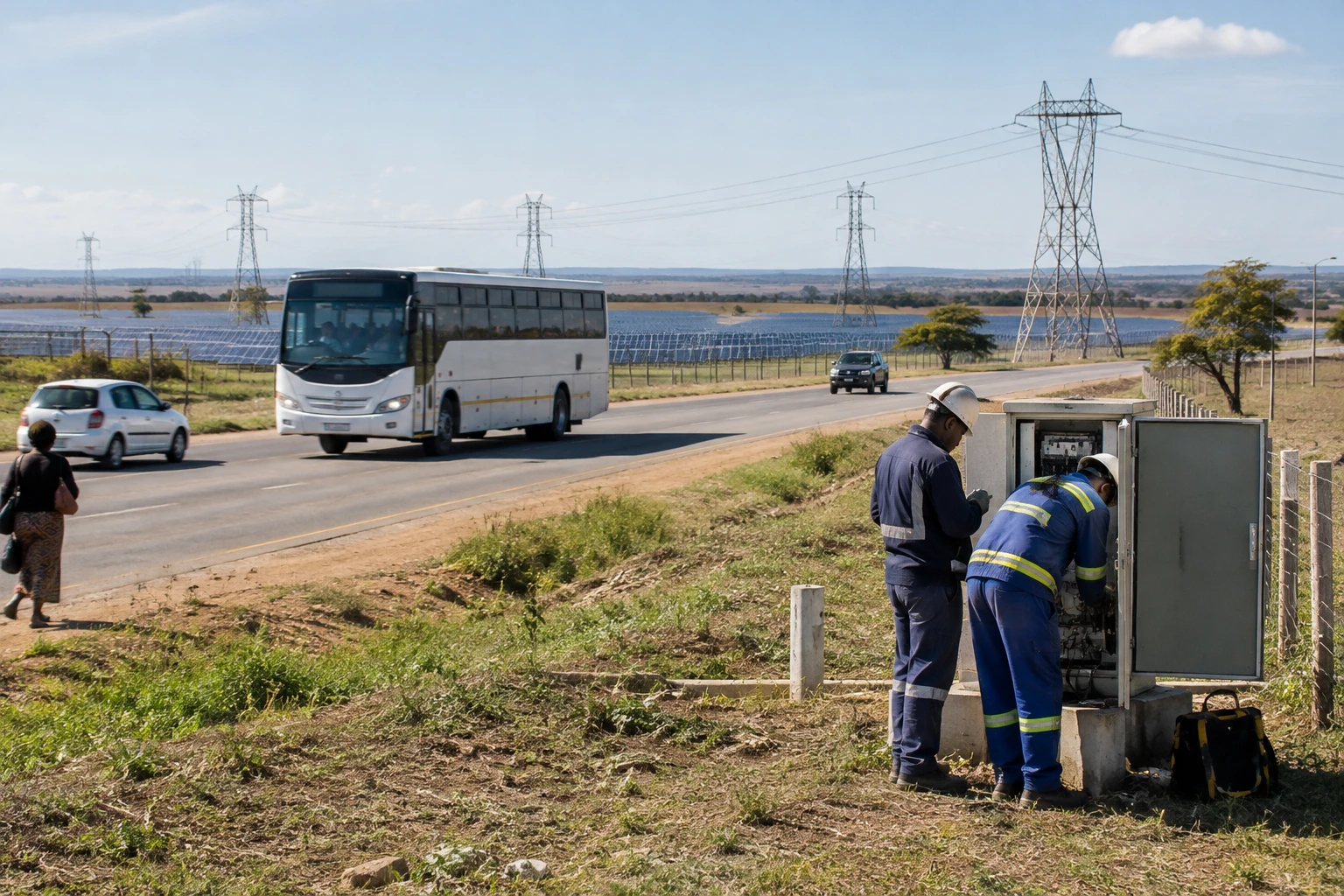
Producing solar electricity in one province and selling it to businesses far away is a model gaining ground in South Africa. The Lion Thorn plant, whose construction has just begun, illustrates this shift. It also shows that adding panels is not enough: the electricity must be delivered and its purchase organised.
A North West plant to supply private clients
The project is near Leeudoringstad, in North West province. Independent power producer Yellow Door Energy is developing it, while PowerChina is responsible for engineering, equipment procurement and construction. The solar photovoltaic plant will have a capacity of 49 MWp, meaning its maximum output under standardised conditions.
Yellow Door Energy and specialist publication Renewables Now say construction began in autumn 2026. Commercial operation is expected in 2028. According to this corroborating information, the plant is expected to produce about 115 GWh during its first year of operation. This figure is a forecast, not production already recorded.
The electricity is to be sold under long-term power purchase agreements to PPC, a South African group specialising in cement and building materials, and POWERX, a private electricity trader. These contracts give producers and lenders visibility over the project’s future revenues. They also enable customer companies to secure part of their supply without building a plant themselves.
The public grid, a link between producers and clients
The electricity will not necessarily be consumed near the plant. It is to be transmitted through the public grid under the “wheeling” mechanism: a producer feeds electricity into the grid, and a client takes it out elsewhere, subject to the applicable metering and tariff rules. Transmission therefore remains an essential part of the project.
This mechanism reflects a particular economic geography. Sites suited to solar generation are not always near the factories or company headquarters that buy the electricity. The national lines connect the two, but their capacity and costs matter. Eskom, the state-owned company that operates a large part of the electricity system, therefore remains central even when generation and sales are private.
In May 2025, the South African government published updated rules on charges for transporting third-party electricity. The stated aim is to facilitate access to the grid and clarify the conditions for wheeling. Eskom also says that generators must meet registration or licensing requirements and obtain a grid connection. These rules make commercial projects possible, but do not by themselves guarantee that transmission capacity is available everywhere.
Diversification beyond solar photovoltaics
Lion Thorn is part of a series of contracts in which PowerChina is involved at different stages of South Africa’s energy sector. In June 2026, the company announced the start of construction on a 75 MW solar plant at Eskom’s Lethabo power station in the Free State. This is a project led by the public operator, rather than a facility intended to supply private buyers directly.
The Chinese group also took part in the construction of Redstone, a 100 MW concentrated solar power plant in the Northern Cape. Unlike photovoltaics, this technology concentrates the sun’s heat and uses molten salt to store thermal energy. PowerChina announced the start of commercial operations on 30 May 2025. The project shows that the group’s contracts span several technologies, with different characteristics for generation and storage.
Diversifying buyers matters as much as diversifying equipment. A contract with Eskom links a project directly to the public company. Lion Thorn’s agreements, by contrast, are based on PPC and POWERX. The plant is thus part of the private electricity market while depending on public infrastructure to deliver its power.
Economic benefits are unevenly distributed
For PPC and the clients supplied by POWERX, the expected benefit is access to renewable electricity under contract. For the developer and its financiers, sales to several buyers may reduce reliance on a single client. For residents and businesses near Leeudoringstad, the benefits will depend more on the jobs actually created, contracts awarded to local suppliers and commitments made to the community.
Yellow Door Energy says it intends to work with local contractors, suppliers and skilled workers. This statement sets out an intention, not a verified record of jobs already created. Similarly, the 115 GWh figure is an estimate for the first year. Monitoring of the construction project will need to clarify contracts awarded locally, the schedule, the grid connection and output once the plant is operational.
At national level, new private capacity adds to projects led by Eskom and market reforms. In July 2026, South Africa’s presidency backed preparatory work to separate out an independent transmission system operator. The change is intended to organise a system in which multiple generators could sell their electricity. It remains a reform in progress, whose implementation and effects will still need to be assessed.
An issue for southern Africa
The SADC, or Southern African Development Community, brings South Africa and its neighbours together in regional co-operation, including on energy. Lion Thorn, however, is first and foremost a national project: the information available makes no mention of an export contract with another country. Its regional significance lies instead in the experience it builds in private financing, electricity transmission and connecting producers with clients.
For South Africans, then, the question is not limited to installed capacity. The expected start of operations in 2028, actual output, arrangements for grid access and local benefits will all need to be monitored. For the region, the question will be whether these mechanisms can support more cross-border trade without national projects diverting attention from infrastructure needs and access to electricity.