Algeria
 Egypt
 Libya
 Morocco
 Sudan
 Tunisia
 Benin
 Cabo Verde
 Côte d'Ivoire
 Ghana
 Guinea
 Guinea-Bissau
 Liberia
 Mali
 Mauritania
 Niger
 Nigeria
 Senegal
 Sierra Leone
 The Gambia
 Togo
 Cameroon
 Central African Republic
 Chad
 DR Congo
 Equatorial Guinea
 Gabon
 Republic of the Congo
 São Tomé and Príncipe
 Burundi
 Comoros
 Djibouti
 Eritrea
 Ethiopia
 Kenya
 Madagascar
 Malawi
 Mauritius
 Mozambique
 Rwanda
 Seychelles
 Somalia
 South Sudan
 Tanzania
 Uganda
 Angola
 Botswana
 Eswatini
 Lesotho
 Namibia
 South Africa
 Zambia
 Zimbabwe
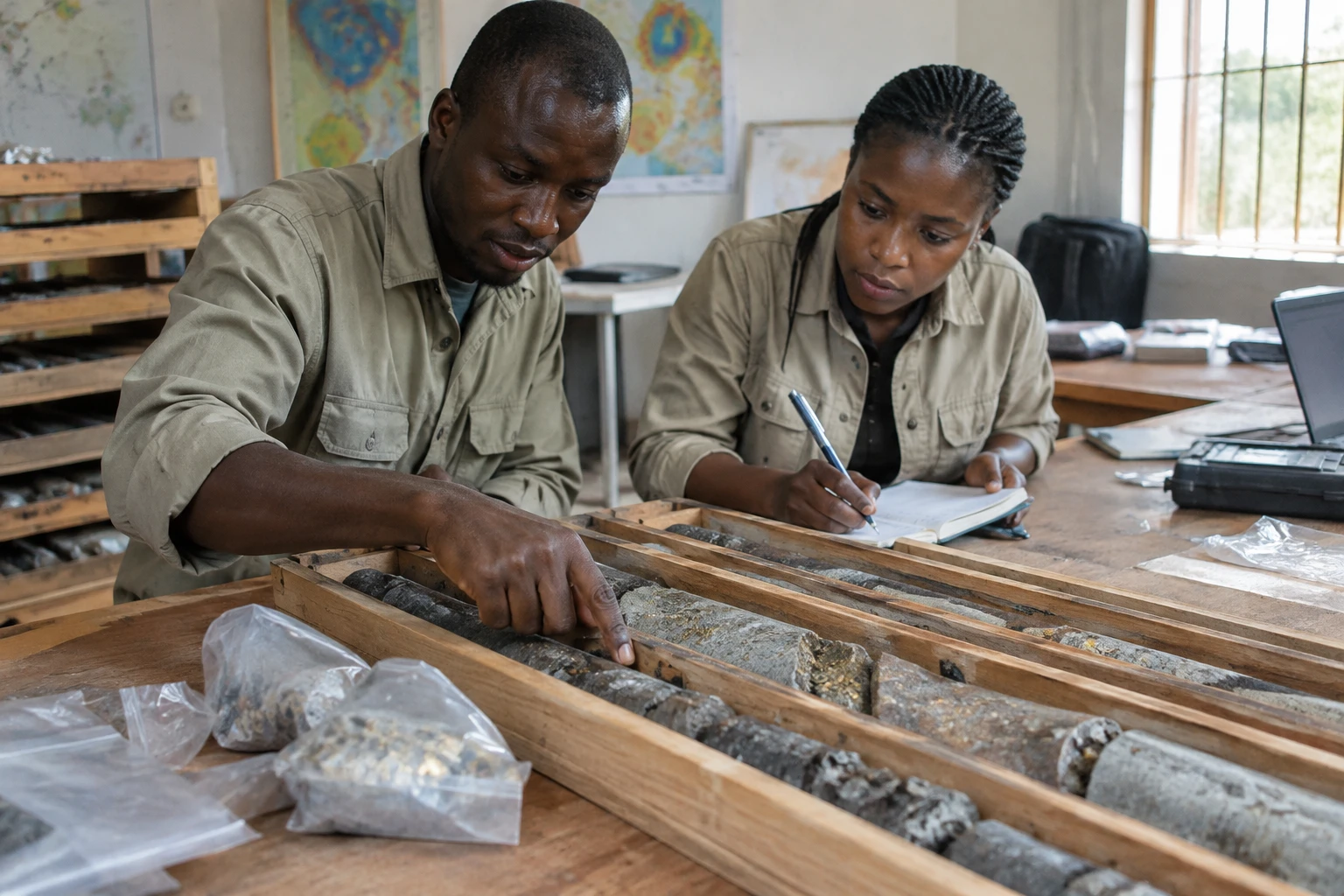
Some 125 kilometres south-west of Ouagadougou, drilling has just broadened the prospects for the Bido gold project. But decisive steps remain between a geological target and a mine: confirming the deposit, securing funding and establishing whether extraction is viable.
A promising target, not yet a resource
On 8 October 2026, British company Panthera Resources announced an exploration target of 700,000 to 1.6 million ounces of gold at the Kwademen prospect, within the Bido permit in Burkina Faso. This is a conceptual range. It is neither a mineral resource estimate nor an exploitable reserve: the company says the work available is not yet sufficient to establish a resource under the rules of the JORC Code, the Australasian standard for reporting mineral resources.
The reverse-circulation drilling programme, a method that brings rock samples to the surface using compressed air, recorded, among other results, 56 metres at 1.16 grams of gold per tonne from a depth of 76 metres. Another intersection yielded 40 metres at 0.59 grams per tonne from just 10 metres. These results were obtained at the Kwademen prospect during a follow-up campaign in the second half of 2026.
The target is based on these intersections and on lower-grade results from 22 other holes in the western zone. Panthera describes mineralisation extending over about 1,400 metres, but stresses that the drilling remains too widely spaced to define a resource. The next announced step is closer-spaced drilling in the higher-grade area. Nearby geochemical and geophysical anomalies have not yet been tested by drilling.
A portfolio spanning Burkina Faso and Mali
Bido is part of an exploration portfolio spanning Burkina Faso and Mali. In Burkina Faso, Panthera owns 80% of the Bido project. The company is also linked to the Cascades project through its stake in Moydow and agreements with its partner DFR Gold. Panthera’s annual report says Cascades has a published estimate of 635,000 ounces, split between indicated and inferred resources, categories that reflect different levels of geological confidence.
In Mali, the Kalaka project includes an estimate of 803,000 inferred ounces at the K1A deposit. “Inferred” means that the available data provide an initial indication of the presence and volume of ore, but with less confidence than for indicated or measured categories. The Bassala project, also in Mali, remains at the exploration stage. The renewal of the Kalaka and Bassala permits was still under way when Panthera’s annual report was published in September 2026.
This administrative uncertainty matters as much as the geological results. Panthera says further work at Kalaka depends on the permit renewal, and that its activities or financing options for the portfolio as a whole are under review. The annual report also says no drilling took place at Kalaka during the financial year ended 31 March 2026. The prospects outlined for the different projects therefore do not mean they will advance at the same pace.
Mining rules in flux
Both countries are seeking to redefine the share of value retained in their territories. In Burkina Faso, the mining code adopted in July 2024 strengthens the participation of the state and Burkinabè investors in mining companies. In Mali, the 2023 mining code and its implementing texts govern permits and national participation. These reforms do not, on their own, determine the outcome for Bido or Kalaka, but they form part of a context in which contracts, renewals and the distribution of mining revenues are coming under greater scrutiny.
For governments, a gold project can contribute to public revenues, infrastructure and employment. For communities near the sites, the benefits also depend on local recruitment, procurement from national businesses, and the management of land and water. At this stage, Bido remains an exploration project: no production timetable or specific local benefit can be inferred from the announced ounce target alone.
The regional context also shows that geological potential does not shield companies from market and governance risks. In 2025, the World Gold Council reported an increase in production in Ghana, while Mali’s output fell, partly as a result of the interruption at Loulo-Gounkoto. These different trajectories show that major West African producers are not interchangeable, and that changes at one site can affect national results.
Next steps: verify, fund, convert
For Bido, the immediate challenge is to tighten the drilling grid to verify the continuity of mineralised zones and, potentially, produce an initial resource estimate. Studies of metallurgy, costs, infrastructure access, and environmental and social impacts will follow. Each could change the project’s economic outlook.
The announced target therefore adds a new element to gold exploration in Burkina Faso, but it guarantees neither a discovery of this scale nor the opening of a mine. Meanwhile, developments in Mali’s permits remain critical for Kalaka and Bassala. In a region where governments want to increase their control over resources, the progress of these assets will depend as much on geology as on authorisations, funding and the conditions set by host countries.
Category: Economy