Algeria
 Egypt
 Libya
 Morocco
 Sudan
 Tunisia
 Benin
 Burkina Faso
 Cabo Verde
 Côte d'Ivoire
 Ghana
 Guinea
 Liberia
 Mali
 Mauritania
 Niger
 Nigeria
 Senegal
 Sierra Leone
 The Gambia
 Togo
 Cameroon
 Central African Republic
 Chad
 DR Congo
 Equatorial Guinea
 Gabon
 Republic of the Congo
 São Tomé and Príncipe
 Burundi
 Comoros
 Djibouti
 Eritrea
 Ethiopia
 Kenya
 Madagascar
 Malawi
 Mauritius
 Mozambique
 Rwanda
 Seychelles
 Somalia
 South Sudan
 Tanzania
 Uganda
 Angola
 Botswana
 Eswatini
 Lesotho
 Namibia
 South Africa
 Zambia
 Zimbabwe
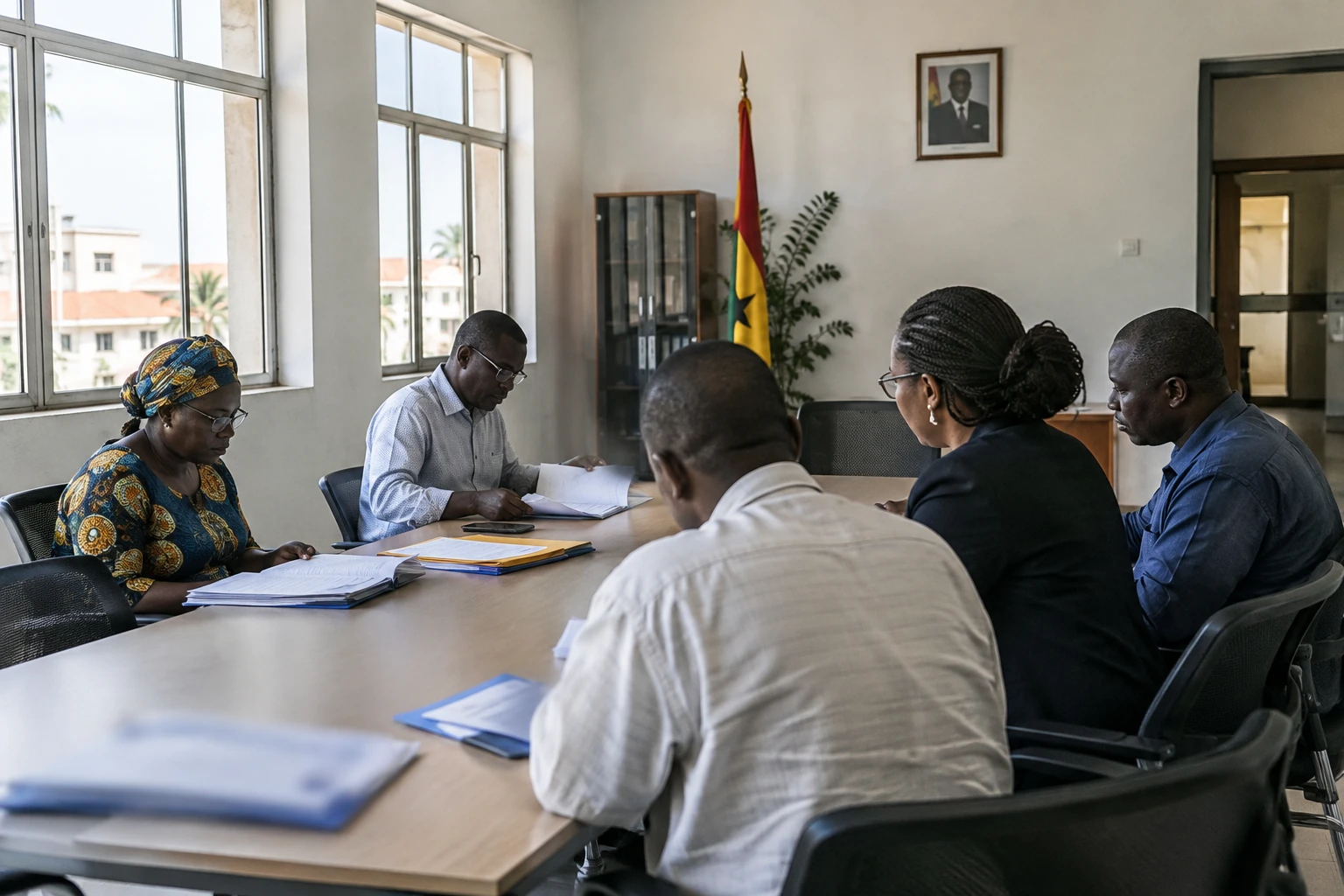
In Guinea-Bissau, the 6 December 2026 election deadline is approaching, with no guarantee that the vote can take place. In Bissau, the National Electoral Commission (CNE) says conditions are not in place. Senegal, for its part, is calling for the political space to be reopened and for any decision on the timetable to be based on an inclusive agreement.
A timetable dependent on concrete guarantees
On 8 October, Prime Minister Ilídio Vieira Té and CNE Vice-President Felisberta Moura Vez informed the transitional president, General Horta N’Tam, of the difficulties surrounding the organisation of the presidential and legislative elections scheduled for 6 December. The commission has not publicly specified which conditions are lacking. No official postponement has been announced at this stage, and no new date has been set.
Senegal said it took note of the legal, technical and institutional constraints highlighted by the authorities. But Dakar is insisting on a political requirement: any change to the timetable must be consensual, inclusive and transparent, with clear guarantees on the end of the transition. The Senegalese government is also calling for restrictions on political and civil activities to be lifted. The statement reported by the Senegalese Press Agency presents Dakar as a mediator in the crisis.
The distinction is important: the announcement of logistical or institutional difficulties does not amount to a decision to postpone the vote. Until the authorities issue a formal decision, 6 December remains the announced date, but whether the vote will go ahead is uncertain. For voters, parties and local administrations, this uncertainty is already complicating preparations for the election.
A transition born of an interrupted election
The current crisis stems from the breakdown of the 2025 electoral process. Guineans voted on 23 November to elect their president and MPs. Three days later, on 26 November, the military announced that it had seized power, deposed President Umaro Sissoco Embaló and suspended the institutions and electoral process, as the announcement of provisional results was expected.
The African Union Commission observed the election. Before the vote, it had already noted divisions over the date of the presidential election, the dissolution of the National Assembly in December 2023, restrictions on civic and political space, and the lack of agreement between the government and opposition on electoral arrangements. It also said that the term of the CNE executive secretariat had expired in 2022. These findings shed light on the current institutional difficulties but do not, on their own, establish the specific reasons cited by the commission this week.
The November rupture left the 2025 results without an official conclusion. The African Commission on Human and Peoples’ Rights reported the suspension of the electoral process in the context of the military seizure of power. The Inter-Parliamentary Union, meanwhile, says the vote was interrupted before the results were published. The statement by the African Commission on Human and Peoples’ Rights and the Inter-Parliamentary Union’s page on the 2025 elections document this sequence of events.
Beyond the date, the question of trust
A credible election depends on several mutually reinforcing elements: an operational electoral commission, accepted rules, freedom to campaign, parties’ access to voters, and the ability to publish and challenge results in accordance with the law. A date alone is therefore not enough. If political actors cannot organise their activities or take part in discussions, an election held on time could still be contested.
The issue is also institutional. The CNE must be able to explain the obstacles, the resources required and the steps needed to overcome them. The transitional authorities, which control the administration and security, have a decisive role in providing these guarantees. Parties and civil society organisations, for their part, need space to speak and negotiate without arbitrary restrictions. Dakar’s call seeks to keep these responsibilities within a framework of dialogue, rather than presenting the timetable as a decision for one actor alone.
The effects of a possible postponement would differ between groups. For leaders, it would prolong discussions about the duration and rules of the transition. For voters, it would delay the choice of representatives and the return to ordinary political life. In the capital and the regions, parties would also need time, security and resources to campaign. Yet without an official announcement or revised timetable, it is difficult for citizens and local organisations to plan their participation.
Regional mediation put to the test
Senegal places its intervention within the framework of ECOWAS, the Economic Community of West African States. The regional organisation monitors political crises in its member states and advocates a return to constitutional order. Before the November 2025 elections, its observation mission met the CNE to review preparations, logistical capacity and guarantees of inclusion. ECOWAS’s account notes that regional electoral assistance is based on consultations with the country’s institutions and stakeholders.
Dakar’s mediation will now have to help produce a verifiable agreement: what conditions are lacking, who must meet them and by when? Senegal’s position combines Guinea-Bissau’s sovereignty with the need for an open process. It does not settle the timetable, but calls for any changes to it to be neither unilateral nor without guarantees.
Across West Africa, the case is testing ECOWAS’s ability to support a transition from military rule to elected institutions, as the region has experienced several constitutional ruptures. For the African Union, too, the issue goes beyond the practicalities of holding a vote: it is about preserving accepted electoral rules and a political outcome recognised by citizens. The next steps will be the publication of the CNE’s detailed explanations, a possible formal decision on the election, and the opening of dialogue between the authorities, parties and civil society.