Algeria
 Egypt
 Libya
 Morocco
 Sudan
 Tunisia
 Benin
 Burkina Faso
 Cabo Verde
 Côte d'Ivoire
 Ghana
 Guinea
 Guinea-Bissau
 Liberia
 Mali
 Niger
 Nigeria
 Senegal
 Sierra Leone
 The Gambia
 Togo
 Cameroon
 Central African Republic
 Chad
 DR Congo
 Equatorial Guinea
 Gabon
 Republic of the Congo
 São Tomé and Príncipe
 Burundi
 Comoros
 Djibouti
 Eritrea
 Ethiopia
 Kenya
 Madagascar
 Malawi
 Mauritius
 Mozambique
 Rwanda
 Seychelles
 Somalia
 South Sudan
 Tanzania
 Uganda
 Angola
 Botswana
 Eswatini
 Lesotho
 Namibia
 South Africa
 Zambia
 Zimbabwe
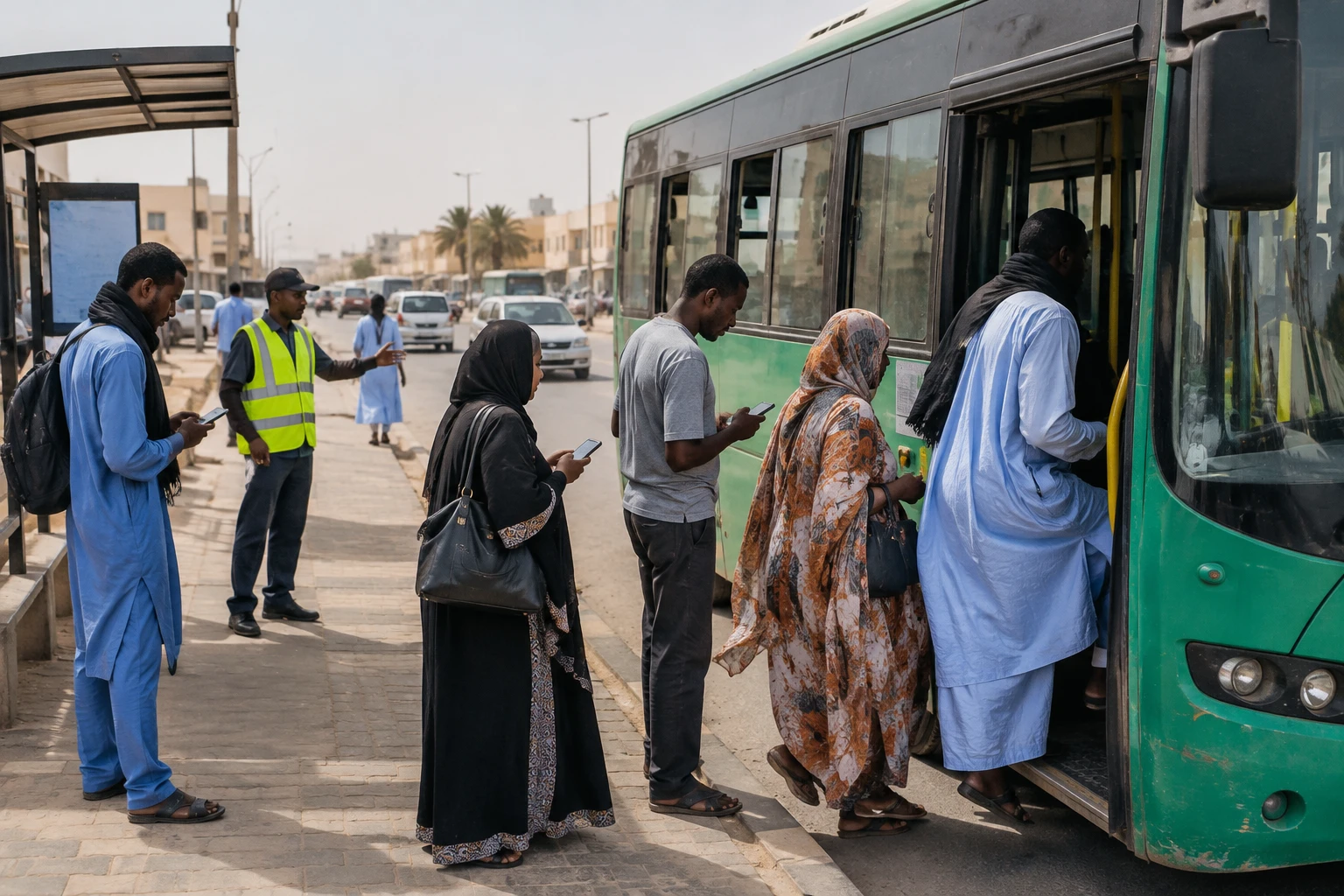
An online administrative procedure is useful only if it works when needed. In Mauritania, mobile network checks are a reminder that reliable connectivity is now a practical condition for accessing public services and economic activity.
Digital services that depend on the network
In Nouakchott and in towns across the country, the authorities want to move some public procedures to digital platforms. They are also preparing uses of artificial intelligence in several sectors. Mauritania’s national strategy covers the period 2025-2029 and cites applications that could help the country’s development. The ministry responsible for digital transformation sets out the national strategies.
E-commerce is also a priority. A national strategy is to guide its development for 2026-2030. Work on this framework involved the relevant government departments and is based on an assessment of the country’s readiness, conducted with the United Nations Conference on Trade and Development. The Mauritanian News Agency reported on the strategy’s approval.
These projects rely on a tool less visible than the applications themselves: signal quality. Transmitting a form, confirming a payment or joining a video call requires a sufficiently stable connection. An interruption has a greater impact on people who live far from administrative offices and rely on remote services to avoid travelling.
Shortcomings found at all three operators
An inspection mission by the Electronic Communications Regulatory Authority (ARE) found shortcomings in the voice and data services of Mattel, Mauritel and Chinguitel. According to information provided as part of the inspection, checks carried out from February to March covered call completion and dropped calls, as well as the performance of 3G and 4G networks in towns, localities and along roads. The results were made public on 7 October. As the available information does not specify the year of this campaign, no year should be attributed to it.
The findings build on a case already being followed by the regulator. In 2024, following an inspection campaign conducted from 23 September to 6 November, the National Regulatory Council penalised the three operators. The measures included fines and reductions in the duration of certain licences. Mauritania’s digital ministry detailed the penalties imposed in November 2024. The regulator’s decisions were based on obligations set out in the terms of the licences and the law on electronic communications.
This precedent lends weight to the new inspections, but it is not enough to show that quality has improved or deteriorated everywhere. The results need to be read locality by locality and in light of the indicators measured. They do, however, establish that the shortcomings are not simply a matter of individual experience: they are assessed against regulatory commitments.
The challenge of enforcement and transparency
For users, coverage shown on a map does not guarantee that a call will connect or that a page will load without interruption. Problems can vary between an urban centre, a less well-served locality and a road linking several towns. The gaps also affect households, public administrations and small businesses differently, as their activities increasingly depend on mobile communications.
For operators, inspections mean investing in equipment, network capacity and maintenance. For the state, the challenge is to enforce obligations without restricting access to services or reducing incentives to modernise infrastructure. Penalties are one lever; monitoring remedial measures and publishing comparable results make it possible to check whether they have lasting effects.
Transparency also matters. Detailed data on the areas tested, required thresholds and progress would help consumers distinguish commercial promises from the quality actually available. It would also make it possible to assess whether investment benefits only the busiest centres or improves service in localities and along roads.
A Mauritanian issue with regional significance
Mauritania is in West Africa, but it is not a member of the Economic Community of West African States (ECOWAS). Its membership of the Arab Maghreb Union and its ties with neighbouring countries give its digital policies a regional dimension. More reliable networks facilitate trade, cross-border services and the flow of information; they do not, however, replace the need for common rules or infrastructure.
Across the continent, Mauritania’s experience illustrates a shared challenge: digital strategies are about more than launching platforms or announcing new technologies. They must also ensure that connectivity works for residents, traders and public services. The next inspections, operators’ responses and implementation of national strategies will show whether the ambitions announced translate into more reliable access, including beyond Nouakchott.