Algeria
 Egypt
 Libya
 Morocco
 Sudan
 Tunisia
 Benin
 Burkina Faso
 Cabo Verde
 Ghana
 Guinea
 Guinea-Bissau
 Liberia
 Mali
 Mauritania
 Niger
 Nigeria
 Senegal
 Sierra Leone
 The Gambia
 Togo
 Cameroon
 Central African Republic
 Chad
 DR Congo
 Equatorial Guinea
 Gabon
 Republic of the Congo
 São Tomé and Príncipe
 Burundi
 Comoros
 Djibouti
 Eritrea
 Ethiopia
 Kenya
 Madagascar
 Malawi
 Mauritius
 Mozambique
 Rwanda
 Seychelles
 Somalia
 South Sudan
 Tanzania
 Uganda
 Angola
 Botswana
 Eswatini
 Lesotho
 Namibia
 South Africa
 Zambia
 Zimbabwe
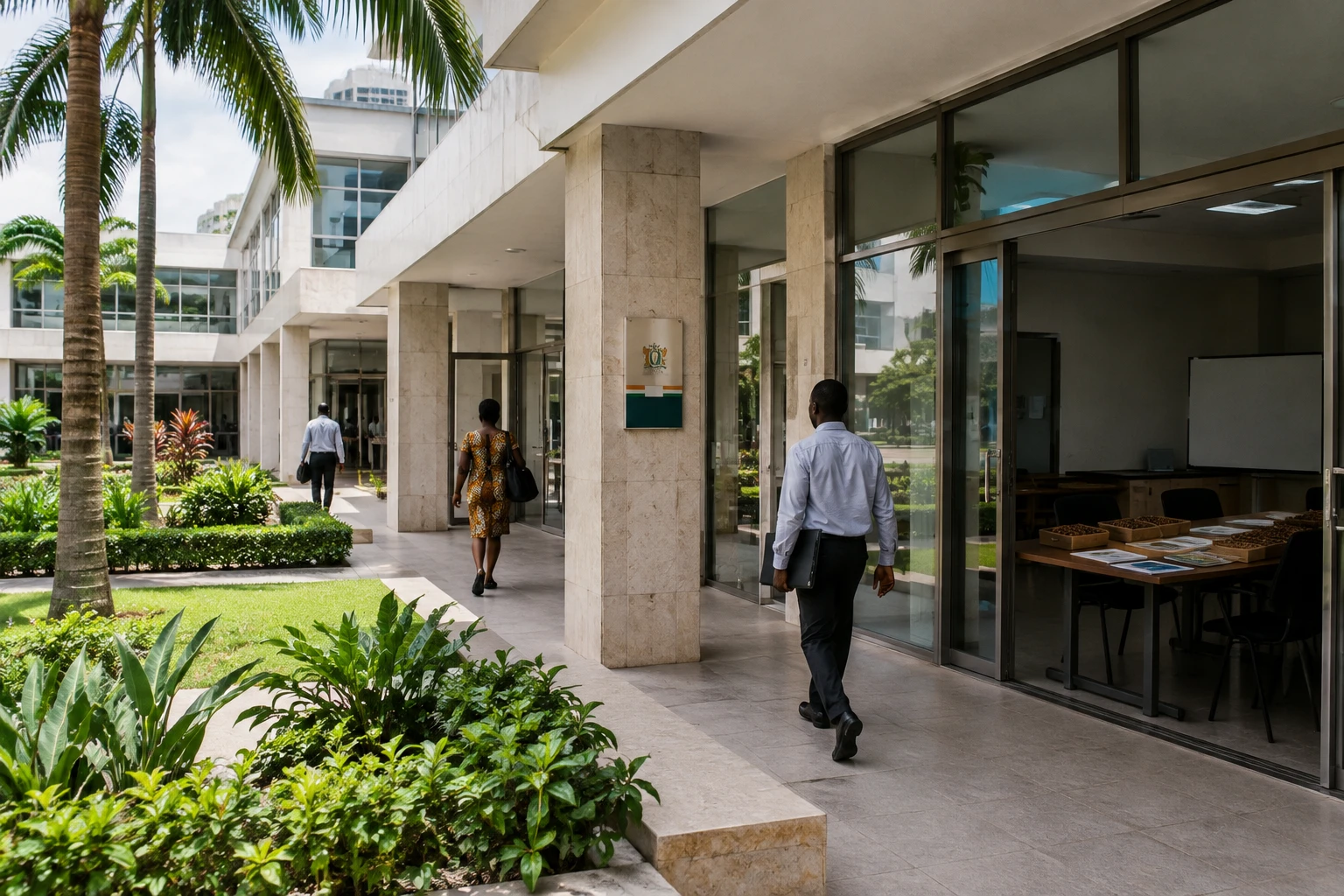
Processing more cocoa locally can create value in Ivory Coast. But new factories are not enough: the sector must also guarantee supplies, support producers and turn beans into finished products.
An industrial ambition set out in the national plan
Ivory Coast, the world’s largest cocoa producer, wants to strengthen local processing. The 2026-2030 National Development Plan sets a target of processing 50% of cocoa by 2030, up from 42% in 2024. This objective is part of a broader strategy of industrialisation and value creation. The Ivorian government sets out these objectives in the 2026-2030 NDP.
At regional level, the issue also concerns trade within ECOWAS, the Economic Community of West African States. Products processed in Ivory Coast can supply neighbouring markets, if costs, transport and trade rules allow. The country’s political capital is Yamoussoukro; Abidjan remains a major economic and industrial centre.
Progress is not starting from scratch. According to customs statistics cited in official data, exports of processed cocoa reached about 613,000 tonnes in 2024, worth nearly CFAF 1,934bn. Ivorian customs publishes statistical series that make it possible to put these figures in context over time. Ivorian Customs statistics provide a reference point for tracking trade trends.
Projects at different stages
On 6 October 2026, the Minister of Trade, Industry and Crafts, Kalil Konaté, received Hein Schumacher, head of Barry Callebaut. Following the meeting, the group announced its intention to triple the capacity of its chocolate production line in Ivory Coast. The announcement was reported by Linfodrome. The cost and timetable for the expansion were not specified.
Barry Callebaut has been present in the country for several decades through SACO. In December 2024, the group inaugurated a chocolate production line in Abidjan, having previously focused mainly on grinding beans and producing semi-finished goods. Tripling this capacity would therefore mark progress towards more highly processed products. However, the announcement alone does not establish how much chocolate will actually be produced or what share will go to the Ivorian or regional market.
Other initiatives are at varying stages. A German delegation led by Hermann Bühlbecker of the Lambertz group made a fact-finding visit on 8 September 2026. Possible local production is still under consideration; this is not a confirmed investment.
In San-Pédro, the CADESA cooperative has, according to available information, launched CocoaTech on 16 July. In its first phase, the unit is to process up to 15,000 tonnes of beans a year, with capacity said to be expandable to 30,000 tonnes. It plans to produce cocoa liquor, butter, cake and powder, among other products. The project represents an announced investment of about €15m. These figures describe planned capacity, not necessarily output already achieved.
Raw material remains the pressure point
Processors need a steady supply. But diseases affecting cocoa trees, including swollen shoot, as well as the effects of climate change, can undermine harvests. On 6 October, the Coffee and Cocoa Council stressed the importance of securing volumes for factories. The regulator also plans to establish a research institute devoted to coffee and cocoa, to develop more resilient plants.
This constraint directly links the factory to the plantation. If industrial capacity increases without sufficiently abundant and predictable harvests, companies risk operating below capacity. For producers, the gains from processing do not automatically translate into higher incomes: this depends in particular on prices, purchase contracts and how value is distributed across the sector. Farmers, often far from major industrial sites, do not necessarily benefit from the same returns as companies based in urban and port hubs.
Traceability is also becoming crucial. It makes it possible to document the origin of beans and the stages in their journey. Barry Callebaut said it wanted to support the national traceability initiative and use the system for all its bean purchases, according to information reported after the meeting. The implementation and actual coverage of this commitment remain to be seen.
Beyond grinding, capturing more value
The priority, then, is not simply to increase the tonnage processed. It is also to move towards finished products, develop industrial skills and create profitable markets. Grinding produces ingredients that are useful to industry, but chocolate sold to consumers involves further stages of manufacturing, packaging, distribution and marketing.
The 2026-2030 NDP timetable will provide an initial benchmark for measuring progress towards the 50% target. It will also be important to monitor whether announced projects materialise, the actual output of the facilities and the effects on agricultural stakeholders. For Ivory Coast and its West African partners, the central challenge is now to build lasting links between harvests, research, processing and market access.