Algeria
 Egypt
 Libya
 Morocco
 Sudan
 Tunisia
 Benin
 Burkina Faso
 Cabo Verde
 Côte d'Ivoire
 Ghana
 Guinea
 Guinea-Bissau
 Liberia
 Mali
 Mauritania
 Niger
 Nigeria
 Senegal
 Sierra Leone
 The Gambia
 Togo
 Cameroon
 Central African Republic
 Chad
 Equatorial Guinea
 Gabon
 Republic of the Congo
 São Tomé and Príncipe
 Burundi
 Comoros
 Djibouti
 Eritrea
 Ethiopia
 Kenya
 Madagascar
 Malawi
 Mauritius
 Mozambique
 Rwanda
 Seychelles
 Somalia
 South Sudan
 Tanzania
 Uganda
 Angola
 Botswana
 Eswatini
 Lesotho
 Namibia
 South Africa
 Zambia
 Zimbabwe
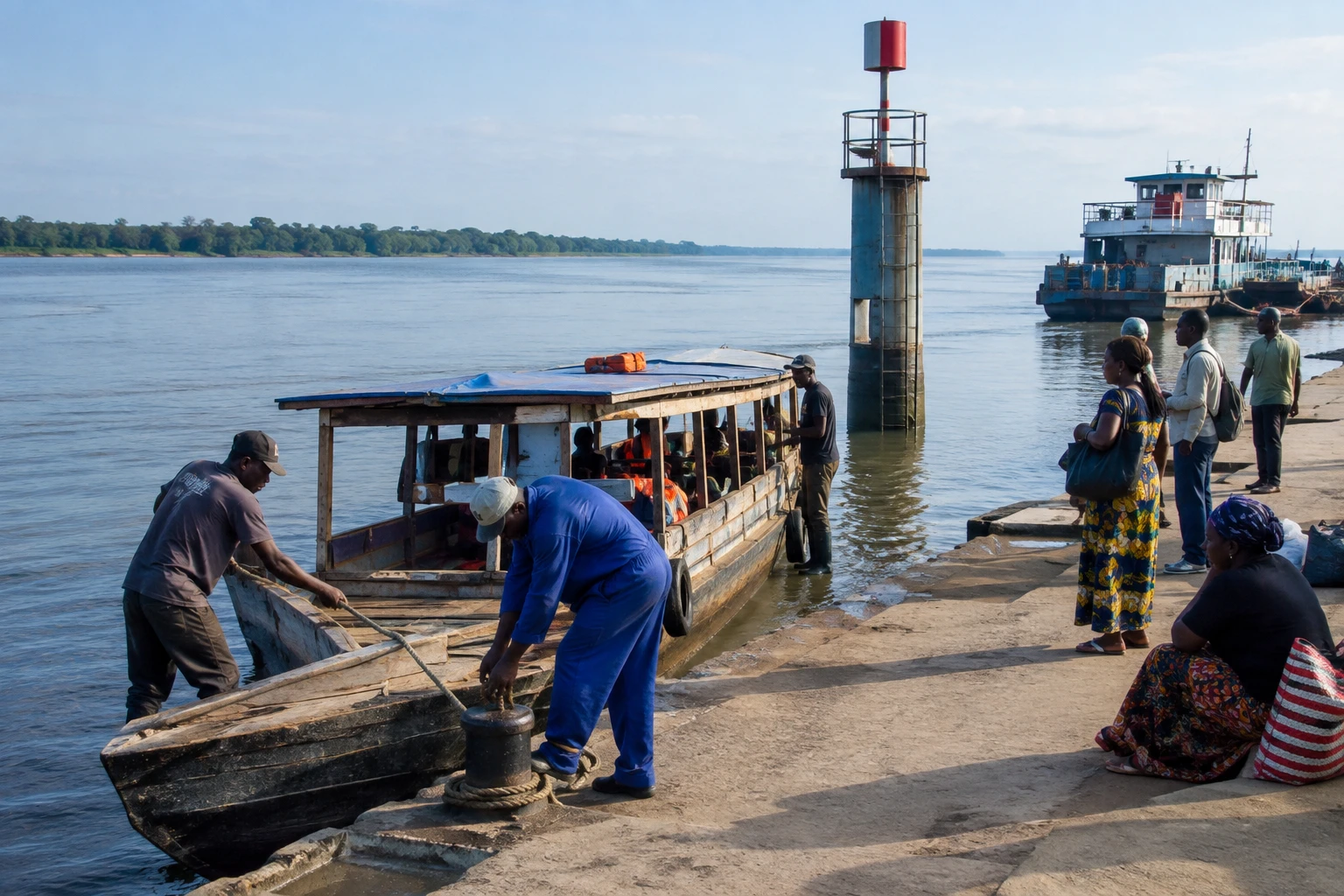
On the waterways of the Democratic Republic of the Congo, banning one type of vessel is not enough to make journeys safe. Millions of people depend on river and lake transport to travel and move goods. The new measure announced in Kinshasa therefore has a twofold challenge: reduce risks without cutting off essential connections.
A vital network, with rules that are hard to enforce
The Congolese navigable network connects areas where roads remain limited or difficult to use. The transport ministry estimates that the DRC has around 25,000 kilometres of waterways that have been explored, of which 16,000 are classified and categorised. These figures were cited at the launch of a campaign to mark the Congo River and the Kasai River on 25 August 2026.
Marking involves installing signs that indicate channels and flag certain hazards. According to the ministry, the campaign includes the commissioning of two buoy tenders and the delivery to the National Transport Office (ONATRA) of a metal barge designed to carry 98 passengers per trip. The Presidency also confirmed the launch of the operation in Kinshasa. Official details of the waterways-marking campaign.
This project addresses a problem that goes beyond the strength of hulls. Accidents reported in recent months have also involved night departures, collisions, breakdowns, heavy cargoes and the absence of reliable passenger lists. When there is no manifest, rescue teams struggle to establish how many people were on board.
Ban announced for 15 November
On 6 October, Jean-Pierre Bemba, the deputy prime minister in charge of transport, called for wooden boats to be banned from 15 November 2026. The measure applies to the Congo River, its tributaries and the country’s other navigable waters. The news was reported on 7 October by several Congolese media outlets, including Beto.cd and Nouveau Média.
According to these reports, the Congolese National Police and the Naval Force will have to intercept vessels that continue operating after the ban takes effect. Seizure is also being considered, in accordance with the law. The measure is part of a series of restrictions already announced: technical inspections, limits on night-time navigation, and checks on carrying capacity and crew training.
The repeated instructions nevertheless raise a practical question: which boats will take over, and on which routes? The metal barge presented in August is a concrete step, but its capacity and presence alone cannot meet all the needs of such an extensive network. The available announcements do not yet set out a timetable for replacing vessels or solutions for operators and passengers in remote areas.
Heavy tolls, but still incomplete
A tally published by Actualite.cd on 7 October reports at least 98 deaths since January in river and lake transport accidents. It lists 15 incidents in eight provinces, but notes that its count is not exhaustive and that several casualty figures remain provisional. The figures should therefore not be read as a consolidated national toll. The 2026 tally of river and lake accidents.
Two tragedies illustrate the difficulties of enforcement. On 3 July, after a boat sank at the confluence of the Kasai and Sankuru rivers, local authorities announced at least 20 deaths and more than 100 people missing in an initial toll. Radio Okapi reported that overloading was cited among the possible causes, without presenting it as an investigation finding. The provisional toll from the sinking on the Kasai and Sankuru rivers.
Near Kisangani, at least six bodies were recovered and 31 people rescued in August after a boat capsized. The passenger manifest could not be found, making it difficult to establish a final toll. An official quoted by Radio Okapi said the boat had left the port after the authorised time. The case shows the possible gap between announced rules and their enforcement at landing stages. Information gathered after the sinking near Kisangani.
Risks also affect lakes and vessels that are not wooden boats. On Lake Tanganyika, the MV MJP sank off Kabimba on 23 September. Radio Okapi reported the following day that 39 people were missing and 36 had survived, while a provincial toll later included in Actualite.cd’s tally put the number missing at 41 and survivors at 43. These discrepancies are a reminder that figures change as searches and checks continue. The initial toll from the sinking of the MV MJP.
The challenge: improve safety without disrupting connections
A ban can remove vessels deemed dangerous from service. But its effectiveness will also depend on enforcement, the availability of alternatives and access to compliant vessels. For passengers in major cities as well as riverside communities, a reduction in services could make travel more difficult and increase the cost of transporting goods. This is a concern to watch, although the authorities have not yet published an estimate of the impact.
Safety also requires verifiable manifests, enforced load limits, rescue equipment and properly marked waterways. The government has launched initiatives on several of these fronts, but announcements will need to translate into regular resources, including in ports and communities far from Kinshasa. Coordination between national services and provincial authorities will be crucial.
The issue extends beyond the DRC’s borders: Lake Tanganyika is shared with several neighbouring countries, and the Congo Basin connects areas used for regional transport. In the short term, the decisive factors will be enforcement of the ban from 15 November, the actual capacity of replacement operators and the publication of reliable accident tolls. River safety will be measured less by the number of rules than by whether passengers and crews can use these waterways without exposing their lives to avoidable risks.