Algeria
 Egypt
 Libya
 Morocco
 Sudan
 Tunisia
 Benin
 Burkina Faso
 Cabo Verde
 Côte d'Ivoire
 Ghana
 Guinea
 Guinea-Bissau
 Liberia
 Mali
 Niger
 Nigeria
 Senegal
 Sierra Leone
 The Gambia
 Togo
 Cameroon
 Central African Republic
 Chad
 DR Congo
 Equatorial Guinea
 Gabon
 Republic of the Congo
 São Tomé and Príncipe
 Burundi
 Comoros
 Djibouti
 Eritrea
 Ethiopia
 Kenya
 Madagascar
 Malawi
 Mauritius
 Mozambique
 Rwanda
 Seychelles
 Somalia
 South Sudan
 Tanzania
 Uganda
 Angola
 Botswana
 Eswatini
 Lesotho
 Namibia
 South Africa
 Zambia
 Zimbabwe
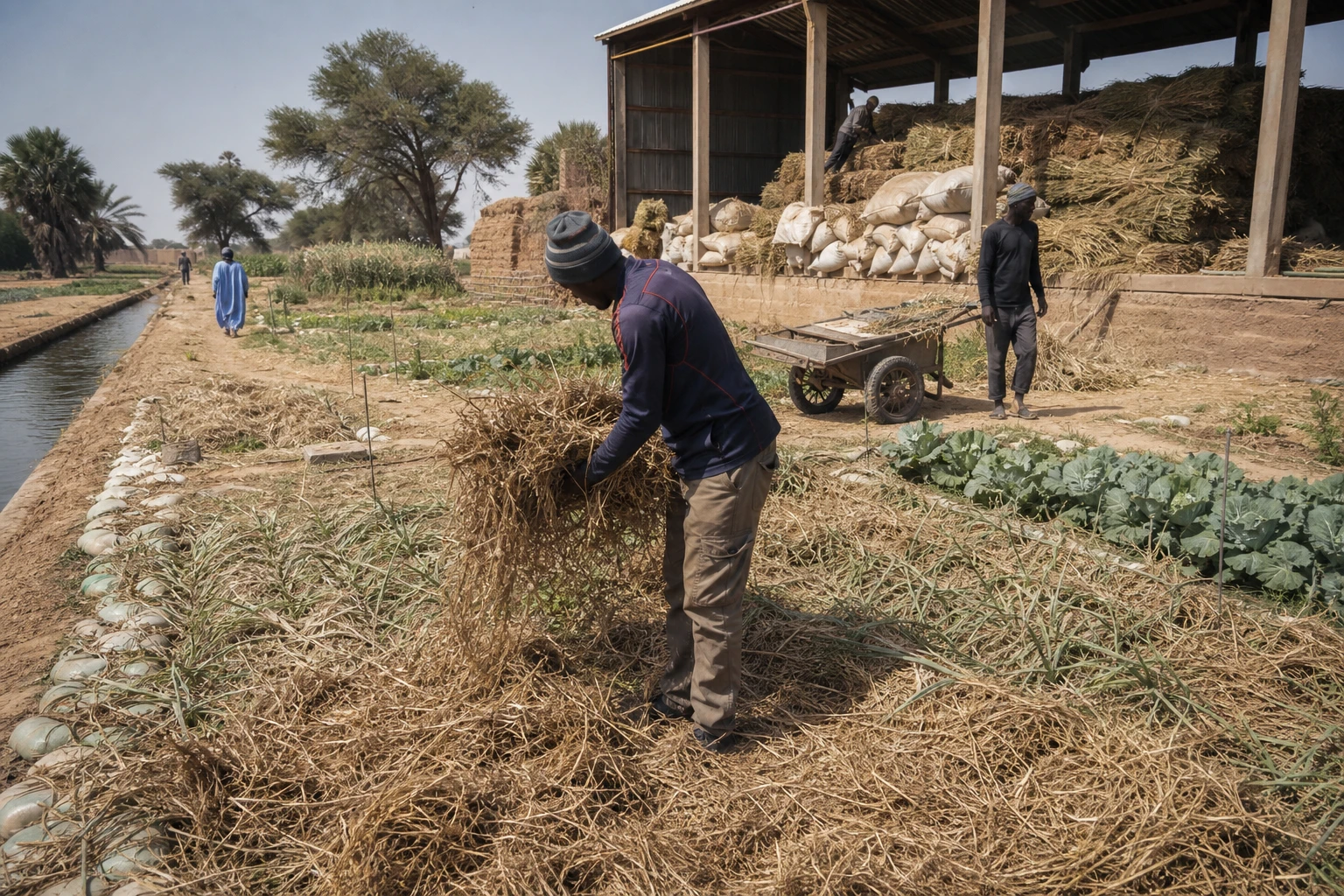
In Rosso, in southern Mauritania, climate adaptation sometimes begins with a simple step: covering the soil to retain moisture. In market gardens and irrigated schemes along the Senegal River valley, farmers are seeking less to overcome the climate than to reduce its impact on yields and incomes.
This shift affects a strategic sector. The utilised agricultural area accounts for less than 0.5% of Mauritania’s territory. Much of the cultivated land still depends on rainfall, the river’s seasonal floods or the proper functioning of hydraulic infrastructure. Variable rainfall, soil degradation and heatwaves therefore have a direct impact on farmers’ work.
Less predictable seasons in an already arid country
Mauritania is not exposed to the same conditions across its entire territory. Irrigated crops are concentrated mainly in the Senegal River valley, around Rosso, Kaédi and Boghé. Further east and south-east, rain-fed crops depend heavily on the timing of rainfall. In oasis areas, access to water remains the main factor of production.
According to the FAO, rural activities play an important role in Mauritania’s economy. They support a large share of the population and contribute, in particular, to supplies of cereals, meat and milk. Yet available land is limited and yields remain sensitive to weather conditions.
On market-gardening farms near Nouakchott, this pressure is reflected in weakened plants, more frequent watering needs and a production season that is harder to predict. Mohamed Mbareck Bacary, an environmental engineer and head of the Tall Haya association, describes rising temperatures and increasingly irregular rainfall. In his view, some crops can no longer withstand current conditions.
Mohamed Fall, a farmer for more than 30 years, shares this assessment. His plots have yielded produce, but in lower volumes than in a typical year. Tomatoes, aubergines, watermelons and peppers are still grown, but the harvest calendar is more constrained. In this context, every saving of water matters.
Mulching: a simple way to save water
On his plot, Mohamed Fall uses straw and rice husks to cover the soil. This technique, known as mulching, limits evaporation and protects the earth from direct heat. After watering, moisture can therefore be retained for several days, depending on conditions in the plot.
The method does not replace irrigation or investment in infrastructure. However, it reduces the frequency of watering and makes use of agricultural residues that often go largely unused. For small farms, this benefit matters as much as finding new varieties or gaining access to more expensive equipment.
The issue goes beyond individual practices. In the Senegal River valley, agriculture also depends on water flows, canal maintenance and coordination between the riparian territories. Mauritania is working on these issues within the Organisation for the Development of the Senegal River, which also brings together Senegal, Mali and Guinea to manage a shared resource.
The FAO also highlights the role of waterways and irrigated schemes in the valley. It notes, in particular, that typha can slow water flows in some infrastructure, making irrigation more difficult.
Turning an invasive plant into an agricultural resource
In Rosso, entrepreneurs are seeking to address this problem from a different angle. Djeinaba Camara, co-founder of Typhinity SARL, is working to turn typha into organic matter for agricultural soils. This aquatic plant proliferates in several wetlands and can obstruct water flows when it colonises canals.
Her idea is to collect this biomass and then use it as a soil amendment to improve the fertility of degraded land. The aim is twofold: to ease the pressure typha puts on hydraulic infrastructure and to offer a local solution that could reduce reliance on chemical fertilisers.
This approach still needs to be developed further. It requires the collection and processing of the plant, as well as quality control of the resulting product. Technical support is also needed to ensure that using typha does not shift the problem to other environments. But the initiative illustrates an important shift: in some Mauritanian projects, adaptation is no longer limited to coping with the effects of climate change. It also aims to create new economic activities.
Production, prices and access
The consequences of climate change do not stop at the edge of the fields. When yields fall, rural households lose part of their income. In cities, a smaller local supply can increase reliance on imported products and expose consumers to fluctuations in international prices.
The World Food Programme describes Mauritania as heavily reliant on international markets for its food supply. Rural areas are particularly vulnerable because they face the combined effects of drought, land degradation and unequal access to infrastructure.
Farmers with reliable irrigation therefore face different constraints from those who depend on rainfall. Similarly, a farm near Rosso may benefit from access to the river and markets, while a producer in a more remote area faces higher costs for water, seeds and transport.
Recent data nevertheless show that the picture is not one of decline alone. The FAO estimates that Mauritania’s cereal production in 2024 reached about 571,000 tonnes, above the average for the previous five years. This performance benefited from more favourable weather in some areas and from public support measures, particularly for irrigated rice.
Local initiatives tackle a regional challenge
Mauritania’s agricultural future is being shaped on several fronts: improved irrigation, soil restoration, the choice of suitable crops, access to credit and infrastructure maintenance. Solutions tested by farmers and local businesses will have lasting effects only if they form part of a coordinated policy.
The issue also concerns the wider Sahel. Across the region, farmers must contend with irregular rainfall, heatwaves and economic shocks that drive up the cost of inputs. The response cannot rest solely on rural households. It requires accessible meteorological services, early-warning systems, suitable seeds and coordinated water management.
For Mauritania, the next step will be to connect these grassroots initiatives with national adaptation policies. The country has included agriculture, the fight against typha and land restoration among its climate priorities. The challenge now will be to move from isolated projects to programmes that can reach small farms, particularly those far from markets and irrigation networks.