Algeria
 Egypt
 Libya
 Morocco
 Sudan
 Tunisia
 Benin
 Burkina Faso
 Cabo Verde
 Ghana
 Guinea
 Guinea-Bissau
 Liberia
 Mali
 Mauritania
 Niger
 Nigeria
 Senegal
 Sierra Leone
 The Gambia
 Togo
 Cameroon
 Central African Republic
 Chad
 DR Congo
 Equatorial Guinea
 Gabon
 Republic of the Congo
 São Tomé and Príncipe
 Burundi
 Comoros
 Djibouti
 Eritrea
 Ethiopia
 Kenya
 Madagascar
 Malawi
 Mauritius
 Mozambique
 Rwanda
 Seychelles
 Somalia
 South Sudan
 Tanzania
 Uganda
 Angola
 Botswana
 Eswatini
 Lesotho
 Namibia
 South Africa
 Zambia
 Zimbabwe
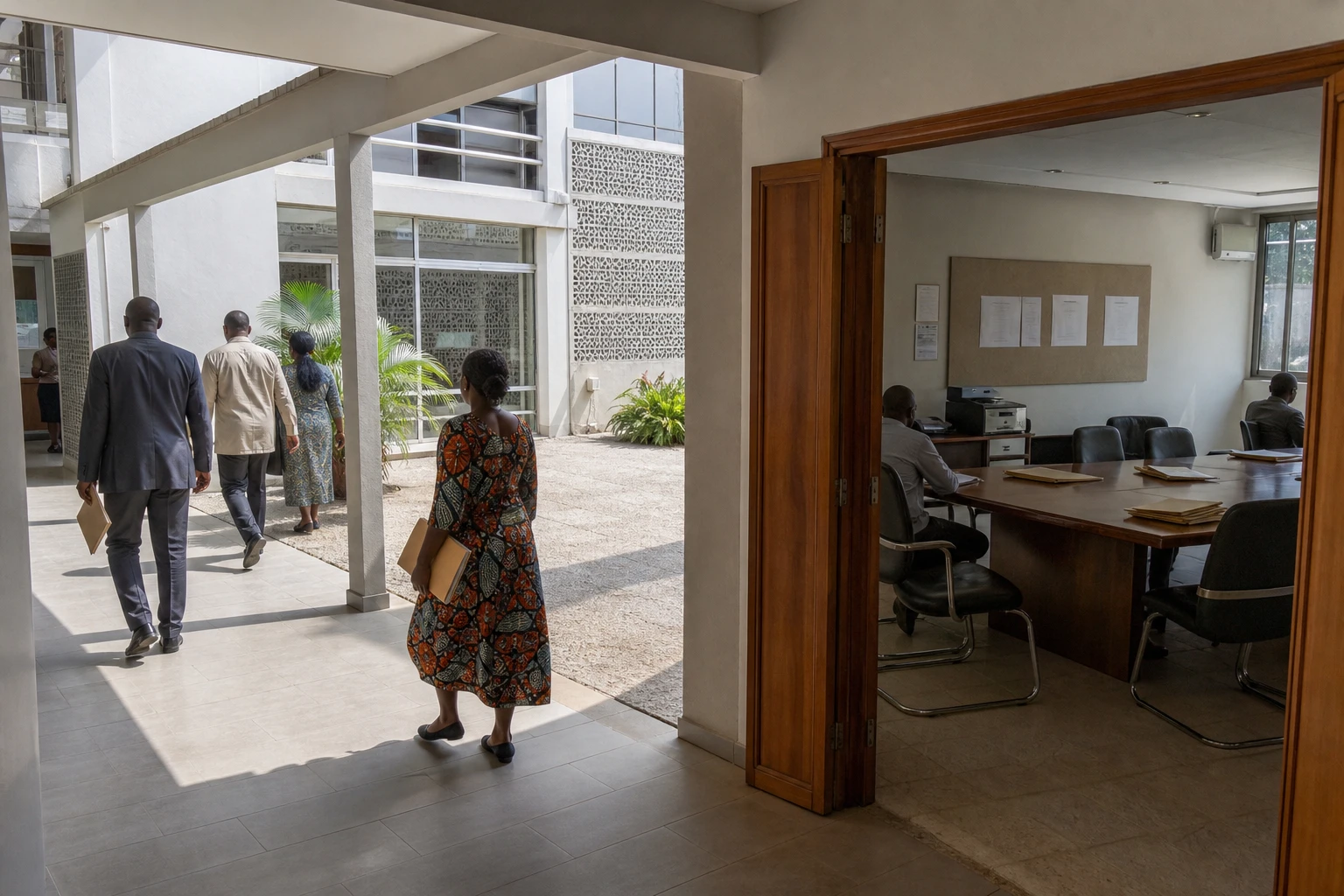
In Ivory Coast, reform of the body responsible for elections is entering a decisive phase. The debate is no longer just about replacing a contested institution. It now concerns how members are appointed, the role of political parties and whether the future system can build lasting trust ahead of the next elections.
A joint proposal, but an opposition still divided
Several opposition groups submitted their proposals to the Minister of the Interior and Security, Vagondo Diomandé, in Abidjan on Monday 5 October 2026. The document was drawn up after several weeks of discussions among various components of the Ivorian opposition.
The initiative brings together, among others, the Coalition for Peaceful Change in Ivory Coast (CAP-CI), Pascal Affi N’Guessan’s Ivorian Popular Front (FPI), Assalé Tiémoko’s Democratic Alliance of Ivory Coast (ADCI), Charles Blé Goudé’s Pan-African Congress for Justice and Equality of Peoples (Cojep), and the Higher Electoral Council led by Simone Ehivet Gbagbo.
The African Peoples’ Party – Ivory Coast (PPA-CI), founded by Laurent Gbagbo, took part in the discussions. However, it did not officially sign the joint document. The party cites internal procedural reasons, according to officials involved in the discussions.
The Democratic Party of Ivory Coast – African Democratic Rally (PDCI-RDA), another major opposition force, has also not joined the joint proposal. It submitted its own recommendations to the Ivorian authorities separately.
Experts rather than political representatives
The document’s central point concerns the composition of the future electoral body. The signatory parties are calling for an institution made up of electoral professionals, recruited according to public and rigorous criteria.
In particular, they want to exclude direct representatives of political parties, the government and public authorities. The stated aim is to reduce suspicions of conflicts of interest and give the institution greater room for manoeuvre.
“It must be a truly independent, neutral and impartial body,” Pascal Affi N’Guessan said when the document was submitted. He also advocates recruitment through a call for applications and performance contracts for the officials selected.
This structure would break with the way the Independent Electoral Commission (CEI) operated, with representatives of the government, opposition, civil society and judiciary. The Ivorian government announced the dissolution of the CEI on 6 May 2026, after years of criticism of its impartiality and effectiveness.
According to the Ivorian government statement, the CEI was established by a law dated 9 October 2001. Its disappearance therefore opens a major institutional process, going well beyond a simple administrative change.
An observatory to monitor the electoral process
The opposition’s proposal also provides for an observatory to monitor the various stages of the electoral process. The body could oversee preparatory operations, document problems and help provide early warning in the event of tensions.
For Charles Blé Goudé, the aim is to prevent disputes from turning into a crisis after the results are announced. The observatory would thus have a preventive role, as well as one of informing the public.
The issue is a sensitive one in Ivory Coast. Disagreements over electoral rolls, local commissions, constituency boundaries and the announcement of results have regularly fuelled mistrust between political camps.
The post-election crisis of 2010-2011 remains the most damaging episode in the country’s collective memory. Since then, every electoral reform has been viewed through the lens of that experience. Political actors know that an institution seen as unbalanced can undermine the legitimacy of an election, even when the technical operations proceed without any major incident.
Government must weigh effectiveness against legitimacy
The Ivorian authorities must now consider several competing models. The government will have to determine the new body’s legal status, funding arrangements, powers and relations with the Ministry of the Interior, the Constitutional Council and the relevant courts.
The choice of membership will be closely watched. An institution made up entirely of experts could reduce partisan confrontation within it. It could also prompt a new question: who will choose these experts, and what guarantees of transparency will there be?
Conversely, the presence of political representatives could make decisions more directly accountable to the parties. However, it carries the risk of an institution being paralysed by power struggles or accused of favouring the camp with the most seats.
The reform will also have different effects across the country. In Abidjan and the major cities, institutional debates are followed by political parties, civic organisations and the media. In rural areas, trust will depend more on the quality of voter registration, access to administrative documents and the functioning of local commissions.
People working in the informal economy, young voters and populations far from administrative centres will also be directly affected. For them, credible reform must mean simple procedures, accessible information and avenues of appeal that can actually be used.
An issue that extends beyond Ivory Coast’s borders
The reform is taking place in a West African region where demand for credible elections is strong. The Economic Community of West African States (ECOWAS), a regional organisation whose role includes promoting cooperation and stability, regularly monitors institutional developments in its member states.
Ivory Coast holds a particular place in the region. Its economic weight, its role in the West African Economic and Monetary Union and the scale of its trade with neighbouring countries give its political crises an immediate regional impact.
A consensual reform could serve as a model for other countries facing distrust of their electoral commissions. Conversely, an agreement limited to part of the opposition would leave a challenge in place even before the new institution is established.
The next step will be the government’s official response. The authorities will have to set out a timetable for the reform and decide whether to open a new round of discussions with the PPA-CI, the PDCI-RDA, other parties and civil society organisations. The credibility of the future body will depend as much on its founding legislation as on how that legislation is negotiated.