Algeria
 Egypt
 Libya
 Morocco
 Sudan
 Tunisia
 Benin
 Burkina Faso
 Cabo Verde
 Côte d'Ivoire
 Ghana
 Guinea
 Guinea-Bissau
 Liberia
 Mali
 Mauritania
 Niger
 Nigeria
 Sierra Leone
 The Gambia
 Togo
 Cameroon
 Central African Republic
 Chad
 DR Congo
 Equatorial Guinea
 Gabon
 Republic of the Congo
 São Tomé and Príncipe
 Burundi
 Comoros
 Djibouti
 Eritrea
 Ethiopia
 Kenya
 Madagascar
 Malawi
 Mauritius
 Mozambique
 Rwanda
 Seychelles
 Somalia
 South Sudan
 Tanzania
 Uganda
 Angola
 Botswana
 Eswatini
 Lesotho
 Namibia
 South Africa
 Zambia
 Zimbabwe
In Dakar, weekend rainfall quickly became more than a passing weather event. Major roads were cut off, neighbourhoods lost mobility and water entered some families’ homes. With further rain forecast, the Senegalese state activated a regional emergency response.
Monitoring measures activated in the Dakar region
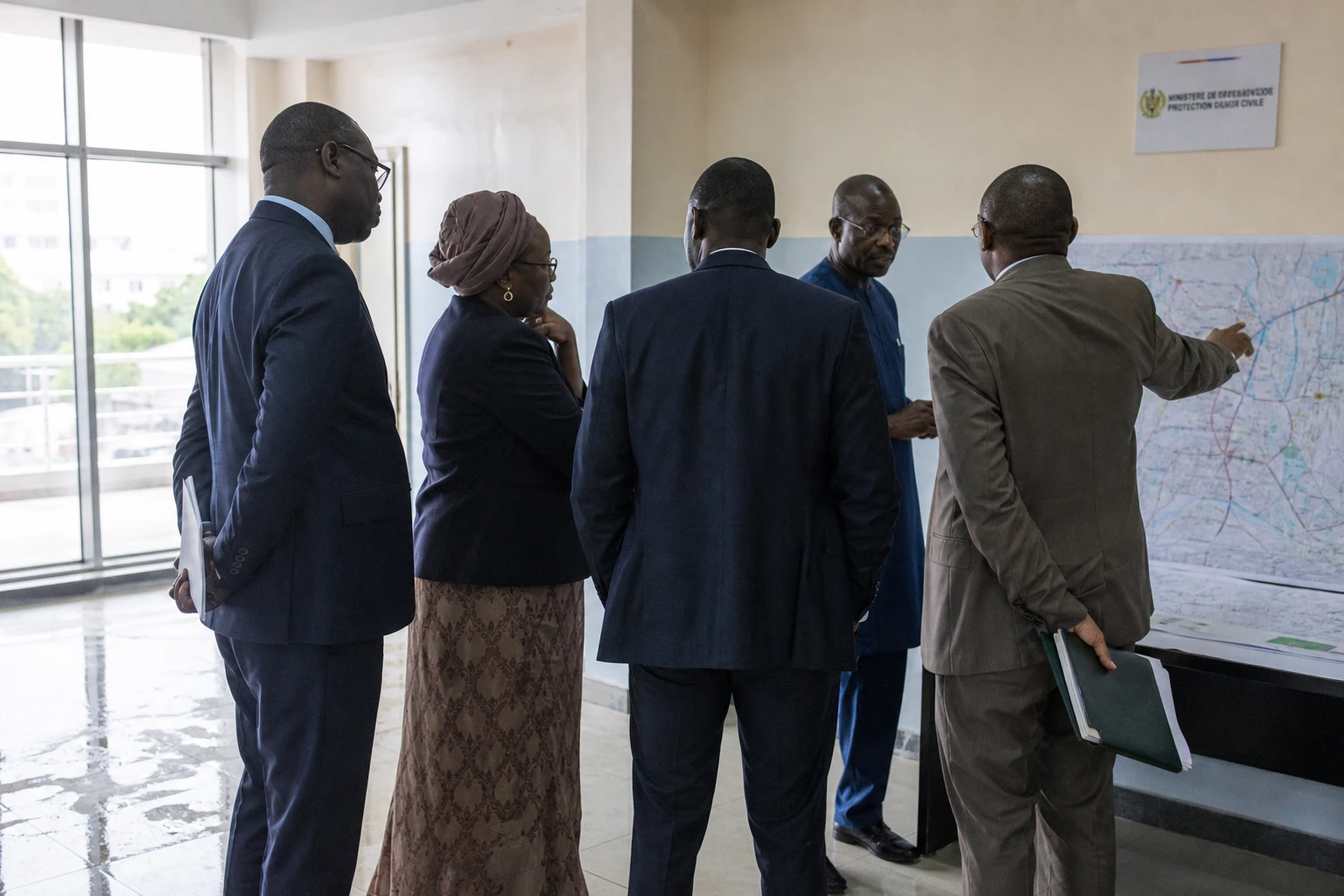
On Monday 5 October 2026, Prime Minister Ahmadou Alhaminou Mohamed Lo chaired an emergency meeting at the Prime Minister’s Office. Several ministries and operational services took part in assessing the situation. The government decided to activate the Dakar Regional Emergency Plan.
The mechanism is intended to ensure continuous monitoring of exposed areas. It brings together, in particular, the departments responsible for the Interior, Sanitation, Water, Family and Solidarity, National Education, Infrastructure and Transport. A monitoring committee is to work with the task force deployed to oversee operations on the ground.
The decision is based on forecasts from the National Agency of Civil Aviation and Meteorology, known by the acronym ANACIM. Further rain was forecast between Monday 5 and Wednesday 7 October. The government therefore sought to anticipate possible effects on transport, water, electricity and essential services.
“The regional emergency plan will be activated to enable us to remain on permanent alert,” the prime minister said after the meeting, according to the Senegalese Press Agency.
Roads blocked and services under pressure
The difficulties are concentrated in several parts of the capital and its suburbs. The toll motorway, which links outlying areas to central Dakar, was heavily disrupted. Thousands of workers, pupils, traders and transport operators use the road every day.
Philippe-Maguilène-Senghor Hospital, in Yoff, is also among the sensitive areas identified by the authorities. According to the Senegalese Press Agency, floodwater led the facility to transfer some patients to other healthcare centres. The situation shows that flooding affects more than traffic. It can also disrupt the continuity of care.
The government says it has ordered the rapid clearing of impassable routes. It also plans to improve public information through an alert system. In affected areas, there are two priorities: draining the water and maintaining access to basic services.
The Minister for Family, Social Action and Solidarity has been instructed to organise assistance for people affected by the floods. The announced measures include the distribution of water and food. The ministry responsible for finance is, in turn, to make the funds needed for emergency operations available.
A crisis that affects residents differently
The consequences are not the same for everyone in the Dakar region. An employee with a car may sometimes be able to find a route around a blocked road. By contrast, workers reliant on public transport risk losing a day’s income as soon as roads become impassable.
Street vendors, artisans, drivers and small traders in the informal economy are particularly exposed. Their livelihoods depend on people being able to get around. When travel stops, income often disappears that same day, with no automatic compensation mechanism.
In low-lying or poorly drained neighbourhoods, families sometimes have to protect their furniture, documents and electrical appliances before they can even think about returning to work. Children, older people and the sick are most vulnerable when streets become difficult to cross.
The situation also highlights the limits of a response based solely on pumping water out after rainfall. In Dakar, urban pressure, the sealing of soil, settlement in exposed areas and inadequate drainage networks in some places worsen surface runoff. Rainwater management therefore requires sustained action on urban planning, infrastructure maintenance and development planning.
Prevention remains the state’s main test
The government had already devoted an interministerial council meeting on 3 July 2026 to flood prevention and management. The meeting addressed clearing drainage networks, maintaining retention basins, strengthening weather monitoring and preparing a national strategy for integrated flood-risk management.
The latest rainfall therefore tests the administration’s ability to turn preventive decisions into visible results. The question is not only how many pumps can be deployed. Response times, coordination between services and the effectiveness of information provided to residents must also be assessed.
The government must also assess the school situation in the Dakar region. The prime minister has asked the Ministry of National Education to consider a possible delay to the start of the school year in areas where floodwater has not receded. Any such decision will depend on the state of the roads and schools, and on safety conditions.
A national and West African issue
Flooding in Dakar is part of a broader context. The capital accounts for a large share of Senegal’s economic and administrative activity. Prolonged disruption therefore quickly affects other regions, supply chains and trade with neighbouring territories.
The issue also concerns the ECOWAS area, the Economic Community of West African States. Major West African cities face comparable challenges: rapid urban growth, undersized sanitation networks and sometimes more intense rainfall. National responses would benefit from sharing weather data, mapping methods and municipal experience.
In the short term, Senegalese authorities will need to monitor the forecast rainfall, the condition of major roads and the needs of people affected by the floods. In the medium term, the credibility of the response will depend on its ability to prevent the same disruptions from recurring. For Dakar’s residents, the emergency is immediate. For the state, the real challenge is prevention before the next heavy rainfall.