Algeria
 Egypt
 Libya
 Morocco
 Sudan
 Tunisia
 Benin
 Burkina Faso
 Cabo Verde
 Ghana
 Guinea
 Guinea-Bissau
 Liberia
 Mali
 Mauritania
 Niger
 Nigeria
 Senegal
 Sierra Leone
 The Gambia
 Togo
 Cameroon
 Central African Republic
 Chad
 DR Congo
 Equatorial Guinea
 Gabon
 Republic of the Congo
 São Tomé and Príncipe
 Burundi
 Comoros
 Djibouti
 Eritrea
 Ethiopia
 Kenya
 Madagascar
 Malawi
 Mauritius
 Mozambique
 Rwanda
 Seychelles
 Somalia
 South Sudan
 Tanzania
 Uganda
 Angola
 Botswana
 Eswatini
 Lesotho
 Namibia
 South Africa
 Zambia
 Zimbabwe
In Abidjan, the debate on youth employment is no longer limited to the number of jobs to create. It also concerns the quality of work, access to finance and the ability of rural or fragile areas to offer sustainable prospects. It is against this backdrop that West Africa is seeking to turn political commitments into measurable results.
In Abidjan, a regional commitment focused on jobs and autonomy
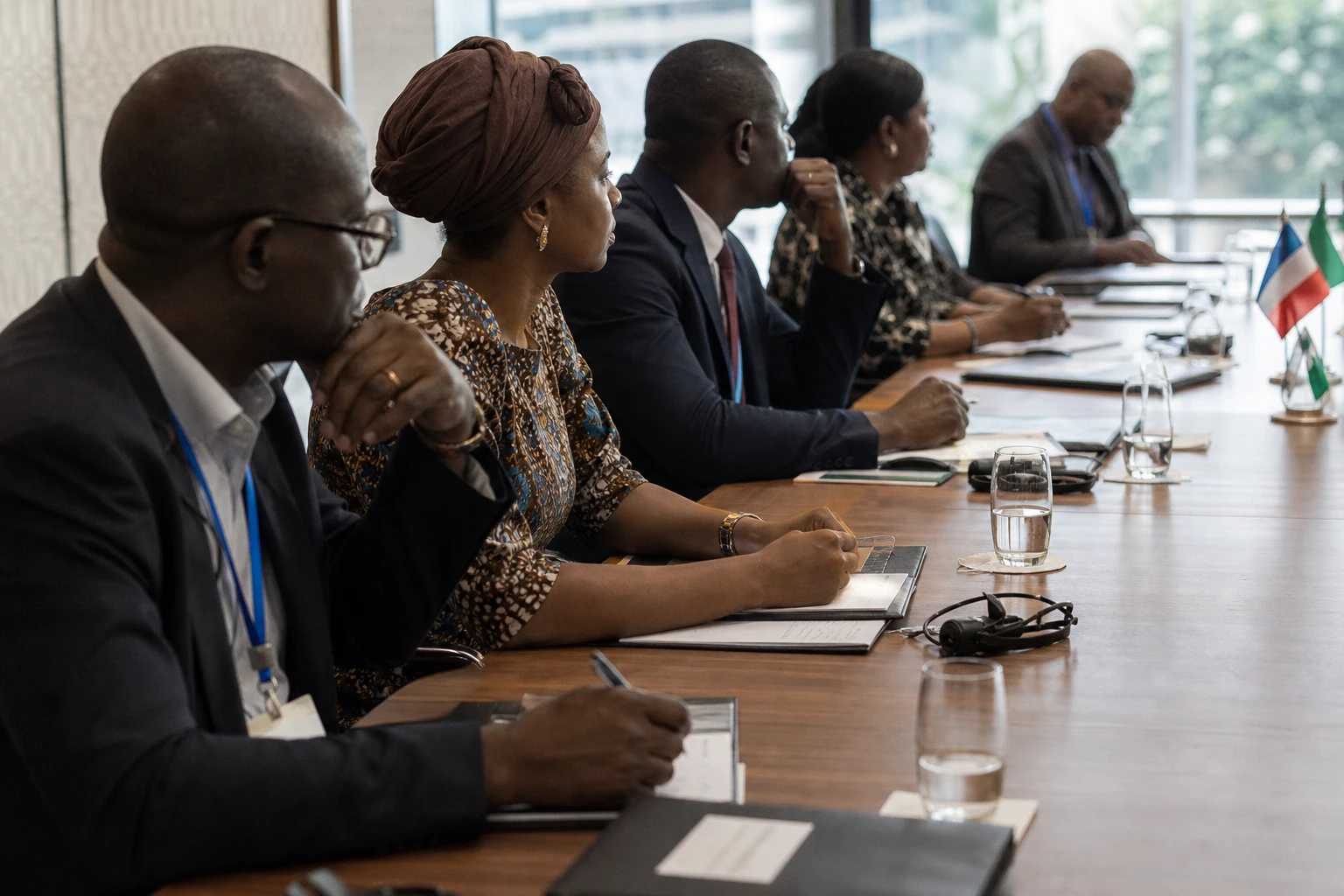
From 28 September to 3 October 2026, about 150 representatives of states, regional organisations, financial institutions, United Nations agencies and civil society met in Abidjan, Côte d’Ivoire’s main economic city. The meeting was organised by the United Nations Office for West Africa and the Sahel, UN Women and the Ivorian government, with technical support from the African Development Bank.
Participants adopted the Abidjan Call and Commitments. The document gives equal priority to two goals: the employment of young people and the economic empowerment of women. It focuses in particular on rural areas, border regions and territories affected by conflict.
This geography is not a secondary consideration. In West African capitals, young people have easier access to training centres, financial services and business networks. In remote regions, provision is more limited. Women there often face additional barriers related to access to land, credit, equipment and markets.
The call therefore recommends increasing investment, strengthening technical and vocational training, developing apprenticeships and improving digital skills. It also urges public and private actors to facilitate young people’s and women’s access to credit, markets and value chains — the steps linking production to sale.
Work exists, but is often precarious
The main regional challenge is not simply to reduce unemployment in the strict sense. Many young people are already working, but in activities without stable contracts or social protection, and with irregular incomes. The informal economy thus remains the main entry point into employment for a large share of West Africa’s young people.
A recent analysis by the International Labour Organization, based on harmonised 2022 data, shows that self-employment accounts for 70.1% of jobs held by 15- to 29-year-olds in the eight countries of the West African Economic and Monetary Union. WAEMU comprises Benin, Burkina Faso, Côte d’Ivoire, Guinea-Bissau, Mali, Niger, Senegal and Togo.
This average, however, masks significant disparities. The share of self-employment stands at 49.9% in Senegal and 82.1% in Niger. Overall, agriculture remains a major source of work. It provides income and skills, but is often exposed to climate hazards, inadequate equipment and difficulties in accessing finance.
Young women are more exposed to the most vulnerable forms of this situation. According to the ILO, they are also more likely than young men to be not in employment, education or training. Family responsibilities, particularly childcare and domestic work, explain part of this gap.
The issue therefore goes beyond the creation of businesses. It also concerns transport, continuing education, childcare, the security of work and recognition of work carried out on family farms or in small businesses.
For Côte d’Ivoire, a national and regional challenge
Côte d’Ivoire is hosting this initiative as it seeks to consolidate sustained growth and distribute opportunities more evenly between Abidjan, other urban centres and the regions. The country has a dynamic network of small businesses, co-operatives and agricultural activities. Yet many graduates still find it difficult to get their first job, and the transition from education to employment remains uneven.
In Yamoussoukro and other secondary cities, the challenge is to bring training into line with local needs. In agricultural regions, this means processing products, logistics, digital technology and access to markets. In Abidjan, priorities lie more in services, industry, technology and jobs linked to the energy transition.
The regional dimension is essential. Côte d’Ivoire belongs to ECOWAS, the Economic Community of West African States, which facilitates co-operation among 15 countries on economic, trade and mobility issues. Labour markets do not stop at national borders. Traders, apprentices, seasonal workers and entrepreneurs already move between several countries.
An effective policy must therefore take cross-border economic areas into account. It can support skills recognised in several countries, simplify access to information and strengthen infrastructure linking production areas to markets. It must also avoid viewing young people in border regions solely through the lens of security.
Turning commitments into verifiable targets
The Abidjan Call reiterates the broad aims of the 2030 Agenda, the African Union’s Agenda 2063 and United Nations resolutions on women, youth, peace and security. It also builds on several regional forums on youth in West Africa and the Sahel.
The text emphasises the participation of young people and women in peace processes and decision-making bodies. This broadens the debate. Sustainable economic inclusion depends on more than funding or training. It also rests on the ability to influence public policies governing access to land, markets, security and essential services.
The challenge now lies in implementation. The call does not yet set out a dedicated regional funding package, a common target for the number of jobs to be created, a number of people to be trained or a shared timetable. Without precise indicators, the commitments risk being difficult to assess.
Co-operation between the ILO and WAEMU, strengthened in February 2026 around a programme to support decent work for the 2026-2030 period, could provide a framework for monitoring. Governments will nevertheless need to define their responsibilities, funding and expected results in each country.
For West Africa, the next test will be a practical one: measuring how many young people gain access to better-paid work, how many women overcome barriers to finance and which regions actually benefit from investment. In Abidjan, the principle has been established. The credibility of the commitment will now be tested in communities, far from conference halls.