Algeria
 Egypt
 Libya
 Morocco
 Sudan
 Tunisia
 Benin
 Burkina Faso
 Cabo Verde
 Ghana
 Guinea
 Guinea-Bissau
 Liberia
 Mali
 Mauritania
 Niger
 Nigeria
 Senegal
 Sierra Leone
 The Gambia
 Togo
 Cameroon
 Central African Republic
 Chad
 DR Congo
 Equatorial Guinea
 Gabon
 Republic of the Congo
 São Tomé and Príncipe
 Burundi
 Comoros
 Djibouti
 Eritrea
 Ethiopia
 Kenya
 Madagascar
 Malawi
 Mauritius
 Mozambique
 Rwanda
 Seychelles
 Somalia
 South Sudan
 Tanzania
 Uganda
 Angola
 Botswana
 Eswatini
 Lesotho
 Namibia
 South Africa
 Zambia
 Zimbabwe
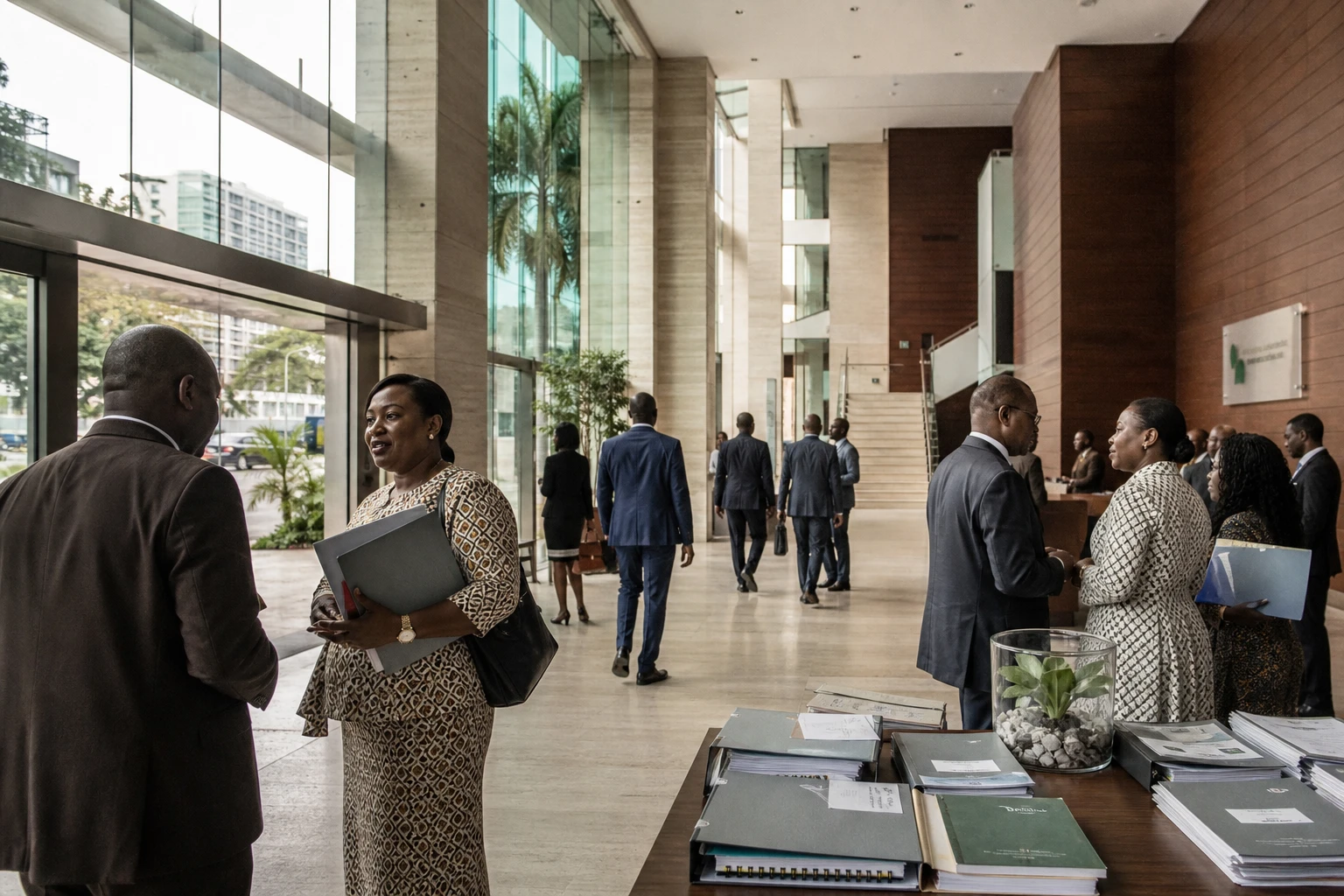
For Ivorian businesses, access to finance depends on more than the availability of capital. It also rests on the ability to turn an idea into a solid, well-documented project that meets banks’ requirements. This was the issue the West African Development Bank (BOAD) sought to discuss directly with the private sector in Abidjan.
In Abidjan, financing starts with project quality
The meeting was held on Thursday 1 October 2026 at the Noom Hotel in Abidjan, in partnership with the Côte d’Ivoire Chamber of Commerce and Industry (CCI-CI). It had a practical aim: to explain BOAD’s mechanisms to business operators and outline the conditions for accessing its resources.
The regional bank operates in the eight countries of the West African Economic and Monetary Union (WAEMU), a bloc that shares, among other things, the CFA franc and common financial institutions. It can finance some businesses directly or work through national banks and financial institutions.
The CCI-CI put project structuring at the centre of the discussions. Its president, Faman Touré, stressed the need for businesses to be sufficiently organised to submit credible applications. “Such a transformation cannot, however, take place without adequate access to finance, but also without businesses that are sufficiently structured and able to present solid, bankable projects to financial institutions,” he said.
The term “bankable” describes a project whose market, costs, expected revenues, risks and repayment plan can be assessed by a lender. This stage is often decisive for SMEs and businesses in expansion mode.
A challenge directly linked to the new development plan
The initiative comes as Côte d’Ivoire embarks on its 2026-2030 National Development Plan (PND). The programme envisages investment of 114,838.5 billion CFA francs over five years. According to official figures, 70.2% of this amount, or about 80,614.7 billion CFA francs, is expected to come from the private sector.
The ambition is therefore considerable. Businesses will have to contribute to industrial modernisation, agro-industry, energy, infrastructure, digital technology, healthcare and education. They will also need to create jobs and increase the value added produced in Côte d’Ivoire, rather than remaining confined to trade or intermediary activities.
The Ivorian Ministry of Planning and Development describes the PND as a framework intended to accelerate the country’s economic and social transformation. The private sector has a central role, with investment expected to increase in the regions and across several value chains.
This focus is, however, increasing pressure on businesses. Lamine Coulibaly, representing the Minister of Trade and Handicrafts, cited several obstacles: insufficient equity, difficulty obtaining guarantees, the cost of credit, loan terms that are too short and payment delays. These constraints particularly affect SMEs, whose cash flow is more fragile than that of large groups.
The challenge, then, is not simply to find money. Businesses also need reliable accounts, clear governance, secure contracts and a realistic timetable. Without these elements, a project may be relevant to the Ivorian economy but remain difficult to finance.
A range of tools for large companies and SMEs
BOAD offers several instruments, including short-, medium- and long-term loans, refinancing lines for financial institutions, equity investments and guarantees. The bank can also assist with project preparation, financial engineering, arranging and syndication.
Syndication involves bringing several lenders together around the same transaction. It spreads risk and mobilises amounts greater than any one institution could provide on its own.
For the direct financing presented to business operators, BOAD’s contribution can reach 50% of a project’s total cost excluding tax, including working capital requirements. The stated threshold for direct financing is 3 billion CFA francs. Below that level, a business can approach a local bank that receives refinancing from BOAD.
Loans can run for up to ten years, with a grace period of up to three years. A grace period allows repayments to begin after a start-up phase. It can be useful for a factory, an agricultural operation or equipment that does not generate revenue immediately.
Refinancing lines are therefore an important route for SMEs. They enable local banks to finance productive investment, microprojects or equipment acquired through leasing. Eligible sectors include agriculture, agro-industry, energy, infrastructure, the digital economy, healthcare, education and property.
BOAD says its interventions can take the form of loans, equity investments, guarantees or support through national financial institutions. The approach aims to bring regional resources closer to businesses that do not always have direct access to financial markets.
Strict conditions to limit risks
Access to these instruments is not automatic. Businesses must submit a market study, a business plan, financial forecasts and a precise description of their technology. They must also document their supply arrangements, markets and organisation.
Environmental and social factors are also part of the assessment. An industrial project must specify its energy needs, waste management, effects on communities and measures to reduce its impact.
The bank also examines the promoter’s equity contribution, the guarantees on offer and the involvement of a commercial bank. This last condition links regional finance to Côte d’Ivoire’s banking network. It can make project monitoring easier, but also adds a hurdle for smaller businesses.
For businesses based outside Abidjan, support will be crucial. Agricultural, mining and industrial projects are often located in the regions, while specialist financial services remain concentrated in the economic capital. The quality of local support will therefore influence the PND’s ability to deliver results beyond the country’s main business centre.
A test for Côte d’Ivoire’s economic transformation
The CCI-CI hopes to follow up the meeting with a monitoring mechanism involving the Chamber, BOAD, the ministry’s technical departments and the SME One-Stop Shop. The aim would be to build a portfolio of projects and then support their promoters through the search for financing.
This approach could narrow the gap between investment announcements and projects that are actually financed. It could also strengthen local content by giving Ivorian businesses a greater role in major projects and supply chains.
The issue, however, extends beyond Côte d’Ivoire. Across the WAEMU, governments are seeking to finance infrastructure, industries and services capable of supporting growth that is less dependent on imports. BOAD plays a bridging role between national policies, local banks and regional investors.
The success of this initiative will be measured less by the number of presentations held than by the volume of projects turned into factories, equipment, services and jobs. For Abidjan and Côte d’Ivoire’s other economic hubs, the next challenge will therefore be moving from information to implementation.