Algeria
 Egypt
 Libya
 Morocco
 Sudan
 Tunisia
 Benin
 Cabo Verde
 Côte d'Ivoire
 Ghana
 Guinea
 Guinea-Bissau
 Liberia
 Mali
 Mauritania
 Niger
 Nigeria
 Senegal
 Sierra Leone
 The Gambia
 Togo
 Cameroon
 Central African Republic
 Chad
 DR Congo
 Equatorial Guinea
 Gabon
 Republic of the Congo
 São Tomé and Príncipe
 Burundi
 Comoros
 Djibouti
 Eritrea
 Ethiopia
 Kenya
 Madagascar
 Malawi
 Mauritius
 Mozambique
 Rwanda
 Seychelles
 Somalia
 South Sudan
 Tanzania
 Uganda
 Angola
 Botswana
 Eswatini
 Lesotho
 Namibia
 South Africa
 Zambia
 Zimbabwe
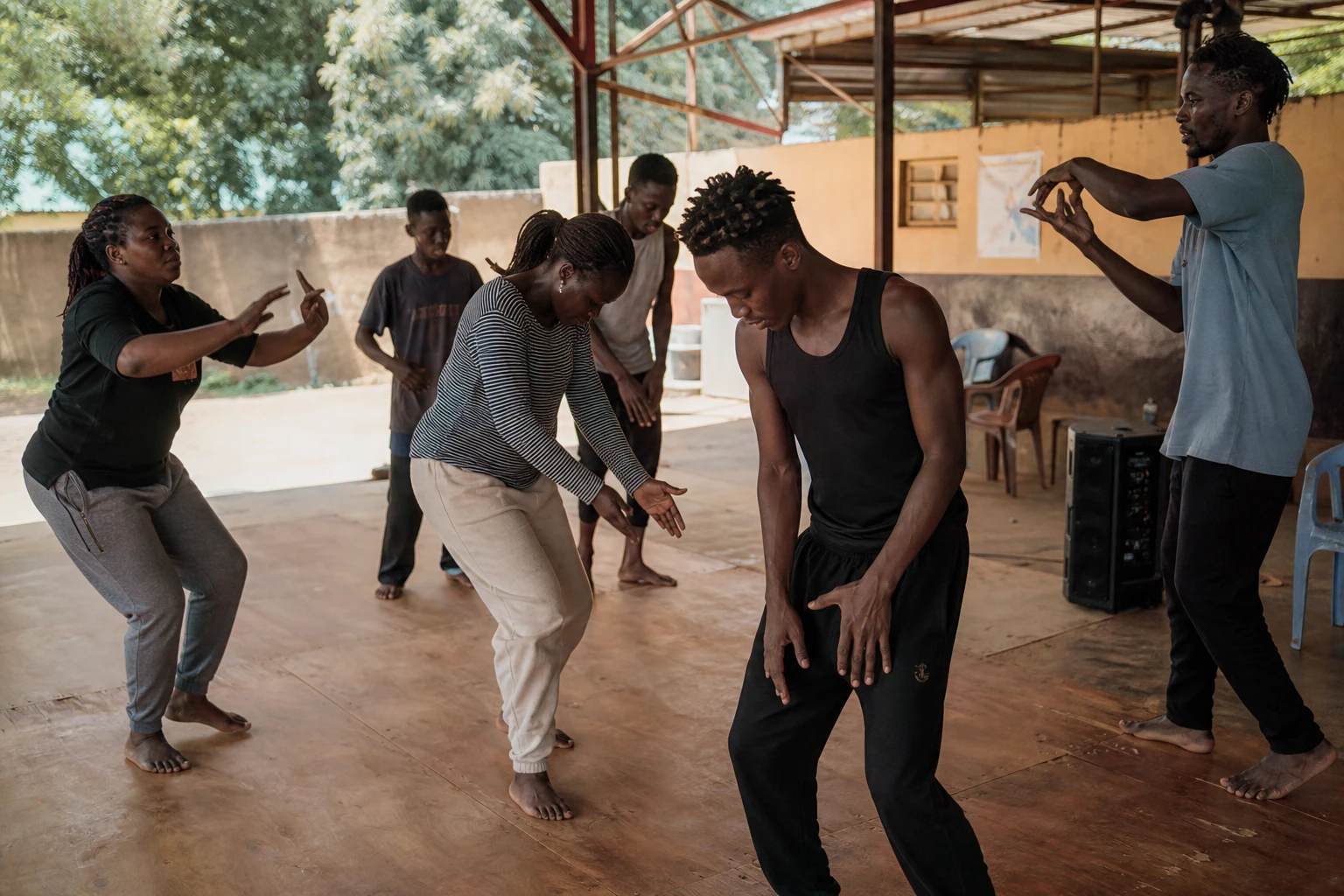
In Bobo-Dioulasso, music is felt not only through the ears. It travels through the floor, bodies and gazes. In rehearsals with the Fientan company, deaf and hard-of-hearing dancers develop their own relationship with rhythm. Their method transforms a sensory constraint into an artistic language.
In Bobo-Dioulasso, rhythm is read through the body
On stage, the dancers often perform barefoot. The percussion makes the floor vibrate. These vibrations become reference points. Gestures, facial expressions and signs then indicate changes in tempo, transitions and the intensity of the choreography.
This approach is called “Vibra-Signe”. It was developed by Yaya Sanou, a dancer, choreographer and teacher from Bobo-Dioulasso, in western Burkina Faso. The method combines vibration, touch, sight, connection with the floor and sign language.
The approach requires a gradual learning process. Students begin by recognising the beats. They then observe their instructor’s movements. Finally, they learn to stay in sync with the group. Precision therefore relies not on hearing, but on constant visual and physical attention.
Adama Sanou, one of Fientan’s dancers, says his commitment to the discipline helped him persevere despite his family’s reservations. “I really love dancing, rehearsing and learning. It’s my love of dance that encourages me to keep going,” he says in sign language.
A company founded to break isolation
Yaya Sanou says he began this work after observing the isolation of deaf young people at a specialist school in the Sarfalao neighbourhood of Bobo-Dioulasso. Many took little part in social and cultural activities. The first dance workshops then served as a place to meet and express themselves.
The Fientan company was built around this ambition. Its name, described as a Dioula word meaning “without disability”, expresses a determination not to confine the artists to an identity defined solely by their hearing impairment.
In the studio, participants learn to introduce themselves, communicate with one another and occupy space. Dance thus becomes an artistic practice, as well as a way to build independence and confidence. For some members, it also offers the possibility of travelling and sharing their knowledge with other young people.
This experience does not remove the obstacles. Several families remain cautious about artistic practice or travel. Social attitudes towards deaf people continue to weigh heavily. The stage, however, allows the dancers to respond through their work rather than by constantly asking for compassion.
Recognition beyond Burkina Faso
Fientan’s journey took on an international dimension in 2023. The company won the gold medal in creative dance at the 9th Jeux de la Francophonie, held in Kinshasa, Democratic Republic of the Congo, from 28 July to 6 August.
The victory was confirmed by the Games’ organisers and the Burkinabe press. It put a creation led by deaf dancers at the heart of a cultural competition bringing together several African and international delegations.
The show “Adepte de mon être” has also been performed in Côte d’Ivoire and Germany. These performances show that Vibra-Signe is not merely a local solution. It can become a tool for artistic creation, sharing knowledge and co-operation between artists.
This recognition remains fragile, however. A medal cannot replace regular funding, rehearsal spaces or professional support. It nevertheless gives the dancers new visibility and strengthens their ability to negotiate their place in the cultural sector.
The challenge of inclusion in Burkina Faso
Available data show the scale of the need. The 2019 General Population and Housing Census identified about 46,500 people aged two or older with significant difficulty hearing or no hearing at all. This figure describes the situation recorded at that time. It is not an updated estimate of the population concerned.
Burkina Faso has launched inclusive education programmes and several measures in support of people with disabilities. In practice, access to services remains unequal. Schools notably lack trained teachers, sign-language interpreters and support services.
Late acquisition of sign language also complicates schooling and social relationships. Some children do not encounter it until they start school. Others grow up in families with few resources to adapt everyday communication.
A study cited by Burkina Faso’s Institute of Social Sciences indicates that 58% of respondents hold a negative perception of deafness. In some communities, it is still associated with a curse or spiritual punishment. These beliefs can encourage exclusion, limit access to education and reduce employment opportunities.
Fientan’s work addresses this very issue. It does not portray the dancers as passive beneficiaries. It shows them as artists able to create, perform and share their work. This shift in perspective is essential. It reframes the question: the problem is not the absence of hearing, but the barriers that prevent people from taking part in collective life.
A regional dimension in a changing West African space
The issue extends beyond Bobo-Dioulasso. Burkina Faso is part of a West African region undergoing major political and social change. Its official withdrawal from ECOWAS, the Economic Community of West African States, took effect on 29 January 2025, alongside Mali and Niger. Despite this institutional break, the movement of people, works and cultural practices remains a regional concern.
Burkinabe artists continue to work with partners across the sub-region. Fientan’s participation in the Kinshasa Games also illustrated another dimension of African exchanges: one that connects capitals and cultural centres through creativity, beyond political frameworks.
For authorities, associations and cultural players, the next challenge is to turn occasional successes into lasting programmes. This means training, accessible venues, the use of sign language and support for companies run by or made up of people with disabilities.
In Bobo-Dioulasso, Fientan has already offered a concrete response. Vibra-Signe does not ask dancers to reproduce a model designed for hearing people. It starts from their experience and broadens the possibilities of the stage. Perhaps this is its greatest significance: a reminder that inclusion is not about opening a door, but rethinking the space so that everyone can truly create within it.