Algeria
 Egypt
 Libya
 Morocco
 Sudan
 Tunisia
 Benin
 Burkina Faso
 Cabo Verde
 Côte d'Ivoire
 Ghana
 Guinea
 Guinea-Bissau
 Liberia
 Mali
 Niger
 Nigeria
 Senegal
 Sierra Leone
 The Gambia
 Togo
 Cameroon
 Central African Republic
 Chad
 DR Congo
 Equatorial Guinea
 Gabon
 Republic of the Congo
 São Tomé and Príncipe
 Burundi
 Comoros
 Djibouti
 Eritrea
 Ethiopia
 Kenya
 Madagascar
 Malawi
 Mauritius
 Mozambique
 Rwanda
 Seychelles
 Somalia
 South Sudan
 Tanzania
 Uganda
 Angola
 Botswana
 Eswatini
 Lesotho
 Namibia
 South Africa
 Zambia
 Zimbabwe
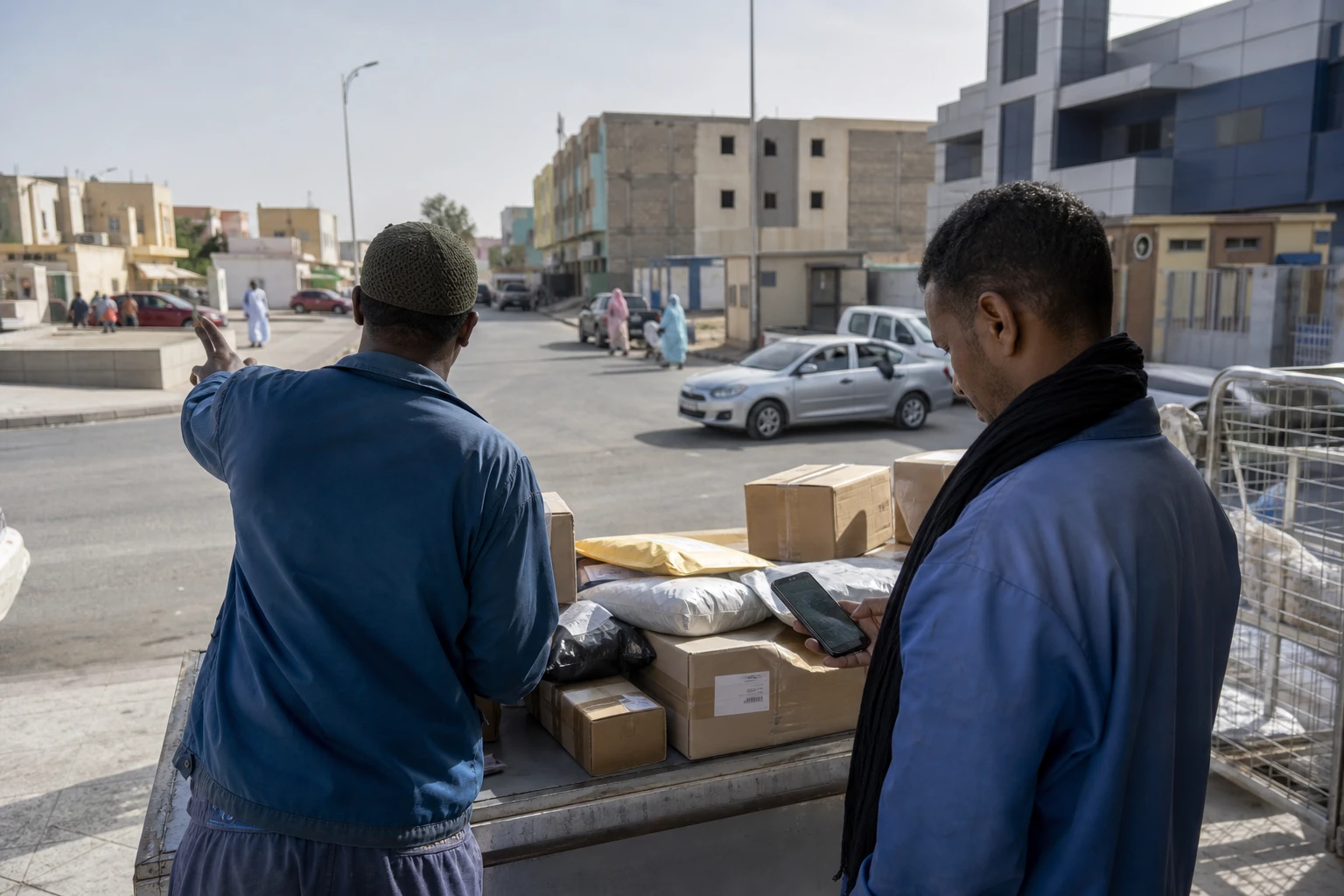
In Nouakchott, an online order can still depend on a phone call, an improvised landmark or a location shared through a messaging app. The planned national digital addressing system aims to turn this everyday practice into economic infrastructure.
An address to connect customers, sellers and couriers
Mauritania’s Ministry of Digital Transformation and Administrative Modernisation presented the project at a workshop that opened on 29 September 2026 in Nouakchott. The four-day meeting aims to discuss a unified national system for geographic and digital addressing.
The system is intended to locate plots, buildings, facilities and doors. It is expected to be based on postal-code zones, a common reference grid and digital management tools. A mapping portal, an address management portal and mobile applications are also planned.
The project is backed by the World Bank under the West Africa Regional Digital Integration Project, known by the acronym WARDIP. The programme supports several projects related to connectivity, digital services and the integration of West African economies.
The Mauritanian government has included the initiative in preparations for its National E-commerce Strategy 2026-2030. The strategy was the subject of a validation workshop in 2025. It is intended to provide a common framework for government departments, businesses and financial sector players.
The last mile: a very practical obstacle
For online marketplaces, an address is not simply an administrative detail. It determines the cost, speed and reliability of delivery. Without a precise location, couriers have to make repeated calls. Customers have to remain reachable. An internet outage or an unavailable phone can then disrupt the entire chain.
The United Nations Conference on Trade and Development (UNCTAD) identified this challenge in its assessment published on 26 March 2024. The organisation says the lack of reliable physical addressing weighs on last-mile delivery, the final stage between a distribution point and the recipient.
The assessment also highlights limitations in postal and logistics infrastructure. In several cases, parcels are directed to post offices rather than customers’ homes. This can work for some buyers, but it reduces the appeal of e-commerce based on home delivery.
The planned system could therefore help both businesses and individuals. Merchants would gain a clearer picture of the areas they serve. Carriers could plan their routes. Government departments would have a shared database for locating public services and economic activity.
A useful reform, but one still to be implemented
Presenting the project does not mean the service is already operational. Several steps remain. The authorities must define the zones, settle on an addressing method, harmonise the data and set rules for sharing it between institutions.
The pilot phase is scheduled for the end of 2026. Its detailed timetable, geographic scope and the localities involved will still need to be confirmed. Success will also depend on the ability to keep data up to date as buildings change use, new neighbourhoods develop or populations move.
Governance will be central. A digital address can make a delivery easier. It also becomes sensitive data when linked to an identity, a business activity or an order history. Data protection rules and oversight mechanisms will therefore need to accompany the technical roll-out.
The project must also avoid widening the gap between Nouakchott, other urban centres and rural areas. Coverage limited to the capital would improve the performance of businesses that are already well organised, but leave much of the country out. The addressing system will have to work in different urban and rural settings.
E-commerce also depends on payments and trust
UNCTAD presents addressing as one element of a wider picture. Its assessment points in particular to the limited use of digital payments and difficulties with financial inclusion. According to the report, only 16% of Mauritanians used digital payment services in the data selected for the study.
This situation limits online sales. A merchant can receive an order remotely but lose part of the profit if payment still depends on cash being handed over at delivery. This increases the cost of the transaction, as well as the risk of cancellation or non-payment.
Trust is another area requiring work. Mauritania already has laws covering electronic transactions, cybercrime, personal data and electronic payment methods. UNCTAD nevertheless recommends strengthening the framework governing transactions and adopting more specific protections for online consumers.
For small and medium-sized businesses, the challenge goes beyond setting up an online shop. They need to master digital marketing, stock management, logistics, cybersecurity and export procedures. These skills will determine whether Mauritanian businesses can sell beyond their city or country.
A link in West Africa’s digital integration
Africa’s e-commerce market is expected to continue growing. Estimates cited in the available material project its value rising from $55bn in 2024 to $112.73bn in 2029. This trend does not guarantee automatic growth for Mauritania. Rather, it highlights the importance of building infrastructure compatible with regional trade.
Mauritania occupies a distinctive position between West Africa, the Maghreb and the Atlantic region. Its digital integration will therefore depend not only on domestic demand, but also on trade with neighbouring countries, diaspora communities and platforms capable of connecting Mauritanian producers with customers outside the country.
From this perspective, a reliable addressing system could become commercial infrastructure as well as a tool for modernising public administration. It could improve document distribution, the location of businesses, postal services and urban planning.
The next step will be to assess the results of the pilot announced for the end of 2026. This will mean examining address accuracy, costs for businesses, access in rural areas and interoperability with postal services and payment platforms. For Mauritanian e-commerce, an address can open the door. It cannot, however, replace a good network, trust or businesses’ ability to serve their customers.