Algeria
 Egypt
 Libya
 Morocco
 Sudan
 Tunisia
 Benin
 Burkina Faso
 Cabo Verde
 Côte d'Ivoire
 Ghana
 Guinea
 Guinea-Bissau
 Liberia
 Mauritania
 Niger
 Nigeria
 Senegal
 Sierra Leone
 The Gambia
 Togo
 Cameroon
 Central African Republic
 Chad
 DR Congo
 Equatorial Guinea
 Gabon
 Republic of the Congo
 São Tomé and Príncipe
 Burundi
 Comoros
 Djibouti
 Eritrea
 Ethiopia
 Kenya
 Madagascar
 Malawi
 Mauritius
 Mozambique
 Rwanda
 Seychelles
 Somalia
 South Sudan
 Tanzania
 Uganda
 Angola
 Botswana
 Eswatini
 Lesotho
 Namibia
 South Africa
 Zambia
 Zimbabwe
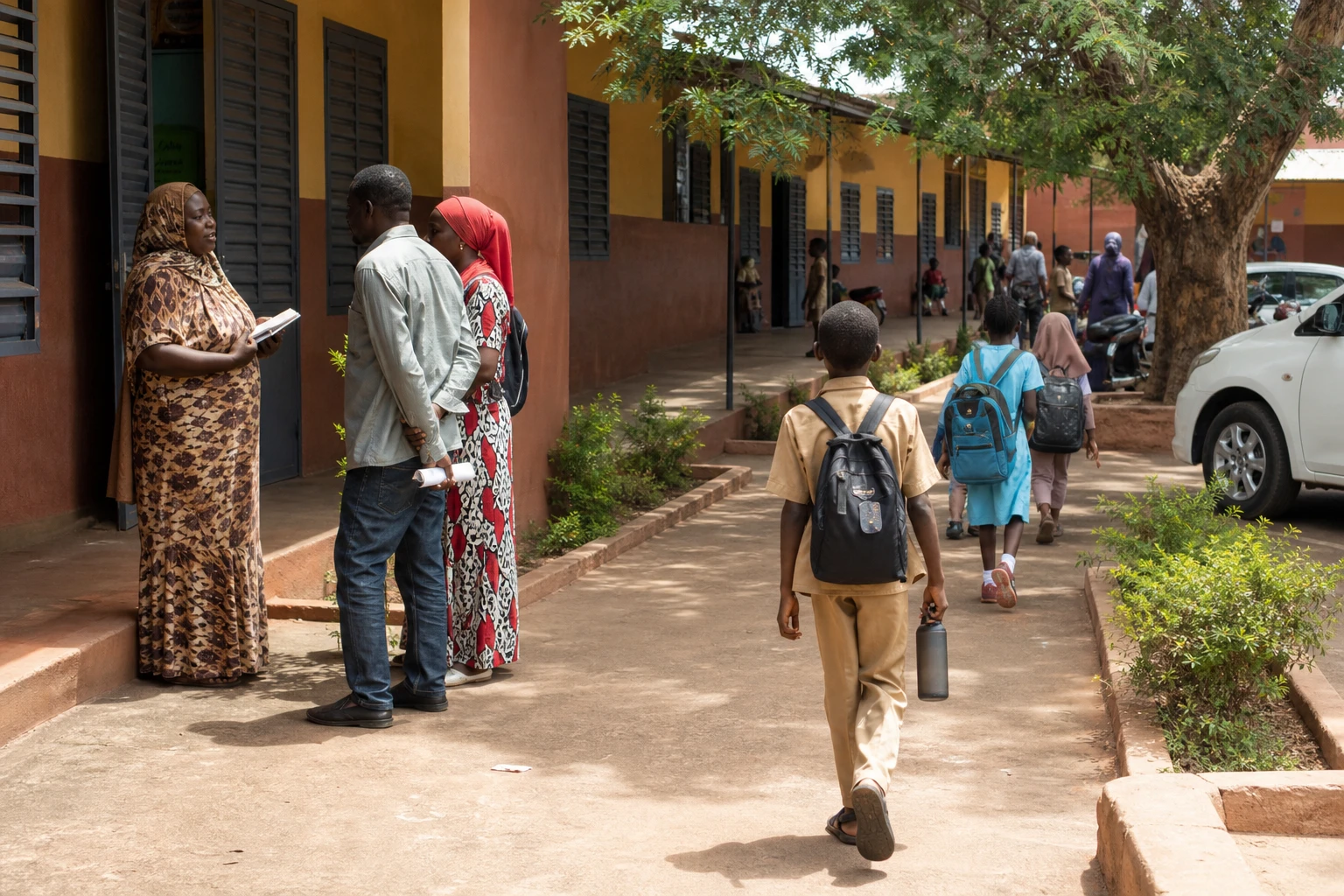
In Bamako, the start of the school year on Thursday 1 October 2026 marks the beginning of a new academic year. But classrooms will remain silent in some parts of the country. According to data from the Mali Education Cluster, 2,444 schools are non-operational. The situation is keeping around 733,200 children out of class and affecting 14,604 teachers.
Official start to the school year, but an uneven experience
Mali’s Ministry of National Education has kept 1 October as the start date for the 2026-27 school year. Several preparatory meetings have been held with unions, parents’ associations, private school operators and representatives of civil society.
Discussions covered the availability of teachers, school supplies, the placement of pupils who passed the basic education diploma and the security of schools. School closures were also among the main concerns raised by those working in the sector.
The figure of 2,444 non-operational schools comes from a report by the Mali Education Cluster published on 24 June 2026. The mechanism coordinates monitoring of the education situation with the participation of the Ministry of National Education, UNICEF and Save the Children. The data have been reported by several Malian media outlets, including Bamada and Malijet.
The number of closed schools has risen steadily. UNICEF recorded 1,344 schools closed at the end of 2020. By September 2023, 1,722 schools were already out of service. The total rose to 2,036 in 2025, before reaching 2,444 in 2026, according to available figures.
Central Mali accounts for most closures
The affected schools are mainly in areas exposed to violence and population displacement. Malian newspaper L’Essor reports that the 2,444 closed schools are concentrated mainly in central Mali and at the basic education level.
The Ségou region tops the list, with 506 non-operational schools. It is followed by several areas in Bandiagara, Timbuktu, Mopti and Ménaka. The Kidal and Ménaka regions are also heavily affected, although the available data do not always allow direct comparisons of closure rates between territories.
This geographical pattern is a reminder that the education crisis is not limited to localities closest to the front lines. It also affects rural areas where the administration, social services and transport infrastructure are harder to maintain.
In some municipalities, schools have been attacked, looted or damaged. Others are sheltering displaced families. Elsewhere, teachers can no longer reach their posts or choose not to go when security conditions are considered too dangerous.
The problem is therefore not simply a matter of rebuilding buildings. A school can function only if pupils can get there, teachers can work there and families have a minimum level of stability.
Children and teachers face lasting effects
Closures interrupt learning. They also undermine the education of displaced children, especially when families move several times. In rural areas, the absence of a school can mean longer journeys or push some pupils to abandon their education altogether.
Girls may be particularly exposed to these disruptions. When a school closes, the risks of early marriage, increased domestic work or prolonged exclusion from education can rise. Boys, meanwhile, may be more likely to be called on to help their families or take part in informal economic activities.
Teachers are also suffering the consequences of the situation. The 14,604 professionals affected are not only facing the suspension of their work. Many also have to deal with displacement, uncertainty over their postings and a lack of suitable working conditions.
Temporary solutions are available. Mali and its partners have already turned to community learning spaces, accelerated education programmes and radio-based initiatives. These responses help maintain contact with pupils. They do not, however, replace a stable school with trained staff who are regularly present.
UNICEF says the country already has between one and two million children aged 6 to 17 who are out of school. Insecurity-related closures are therefore worsening a structural problem that extends beyond the start-of-year calendar.
‘Year of Education and Culture’: a promise tested on the ground
Malian authorities have designated 2026-27 the ‘Year of Education and Culture’. The government presents the initiative as a framework for strengthening learning, infrastructure, national languages and community participation.
The ministry also says it wants to improve the quality of teaching and mobilise local authorities, parents, unions and education partners. These objectives give the 2026 school year national significance.
The gap between this ambition and the number of closed schools is, however, the year’s main political test. The question will be less about declaring education a priority than about measuring actual reopenings, teachers’ return and continuity of classes in vulnerable areas.
In Bamako, the start of the school year may give the impression of a school system returning to normal. In the central and northern regions, it will take a different form. Some pupils will resume classes at their schools. Others will follow a temporary programme. Many will remain cut off from education.
An issue that extends beyond Mali’s borders
Mali’s situation is part of a wider education crisis in the Sahel. In Burkina Faso and Niger, violence and displacement are also disrupting the education of hundreds of thousands of children. Regional responses must therefore bring together security, humanitarian aid, teacher mobility and sustainable education funding.
The institutional context has changed since Mali, Burkina Faso and Niger withdrew from ECOWAS, the Economic Community of West African States, with the withdrawal taking effect on 29 January 2025. This regional realignment complicates established cooperation frameworks, but does not remove the shared needs of the population.
For Mali, the next indicators will be concrete: the number of schools reopened, teachers’ actual presence, support for displaced children and changes in security around schools. The Year of Education and Culture will be judged by these results, in classrooms in Bamako as well as in municipalities farthest from the national centre.