Algeria
 Egypt
 Libya
 Morocco
 Sudan
 Tunisia
 Benin
 Burkina Faso
 Cabo Verde
 Côte d'Ivoire
 Ghana
 Guinea
 Guinea-Bissau
 Liberia
 Mali
 Mauritania
 Niger
 Nigeria
 Senegal
 Sierra Leone
 The Gambia
 Togo
 Cameroon
 Central African Republic
 Chad
 DR Congo
 Equatorial Guinea
 Gabon
 Republic of the Congo
 São Tomé and Príncipe
 Burundi
 Comoros
 Djibouti
 Eritrea
 Ethiopia
 Kenya
 Madagascar
 Malawi
 Mauritius
 Mozambique
 Rwanda
 Seychelles
 Somalia
 South Sudan
 Tanzania
 Uganda
 Botswana
 Eswatini
 Lesotho
 Namibia
 South Africa
 Zambia
 Zimbabwe
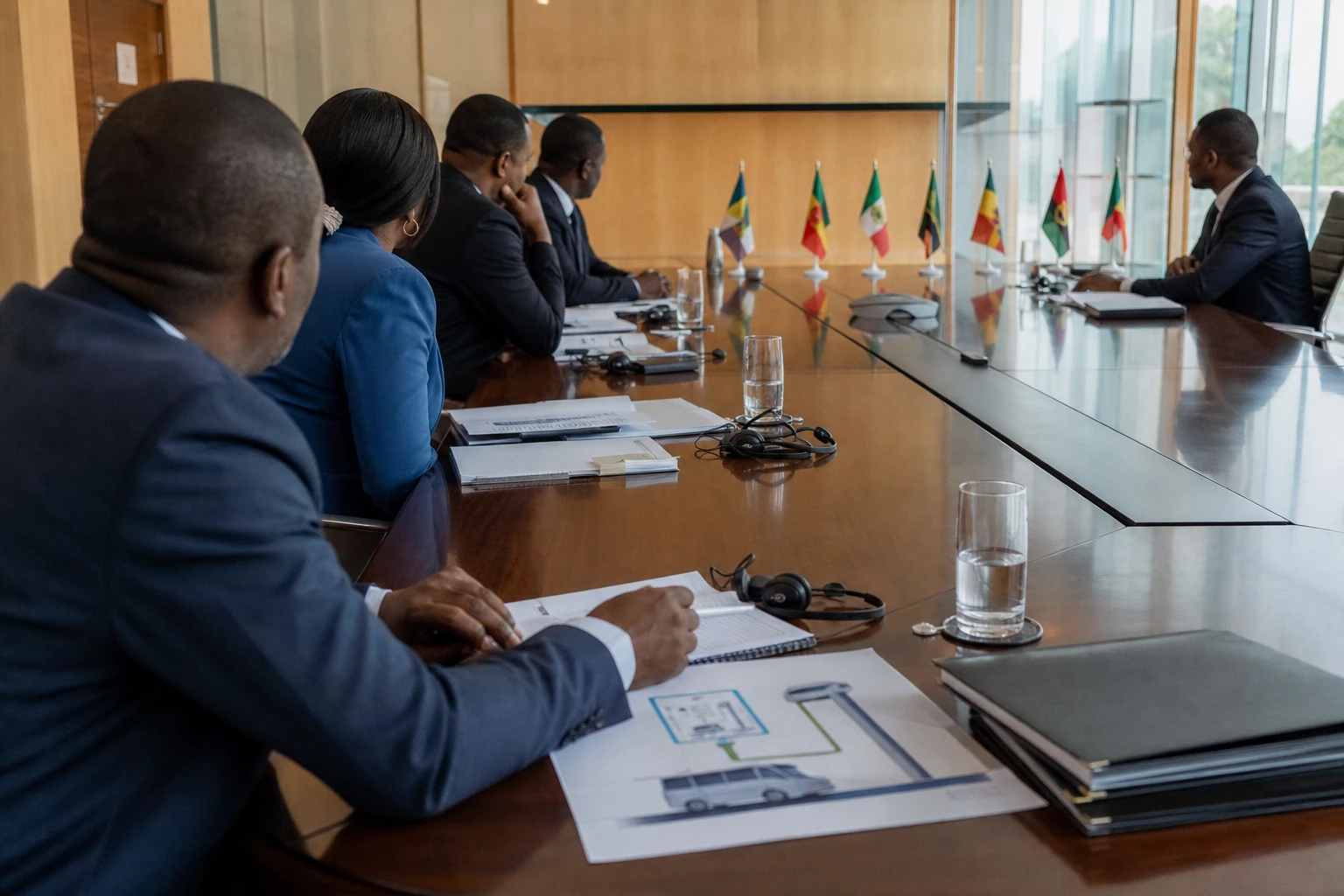
In Luanda, the transition to electric buses will not be decided on the roads alone. It will also depend on Angola’s ability to produce, distribute and manage the electricity needed to run a cleaner public fleet. The ONDJILA GREEN programme therefore sets in motion an industrial and institutional undertaking that goes far beyond buying vehicles.
A first phase focused on Luanda
On 28 September 2026, Angola’s Ministry of Transport announced the gradual introduction of at least 1,000 electric buses. The project also envisages up to 2,000 charging points nationwide.
The announcement was made in Luanda at the Angola Hub Transport and Logistics Summit. It is part of the ONDJILA GREEN programme, built around an agreement between the Ministry of Transport, the Angolan Sovereign Fund and OPAIA Motors, a local company active in transport assembly and equipment.
The first phase is due to begin with 240 charging stations. They will be installed mainly in the capital, according to information released by OPAIA Motors. However, a detailed timetable for the national rollout has not yet been made public.
Choosing Luanda follows an operational logic. The capital accounts for a large share of daily journeys, transport operators and technical infrastructure. It is also the main testing ground for routes, charging schedules and operating costs.
For passengers, the stakes are tangible. An electric bus improves service only if it runs regularly, keeps to its schedule and remains affordable. A modern fleet alone will therefore not solve mobility problems if routes, ticketing and maintenance do not advance at the same pace.
The real challenge: making the whole system work
Angola’s strategy now rests on a more precise regulatory framework. In October 2024, Angola approved a national strategy for electromobility. In January 2025, a legislative decree established the legal framework for electric vehicles and charging infrastructure.
These texts provide, among other things, for a national organisation of charging points, rules for operators and conditions for access to the electricity grid. They also place electromobility at the intersection of several public policies: transport, energy, industry and the environment.
This legal basis will now need to be translated into practical procedures. Vehicles will have to be type-approved, safety standards set, electricity billing organised and responsibilities in the event of a breakdown defined. The network’s day-to-day operation will be just as important as its installation.
Electricity supply is another sensitive issue. Bus depots will need sufficient capacity to charge several vehicles at the same time. The authorities will therefore have to coordinate the programme with grid operators and plan requirements around peak periods.
The issue is not only how much electricity is available, but also how reliable the supply is. A prolonged outage could immobilise part of a fleet and disrupt urban routes. Backup solutions, such as stationary storage or support from renewable sources, could be considered depending on the sites.
Financing also remains to be clarified. The authorities have announced the programme’s targets but have not detailed its overall cost, how the buses will be procured or how investment will be divided between the state, companies and potential lenders.
This information will be essential to assess whether the timetable is feasible. The cost of an electric bus is not limited to its purchase. It includes batteries, charging points, electrical works, management software, training and the future replacement of equipment.
A local industry to build
OPAIA Motors’ involvement gives the project an industrial dimension. The company could contribute to assembly, vehicle adaptation and the development of local skills. This prospect aligns with the national strategy, which presents electromobility as an opportunity to create activities related to vehicles and their components.
Maintenance will be one of the first tests. Electric buses have fewer mechanical parts than diesel models, but they rely more heavily on electronics, software, batteries and charging systems. Angolan technicians will need to master this equipment to reduce downtime and limit dependence on external support.
Training will need to cover workshops as well as drivers, depot managers and safety teams. Procedures for working on high-voltage batteries require specific skills. Developing these skills can create qualified jobs, provided it is built into the programme from the rollout phase.
The location of the first equipment will also affect different parts of the country. Excessive concentration in Luanda could widen disparities with other cities. By contrast, a gradual expansion to centres such as Lubango, Benguela or Huambo would make it possible to test models suited to urban networks of different sizes.
Needs will not be the same everywhere. Distances, terrain, urban density and grid availability will vary from province to province. A solution suited to Luanda therefore cannot automatically be replicated across the country.
A trend extending beyond Angola’s borders
Angola is not alone in this shift. Several African countries are seeking to reduce fuel costs and emissions from urban transport. Kenya and Rwanda have seen the emergence of operators specialising in electric buses. In Senegal, public transport projects also incorporate goals for modernisation and pollution reduction.
Regionally, Angola is part of the Southern African Development Community, or SADC, which brings together countries facing shared challenges around energy, urbanisation and transport corridors. The growth of electromobility could open up new exchanges on standards, equipment and training.
The programme also has continental significance. The African Union is working on guidance to help states develop their own frameworks for electric vehicles. Angola could thus serve as a testing ground for mobility suited to large African cities, without mechanically reproducing models designed for other markets.
The next indicator will be the move from announcement to the first installations. The operational signing of the agreement, publication of the timetable, choice of buses, financing of the first 240 stations and training of teams will all need to be followed.
The ONDJILA GREEN programme will therefore be judged by the continuity of service, not simply by the number of vehicles announced. For Angola, success will mean creating a complete ecosystem: reliable energy, accessible infrastructure, local maintenance and public transport that is genuinely useful to people in Luanda and the country’s other cities.