Algeria
 Egypt
 Libya
 Morocco
 Sudan
 Tunisia
 Benin
 Burkina Faso
 Cabo Verde
 Côte d'Ivoire
 Guinea
 Guinea-Bissau
 Liberia
 Mali
 Mauritania
 Niger
 Nigeria
 Senegal
 Sierra Leone
 The Gambia
 Togo
 Cameroon
 Central African Republic
 Chad
 DR Congo
 Equatorial Guinea
 Gabon
 Republic of the Congo
 São Tomé and Príncipe
 Burundi
 Comoros
 Djibouti
 Eritrea
 Ethiopia
 Kenya
 Madagascar
 Malawi
 Mauritius
 Mozambique
 Rwanda
 Seychelles
 Somalia
 South Sudan
 Tanzania
 Uganda
 Angola
 Botswana
 Eswatini
 Lesotho
 Namibia
 South Africa
 Zambia
 Zimbabwe
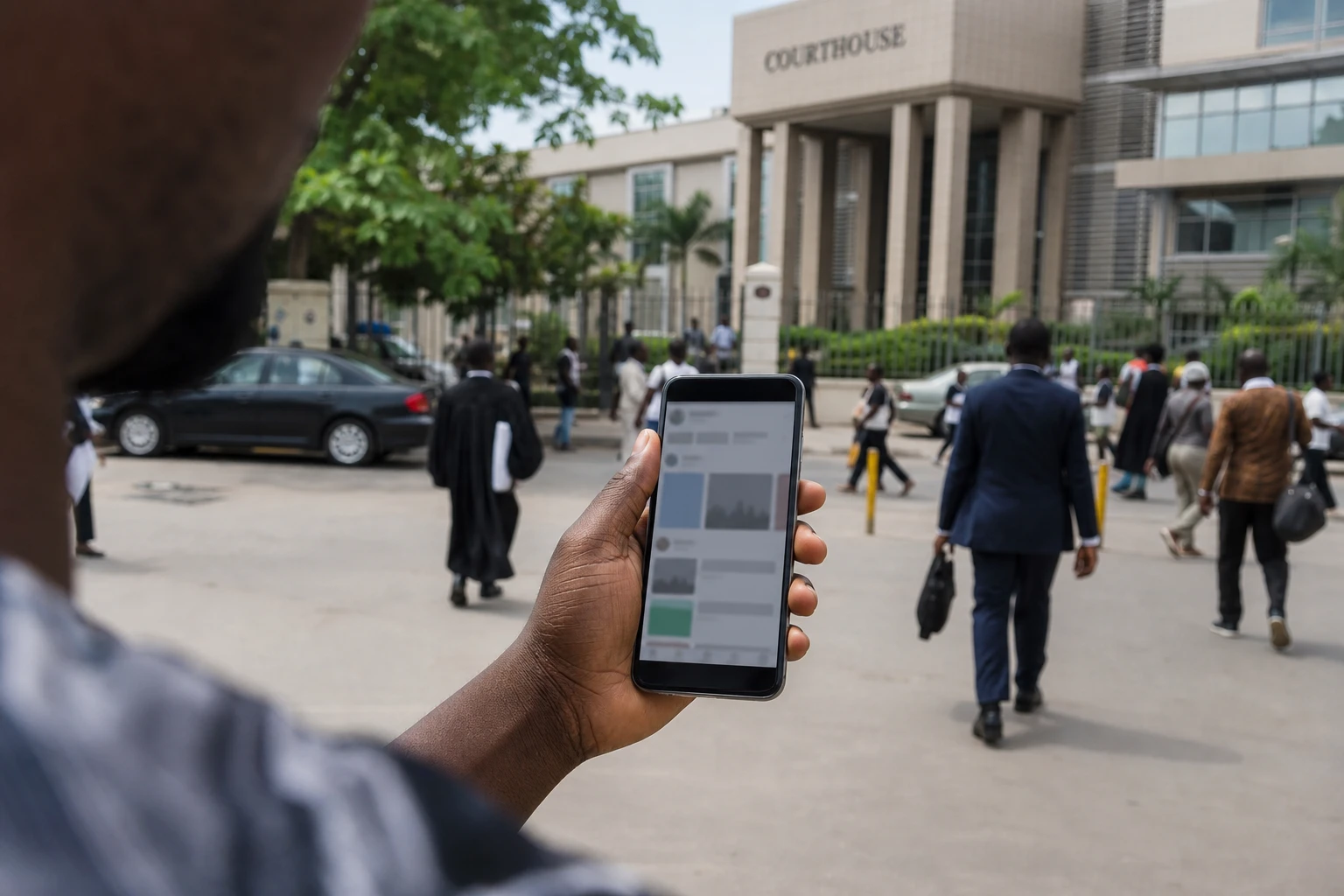
In Accra, a confrontation outside the High Court has shifted the debate on disinformation towards a more sensitive question: how far can the state go when an investigation involves online content, a detained nurse and the lawyer representing her?
The case involves freedom of expression, the independence of the legal profession and the powers of an investigative agency. It also comes at a time when political transitions in Ghana remain regular, but each government can set precedents that its successor will inherit.
Arrest attempt on High Court premises
On 23 September 2026, officers from Ghana’s Economic and Organised Crime Office (EOCO) attempted to take Nana Agyei Baffour Awuah to their offices. The incident took place at the Accra High Court, after a hearing on his client Salomey Awiti Baffoe’s application for bail.
Baffour Awuah is the MP for Manhyia South and a lawyer. Videos circulated on social media show a confrontation near a vehicle. EOCO said its officers were acting as part of an ongoing investigation. The agency also said it had invited the MP twice in February 2026, but he had not appeared.
The MP disputes this account. He says the first letter was addressed to the senior partner at his law firm, not directly to him. He also says representatives from the firm met investigators three times and provided information and a written statement.
As of 29 September 2026, no known court ruling had established that the arrest attempt was connected to Baffour Awuah’s role in Salomey Baffoe’s defence. EOCO says it was acting to further its investigation. The MP, meanwhile, believes the timing and location of the operation raise questions about the safeguards afforded to a lawyer representing a person facing prosecution.
The Ghana Bar Association, the country’s professional body for lawyers, has called for any action against a member of the Bar to comply with the Constitution, legal procedures and the independence of the defence. In a statement dated 24 September, it warned that an intervention conducted in such circumstances could create the impression of intimidation and have a “chilling effect” on lawyers.
Another lawyer present during the incident, Enoch Anhwere Afoakwa, also reported to the police an assault he says he suffered during the confrontation. The complaint has yet to be examined by the relevant authorities. At this stage, it does not constitute a judicial finding on responsibility.
‘Ghana Jollof’ case at the centre of controversy
The attempted arrest is part of proceedings against Salomey Awiti Baffoe, a 40-year-old senior nurse. Prosecutors accuse her of complicity in the alleged publication and circulation of false information on social media.
The investigation concerns content associated with a TikTok account known as “Ghana Jollof”, attributed to Barbara Asantewaa Kodua. The authorities suspect Baffoe acted as an intermediary and helped recruit people to recirculate some videos. These allegations have not been established by a court ruling. The defendant has pleaded not guilty.
On 24 September, the Accra High Court rejected her application for bail. According to reports of the hearing, the court cited the risk of interference with electronic evidence or witnesses while investigations continued. The court nevertheless asked the prosecution to expedite proceedings. Salomey Baffoe is due to appear again on 30 September 2026.
The case relies in particular on sections 20 and 208 of the Criminal Offences Act 1960. Section 208 penalises the publication or reproduction of a statement, rumour or report likely to cause fear, alarm or a breach of public order, where its author knows, or has reason to believe, that the content is false. The law also allows an accused to cite reasonable steps taken to verify the accuracy of the information.
This provision gives the state a criminal-law tool to address certain publications. But it leaves a central question open: how can genuinely fabricated information be distinguished from clumsy political criticism, journalistic error or an accusation the government simply finds inconvenient?
A fragile balance between security and public debate
Ghana’s Constitution protects freedom of speech, freedom of the press and the work of the media. These rights are not absolute. They may be restricted to protect public order or the rights of others, provided the restrictions are prescribed by law and applied through due process.
The issue, then, is not only whether an offence relating to false information exists. It is also about how investigations are conducted. An attempted arrest at a courthouse, in front of lawyers and after a hearing, may fuel fears that legal representation itself could become a source of risk.
For political leaders, the stakes are immediate. The governing majority may regard EOCO’s action as a routine measure to secure the co-operation of a witness or someone relevant to an investigation. The opposition may see it as the selective use of institutions. For judges and lawyers, the priority is to preserve the separation between investigation, prosecution and defence.
The effects extend beyond those involved in the case. In newsrooms, on radio and across social media, a growing number of prosecutions may encourage self-censorship. Established media outlets have verification procedures, while independent creators often have fewer resources. Yet the law must be applied according to clear criteria in both cases.
A precedent watched beyond Ghana
Ghana occupies a distinctive place in West Africa. Since the return to constitutional rule in 1992, the country has seen several changes of power between its two main political parties. This experience underscores the importance of institutional safeguards: a procedure used against an opponent today could be taken up by another government tomorrow.
The debate also concerns the Economic Community of West African States (ECOWAS), which brings together countries in the region and upholds principles of constitutional governance. Ghana is not alone in facing the challenge of combating online manipulation campaigns. Across several West African states, authorities are seeking to respond to viral rumours, calls for violence and false alerts without stifling pluralism.
The next steps in the proceedings will therefore be followed on two fronts. The courts will have to determine responsibility in the case against Salomey Baffoe. The institutions will also have to explain the legal basis for the attempted arrest of Baffour Awuah and the safeguards applicable to an MP who is also a lawyer.
For Ghana, the issue extends beyond this case. It touches on the strength of its checks and balances, trust in its institutions and the ability of its democracy to combat harmful content without turning dissent into an offence.
The report on the incident at the Accra High Court, the Ghana Bar Association’s response and the decision on Salomey Baffoe’s bail application provide updates on the main aspects of the case.