
 Algeria
 Egypt
 Libya
 Morocco
 Sudan
 Tunisia
 Benin
 Burkina Faso
 Cabo Verde
 Ghana
 Guinea
 Guinea-Bissau
 Liberia
 Mali
 Mauritania
 Niger
 Nigeria
 Senegal
 Sierra Leone
 The Gambia
 Togo
 Cameroon
 Central African Republic
 Chad
 DR Congo
 Equatorial Guinea
 Gabon
 Republic of the Congo
 São Tomé and Príncipe
 Burundi
 Comoros
 Djibouti
 Eritrea
 Ethiopia
 Kenya
 Madagascar
 Malawi
 Mauritius
 Mozambique
 Rwanda
 Seychelles
 Somalia
 South Sudan
 Tanzania
 Uganda
 Angola
 Botswana
 Eswatini
 Lesotho
 Namibia
 South Africa
 Zambia
 Zimbabwe
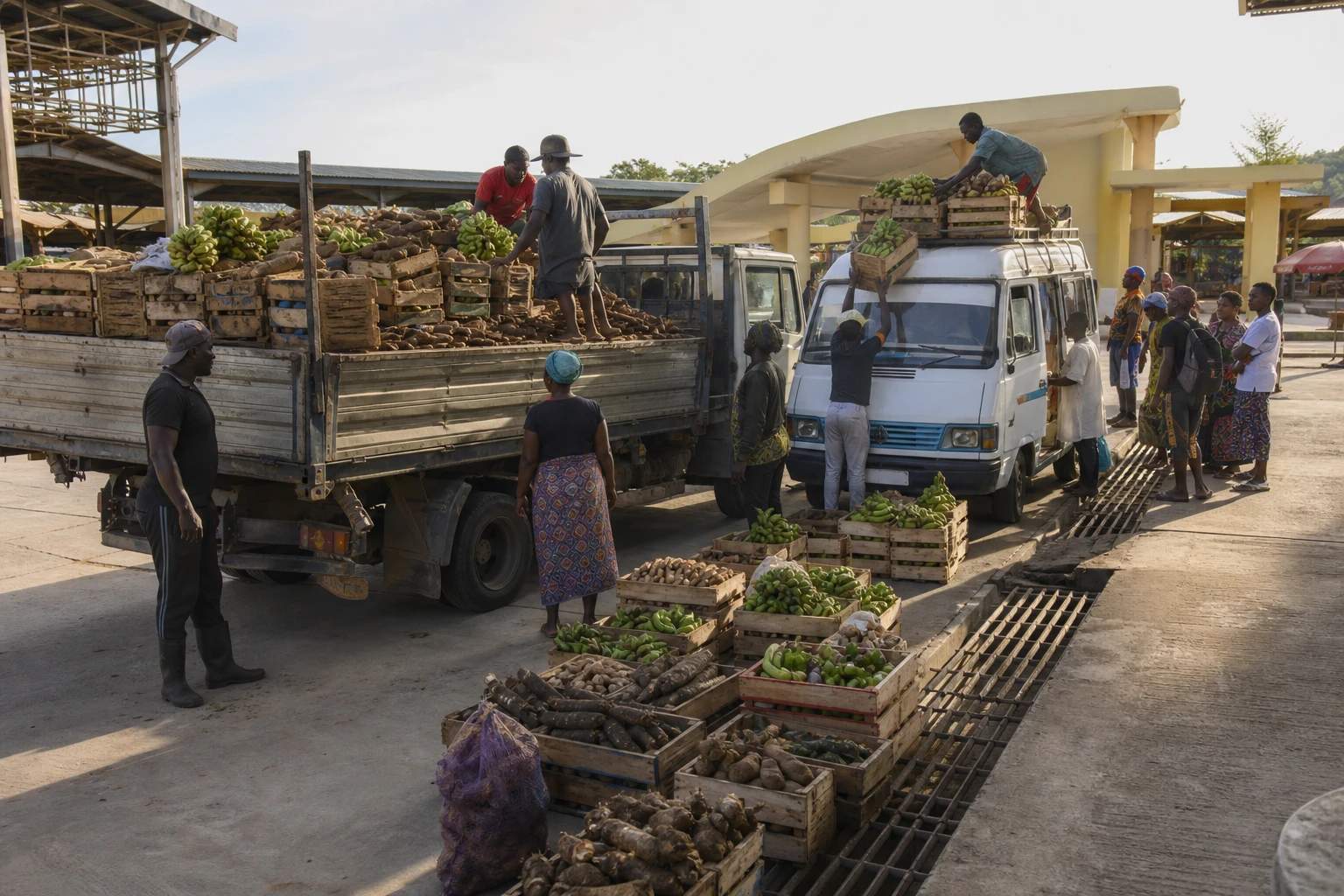
Between a producer based in a rural area and a consumer in Abidjan, food products still pass through several channels. This succession of intermediaries, transport difficulties and post-harvest losses can affect both farm incomes and the prices paid at market.
Ivory Coast is therefore seeking to organise this supply chain more effectively. The project is not limited to building infrastructure. It also concerns rules, market management and the role of traders who buy produce directly at the edge of fields.
A national framework to bring production closer to consumption
On 26 September 2020, a workshop overseen by the Ivorian ministry responsible for trade approved several texts and tools designed to structure local markets. These spaces are intended to collect, consolidate, store and redistribute food products close to production areas.
Among the documents approved was a preliminary bill on the organisation of food-product marketing. A draft interministerial decree was also intended to give regional prefects additional means to oversee certain trading practices, including “field-side” purchases, meaning transactions concluded directly at the place of production.
The initiative also provided for common statutes and internal rules for local markets. Their management was to be entrusted to a specialised national company. An administrative and financial procedures manual, as well as an operating guide, were incorporated into the scheme.
The chosen business model was based on self-financing. In practice, revenue from commercial activities is expected to help cover the markets’ day-to-day running costs. This approach aims to limit long-term dependence on public funding, while raising a central question: how can costs be kept affordable for small-scale producers and traders?
The “Food security from farm to fork” programme — officially launched in November 2024 with the Office for the Marketing of Food Products and LadyAgri — extends this approach through digitalisation, networking among stakeholders and capacity-building for women working in food supply chains. The Ivorian government presents the SAFAF programme as a tool for strengthening the resilience of food supply chains.
Infrastructure to cut losses and distances
The legal framework accompanies a broader infrastructure programme. The Ivorian state plans to build 155 local markets, with an announced investment of about 20 billion CFA francs. The first phase covers 40 markets, followed by two further rounds of 50 and then 65 facilities.
The launch of this first phase was announced as part of the government’s Social Programme. Its cost was estimated at 6.2 billion CFA francs. The aim is to create collection and consolidation points capable of supplying wholesale and retail markets in the main centres of consumption.
Several sites have since begun to be handed over. The local market in Daboré, in the Loh-Djiboua region, was inaugurated on 28 February 2025. The market in Diabo, in the Gbêkê region, was commissioned on 21 March 2025. These facilities include loading areas, offices and storage capacity. The Ivorian trade ministry details progress on the 155-market programme.
At Diabo, the site has an announced storage capacity of about 100 tonnes. It is intended to make it easier to consolidate harvests before they are shipped to urban areas. This role is important for produce grown by numerous smallholders across dispersed plots.
The scheme also provides for transport and handling equipment. Tricycles can collect produce from farms in the first instance. Trucks then take over to transport it to consolidation sites and consumer markets. This arrangement addresses a practical problem: available produce does not automatically become a commercial supply if it cannot be transported quickly.
Balancing regulation with informal activity
Field-side trading already plays a major role in rural Ivory Coast. It enables producers to sell their harvests quickly and women traders to buy directly. However, transactions can take place on unequal terms when producers have little information about prices, available volumes or potential markets.
Better oversight could therefore improve transparency. Information on wholesale, retail and field-side prices can help stakeholders negotiate with greater visibility. The Office for the Marketing of Food Products already provides price data and market updates on Ivorian markets.
Regulation must nevertheless avoid undermining small operators. In many localities, women traders play an essential role in daily supplies. They connect villages, secondary markets and major urban centres. Successful formalisation will therefore require simple rules, accessible spaces and services suited to their financial means.
Storage is also crucial. Without warehouses, cold rooms or processing facilities, producers are often forced to sell immediately, including when supply is abundant and prices are low. Local markets can ease this pressure, but only if their management ensures equipment is maintained and services remain regularly accessible.
For consumers, the expected effect is chiefly greater availability and more regular supplies. For producers, the challenge is to secure better value for their harvests. For local authorities, the aim is to have better-organised markets, with clear rules on use of space, hygiene and the movement of goods.
A policy extending beyond Ivory Coast
The reform aligns with the priorities of the Economic Community of West African States, ECOWAS, which is seeking to strengthen regional trade and food security. Ivorian food products already move to neighbouring countries. Better organisation at home could therefore improve flows to West African markets, provided trade remains fluid.
It also comes as countries in the region seek to reduce their exposure to supply disruptions. Price pressures, logistical difficulties and the effects of climate change are making control of local food supply chains more strategic.
Ivory Coast has an extensive commercial network, but the programme’s success will depend less on the number of buildings than on how they work in practice. It will be necessary to monitor the commissioning of markets, their use by producers, the role given to women traders and changes in post-harvest losses.
The next challenge will therefore be operational: turning these markets into genuine platforms for collection, information and distribution. Along this path, Yamoussoukro and other urban centres will benefit from more regular supplies only if production areas also have suitable transport, storage and marketing solutions.



