Algeria
 Egypt
 Libya
 Morocco
 Sudan
 Tunisia
 Benin
 Burkina Faso
 Cabo Verde
 Ghana
 Guinea
 Guinea-Bissau
 Liberia
 Mali
 Mauritania
 Niger
 Nigeria
 Senegal
 Sierra Leone
 The Gambia
 Togo
 Cameroon
 Central African Republic
 Chad
 DR Congo
 Equatorial Guinea
 Gabon
 Republic of the Congo
 São Tomé and Príncipe
 Burundi
 Comoros
 Djibouti
 Eritrea
 Ethiopia
 Kenya
 Madagascar
 Malawi
 Mauritius
 Mozambique
 Rwanda
 Seychelles
 Somalia
 South Sudan
 Tanzania
 Uganda
 Angola
 Botswana
 Eswatini
 Lesotho
 Namibia
 South Africa
 Zambia
 Zimbabwe
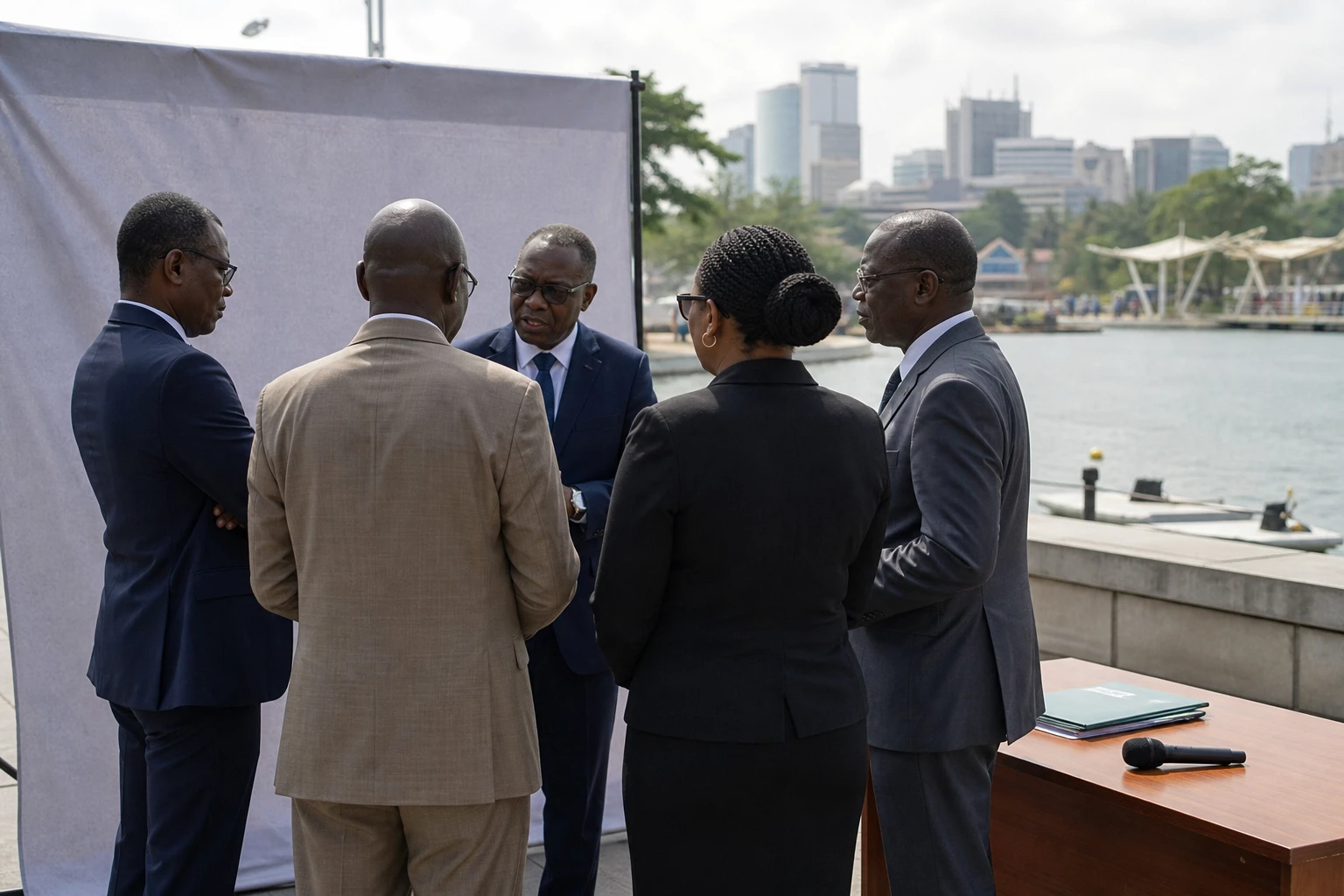
In Abidjan, the Ébrié Lagoon has become the meeting point of two visions of the city. On one side, Plateau municipality wants to turn its waterfront into a leisure area. On the other, the Autonomous District of Abidjan intends to regain control of a site it considers to fall under its authority. In the night of 11 to 12 September 2026, this administrative rivalry reached a new stage.
A strategic waterfront at the heart of the business district
The area concerned lies between the Félix-Houphouët-Boigny and General de Gaulle bridges. It runs alongside Plateau, the administrative, financial and commercial centre of Côte d’Ivoire’s economic capital. The area opens directly onto the Ébrié Lagoon, one of Abidjan’s defining urban features.
For several years, the authorities have sought to improve the organisation of the lagoon waterfront. The stated aim is twofold: to improve living conditions and make better use of highly sought-after public land. These areas can accommodate promenades, cultural spaces, commercial activities or leisure facilities.
But their management involves several levels of government. The municipality administers its territory and carries out local projects. The Autonomous District of Abidjan, meanwhile, coordinates policies across the metropolitan area. This overlap can make the division of responsibilities unclear, especially when competing projects are planned for the same space.
Municipal installations destroyed overnight
In the night of Friday 11 to Saturday 12 September 2026, an operation targeted some of the installations built or under construction on Plateau’s lagoon promenade. The municipality says District machinery destroyed several facilities intended for leisure and family activities.
The site included facilities associated with the Oxy Park II area, as well as installations planned for playgrounds, dining areas and places to relax. The municipality estimates that the destroyed works were worth several hundred million CFA francs. At a press briefing on 24 September, however, Mayor Jacques Gabriel Ehouo cited an investment of more than one billion CFA francs for a project that was, he said, about 90% complete.
These figures differ from the initial estimates provided by the municipality. They should therefore be treated as political and administrative estimates until an independent audit or detailed contractual document establishes them.
Jacques Gabriel Ehouo denounces an operation carried out without the municipality’s prior agreement. He is calling for the destruction to stop, the damage to be repaired and the installations to be rebuilt. The municipality has also announced that it will approach the competent authorities and pursue an administrative appeal.
The District offers a different account. In its statement, it describes the operation as an effort to “clear, sanitise and develop” the lagoon bay. It says it wants to clear public land that has been occupied irregularly and prepare an overall project for the area.
A dispute over powers that goes beyond urban planning
The disagreement is therefore not only about destroyed facilities. It also concerns each institution’s ability to decide the future of a site in the heart of Abidjan.
The Autonomous District of Abidjan justifies its action on the grounds of urban order. The term refers to efforts to tackle unauthorised occupation, makeshift construction and uses deemed incompatible with public planning. Plateau municipality, for its part, rejects the idea that its installations could be equated with anarchic occupation.
This divergence reveals a longstanding difficulty in Côte d’Ivoire’s decentralisation. Municipalities have their own responsibilities, while the District carries out projects at metropolitan scale. When both levels act on the same site, consultation is essential. Without it, a project presented as an improvement to the area can quickly become an institutional dispute.
The precedent matters to residents and businesses in Plateau. Traders, restaurateurs, families and users of public spaces are the first to be affected by changes to the site. Further demolition could disrupt activities, put private investment at risk and reduce access to facilities that have recently opened or been announced.
The issue also concerns public finances. When works funded by one local authority are destroyed by another public authority, the cost goes beyond the damaged materials. It includes studies, contracts, jobs involved and any potential compensation. Without legal clarification, there is a risk of public money being spent repeatedly on the same site.
Political tension amid local realignment
The dispute is also unfolding in a political environment in which officials from different parties hold office. Ibrahim Cissé Bacongo heads the Autonomous District of Abidjan and holds a senior position within the Rally of Houphouëtists for Democracy and Peace, the ruling party. Jacques Gabriel Ehouo heads Plateau municipality under the banner of the Democratic Party of Côte d’Ivoire.
Both officials reject a purely partisan interpretation of the case. The mayor presents the dispute as a matter of legality and respect for local powers. The District emphasises urban order and the transformation of the metropolis. Yet this difference in positions inevitably fuels political interpretations.
Relations between the two administrations have already gone through periods of tension. In July 2025, their exchanges concerned the reorganisation of commercial activities, land management and several renovation projects in the municipality. That episode showed that dialogue remained possible. The overnight destruction denounced by the municipality now puts this approach to cooperation under strain.
A test for the governance of Greater Abidjan
Beyond Plateau, the case raises a central question for urban governance in Côte d’Ivoire: who arbitrates when a municipal project conflicts with a metropolitan vision? The answer will need to combine the law, financial transparency and consultation with the people affected.
The issue is also relevant to the Economic Community of West African States, ECOWAS, because major regional cities face similar challenges. Accra, Lagos, Dakar and Lomé are also seeking to modernise their waterfronts, regulate land occupation and make public spaces more attractive. In each of these cities, however, urban transformation must preserve the continuity of activities and trust between institutions.
The next stage will be legal and administrative. The legal basis for the operation will need to be determined, the true value of the destroyed installations established and the project the District intends to carry out along the waterfront specified. A negotiated solution would avert another confrontation. Above all, it must ensure that Abidjan’s modernisation does not come at the cost of lasting rivalry between its own institutions.