
 Algeria
 Egypt
 Libya
 Morocco
 Sudan
 Tunisia
 Benin
 Burkina Faso
 Cabo Verde
 Côte d'Ivoire
 Ghana
 Guinea
 Guinea-Bissau
 Liberia
 Mali
 Mauritania
 Niger
 Nigeria
 Senegal
 Sierra Leone
 The Gambia
 Togo
 Cameroon
 Central African Republic
 Chad
 DR Congo
 Equatorial Guinea
 Gabon
 Republic of the Congo
 São Tomé and Príncipe
 Burundi
 Comoros
 Djibouti
 Eritrea
 Ethiopia
 Kenya
 Madagascar
 Malawi
 Mauritius
 Mozambique
 Rwanda
 Seychelles
 Somalia
 South Sudan
 Tanzania
 Uganda
 Angola
 Botswana
 Eswatini
 Lesotho
 Namibia
 Zambia
 Zimbabwe
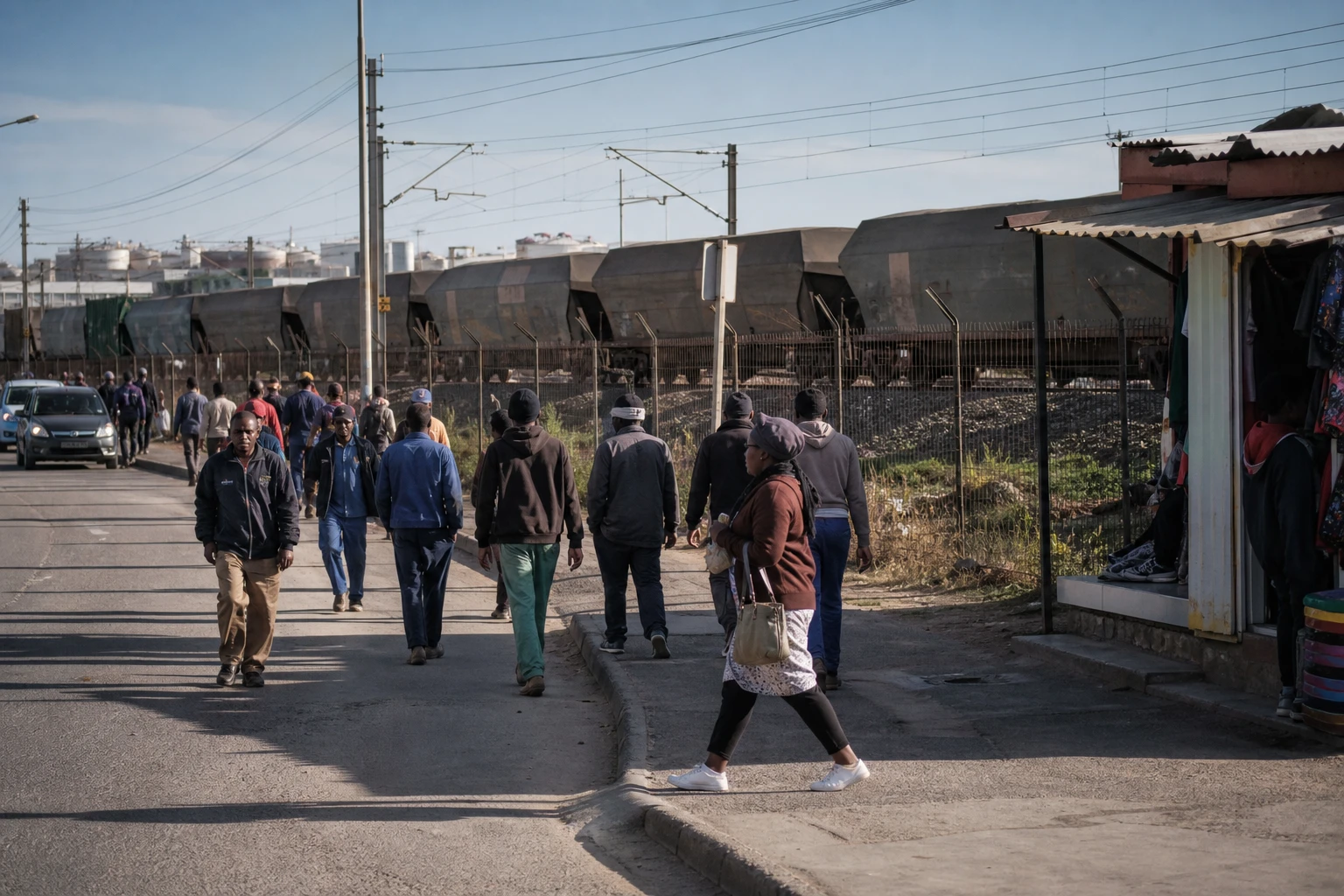
For South Africa, manganese has become a real-world test of logistics reform. The country has abundant resources and a strong global market, but its exports are still held back by a saturated rail network and ports under pressure.
A strategic corridor between the mines and the ocean
State-owned group Transnet launched a selection process on 23 September 2026 to find a private partner to help modernise the Ngqura manganese export corridor. The infrastructure links mining areas in the Northern Cape to the Port of Ngqura, in the Eastern Cape province, near Gqeberha.
The project concerns a rail route of about 1,100 kilometres. It is to cover track rehabilitation, rolling stock management, and the construction and operation of a new port terminal dedicated to manganese.
Transnet has budgeted between 30 billion and 44 billion rand, or about $1.83 billion to $2.68 billion. The proposed partnership could run for 25 years. The future terminal is expected to handle about 14.7 million tonnes a year in its first phase, with capacity set to increase depending on demand and investment.
The process launched in September is a first step. Interested companies must first demonstrate their financial, technical, legal and operational capabilities. Shortlisted candidates will then take part in a more detailed tender process.
The paradox of a mining giant constrained by its railways
South Africa has about 70% of the world’s known manganese resources. It is also one of the leading producers and exporters of the ore, which is used mainly in steelmaking. Manganese is also used in some battery technologies and in the production of metal alloys.
Export figures illustrate the sector’s potential. According to the Minerals Council South Africa statistical report, the country is estimated to have exported about 26.2 million tonnes of ore in 2025, compared with 22.3 million tonnes in 2024. This estimate is based in part on customs data for the first 11 months of 2025, annualised by the mining industry body.
Rising volumes are, however, putting greater pressure on the logistics chain. The mines in the Northern Cape are far from the ports. When rail does not operate at full capacity, companies rely more heavily on road transport. This is more expensive over long distances and increases heavy goods vehicle traffic around industrial and port routes.
The problem therefore extends beyond mining companies. It also affects transport operators, communities along the corridors and logistics workers. In rural areas of the Northern Cape, delays can make shipments less regular. In the Eastern Cape, the smooth operation of the port determines activity at industrial hubs and related services.
Transnet gradually opens its network to private operators
The Ngqura project is part of a wider reform of South Africa’s rail freight system. For decades, Transnet controlled both the infrastructure and network operations. The government is now seeking to bring in more private operators, while retaining public control over the tracks and access rules.
In May 2026, Transnet Rail Infrastructure Manager, the entity responsible for managing network access, announced agreements with 11 private rail freight companies. These operators are expected to provide an additional capacity of 24 million tonnes. The potential could reach 52 million tonnes over the next five years.
This opening does not mean the problems have been resolved. New operators will need locomotives, wagons, reliable slots and clear safety rules. They will also depend on the condition of the tracks and coordination with port terminals. Without major infrastructure investment, competition between operators risks shifting bottlenecks rather than eliminating them.
The South African government is aiming for a significant increase in the volume of goods carried by rail by the end of the decade. The Ngqura corridor is therefore intended to serve both as a mining project and as a test case for this new organisation of freight transport.
An industrial issue beyond raw exports
Modernising the corridor could strengthen South Africa’s position in the Asian market. About 95% of South African manganese exports went to Asia in 2025, with China alone accounting for nearly 68% of volumes, according to the Minerals Council South Africa.
This trade dependence gives infrastructure reliability particular importance. Buyers want regular volumes, predictable delivery times and controlled costs. A failing network can therefore lead to lost market share, even when the ore remains competitive in terms of quality.
The project also raises a question of industrial policy. South Africa mainly exports raw ore. Yet more efficient logistics could underpin a more ambitious strategy combining extraction, metallurgical processing and the development of new uses for manganese. This shift will, however, depend on available electricity, industrial investment and global demand.
The corridor’s regional significance
The project is also of interest to the Southern African Development Community, SADC, which includes South Africa, Namibia, Botswana, Mozambique and Zambia, among others. In the region, rail and port corridors play a central role in linking landlocked mining areas to international markets.
A lasting improvement to South Africa’s network could ease pressure on some road routes and strengthen complementarity between southern Africa’s ports. It could also serve as a model for other reforms based on third-party access to public infrastructure.
The next milestones will be the selection of candidates and then the conclusion of the partnership. The outcome will depend as much on financing as on the timetable for works, corridor governance and the ability to guarantee fair access for different users. For Pretoria, the stakes go beyond manganese: the aim is to restore the credibility of a logistics system essential to national competitiveness.



