Algeria
 Egypt
 Libya
 Morocco
 Sudan
 Tunisia
 Benin
 Cabo Verde
 Côte d'Ivoire
 Ghana
 Guinea
 Guinea-Bissau
 Liberia
 Mali
 Mauritania
 Niger
 Nigeria
 Senegal
 Sierra Leone
 The Gambia
 Togo
 Cameroon
 Central African Republic
 Chad
 DR Congo
 Equatorial Guinea
 Gabon
 Republic of the Congo
 São Tomé and Príncipe
 Burundi
 Comoros
 Djibouti
 Eritrea
 Ethiopia
 Kenya
 Madagascar
 Malawi
 Mauritius
 Mozambique
 Rwanda
 Seychelles
 Somalia
 South Sudan
 Tanzania
 Uganda
 Angola
 Botswana
 Eswatini
 Lesotho
 Namibia
 South Africa
 Zambia
 Zimbabwe
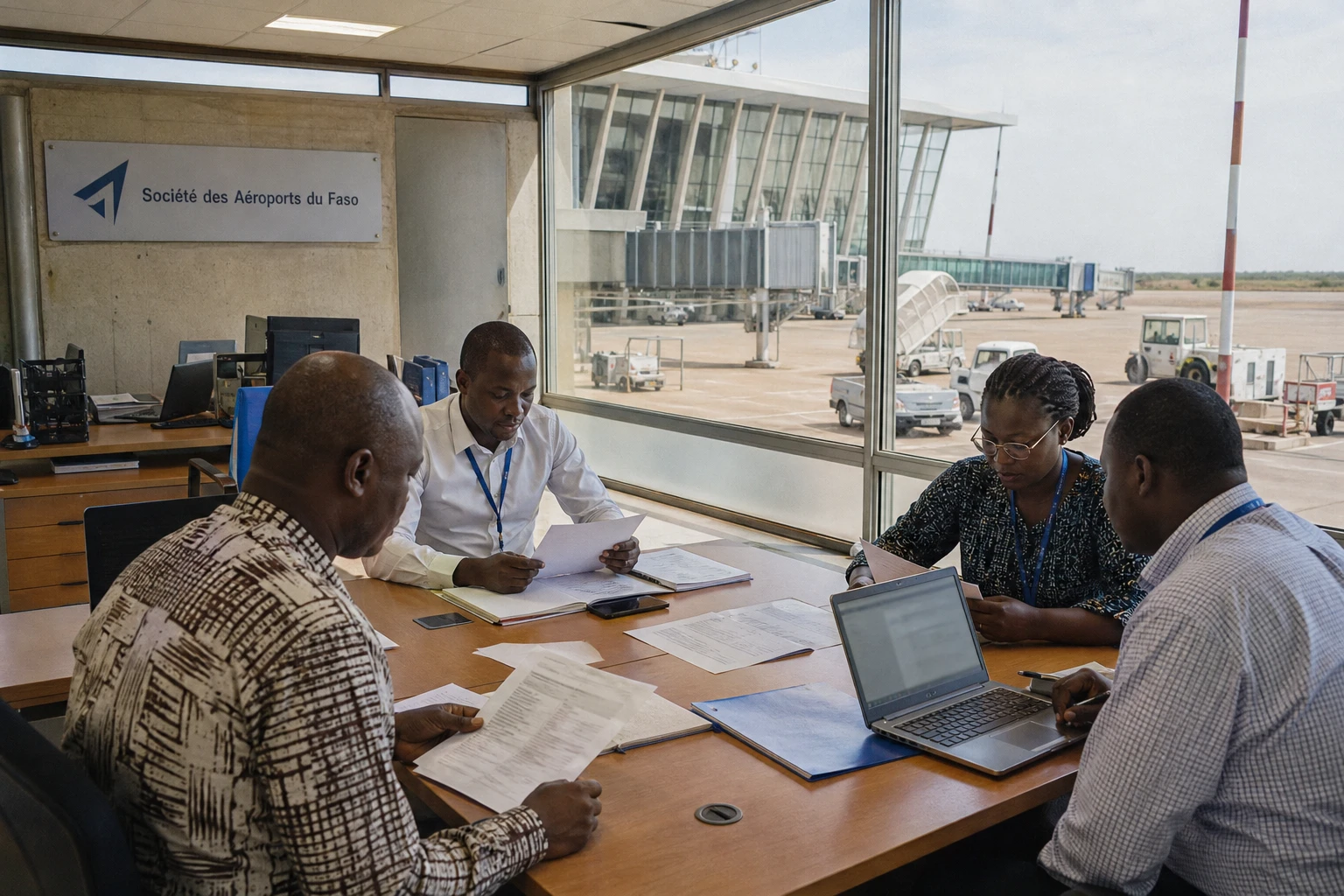
In Ouagadougou, modernising air transport is no longer just about runways or terminals. It also depends on how information circulates between teams, how operations are monitored and how decisions are documented. It is in this context that the Société des Aéroports du Faso is testing a new digital platform designed to strengthen the management of airports in Burkina Faso.
A tool to improve operational coordination
On the sidelines of the 35th annual general assembly of Airports Council International Africa, SAFA signed a memorandum of understanding with ACI Africa and German software publisher BARTHAUER Software GmbH. The agreement opens a pilot phase for SACOS, or Smart Airport Certification and Operations Software, a programme designed for the certification and operation of airport facilities.
The meeting took place in Abuja, Nigeria, from 19 to 25 September 2026. ACI Africa, which represents the interests of the continent’s airports, themed this edition around next-generation infrastructure, performance and resilience.
The pilot phase is intended to allow SAFA to assess the solution in real or representative conditions. The aim is to measure its usefulness for monitoring activities, coordinating services, managing procedures, tracking interventions and checking compliance with safety requirements.
The platform is designed, in particular, to centralise data relating to infrastructure, runways, terminals, inspections and technical documents. It can also operate offline, an important feature for teams working in areas where internet connectivity remains unreliable.
The test does not yet amount to definitive adoption. SAFA will need to check whether the tool meets its procedures and operational needs and is compatible with the systems already in use. It will also have to assess requirements for training, technical support and maintenance.
A step in the sector’s reorganisation
The trial comes as Burkina Faso redefines the governance of its aviation infrastructure. Since 1 January 2026, the Société des Aéroports du Faso has been described as the country’s sole airport operator. This change gives the state-owned company a central role in the operation, development and upgrading of national airport facilities.
The transformation concerns Ouagadougou International Airport first, but does not stop there. It also affects regional facilities, notably Bobo-Dioulasso airport, as well as infrastructure intended to support future growth in traffic.
For a landlocked country such as Burkina Faso, air connectivity is an important logistical asset. It facilitates business travel, trade and links with West African capitals. It can also reduce the isolation of some economic activities when land corridors become longer or more difficult to secure.
The country is, however, operating in a complex regional environment. Burkina Faso, Mali and Niger have announced their withdrawal from the Economic Community of West African States, ECOWAS, an organisation tasked in particular with promoting economic integration and free movement in the region. This new configuration requires transport operators to preserve useful links despite institutional changes and uncertainty over regional mechanisms.
Donsin and Air Burkina give the project wider significance
Digitising airport management is part of a broader undertaking. The Donsin International Airport project is intended gradually to replace the Ouagadougou facility, which was built in the 1960s. The project’s first phase is planned to provide capacity for about one million passengers a year, according to public documents on the infrastructure.
Donsin will be more than a new airport. It will also need to operate as a coordinated system, with clear procedures, clearly allocated responsibilities and information available at the right time. In this context, a digital management tool can help track inspections, incidents, equipment and maintenance operations.
SAFA describes Donsin as a facility intended gradually to strengthen Burkina Faso’s international openness and its role in regional exchanges. The project’s success, however, will depend as much on day-to-day organisation as on the construction of buildings and runways.
The national carrier is the other strand of this restructuring. The revival of Air Burkina is intended to restore a regular service after a period marked by operational and financial difficulties. New aircraft and more structured airport management could improve the continuity of routes. However, they will not be enough without strong coordination between the airline, airports, security services, civil aviation authorities and service providers.
The challenge will be as much human as technological
The main challenge for the SACOS project lies not only in its features. It also lies in whether teams adopt it. A platform can centralise data without improving operations if staff do not have appropriate training, reliable access and shared procedures.
Continuity will also be critical. Airports must be able to maintain operations in the event of a breakdown, internet outage or difficulty accessing servers. Offline functions can reduce this risk, but they require strict rules for synchronisation and backup.
Data protection also requires particular attention. Airport information concerns security, equipment, movements and internal procedures. Its hosting, access and sharing will therefore need to be governed by clearly defined responsibilities.
A signal watched by other African airports
Burkina Faso is not the only African country seeking digital tools to professionalise the management of its airport facilities. SACOS is also presented as a solution for other airports on the continent, notably in Tunisia and Senegal. This trend reflects a broader shift: African airports are seeking to improve performance without relying solely on expanding infrastructure.
For SAFA, the pilot’s results will help determine whether the solution can be extended to other airports in Burkina Faso. The next steps will therefore be closely watched: the technical assessment of the trial, staff training, integration with existing systems and coordination with Donsin’s gradual commissioning.
Ultimately, success will be measured less by the launch of the software than by its practical effects: better-tracked interventions, better-documented inspections, more responsive services and more reliable information for travellers and airlines alike. Only then can digital technology become a genuine tool of operational sovereignty for air transport in Burkina Faso.