Algeria
 Egypt
 Libya
 Morocco
 Sudan
 Tunisia
 Benin
 Burkina Faso
 Cabo Verde
 Côte d'Ivoire
 Ghana
 Guinea
 Guinea-Bissau
 Liberia
 Mali
 Mauritania
 Niger
 Nigeria
 Senegal
 Sierra Leone
 The Gambia
 Togo
 Cameroon
 Central African Republic
 DR Congo
 Equatorial Guinea
 Gabon
 Republic of the Congo
 São Tomé and Príncipe
 Burundi
 Comoros
 Djibouti
 Eritrea
 Ethiopia
 Kenya
 Madagascar
 Malawi
 Mauritius
 Mozambique
 Rwanda
 Seychelles
 Somalia
 South Sudan
 Tanzania
 Uganda
 Angola
 Botswana
 Eswatini
 Lesotho
 Namibia
 South Africa
 Zambia
 Zimbabwe
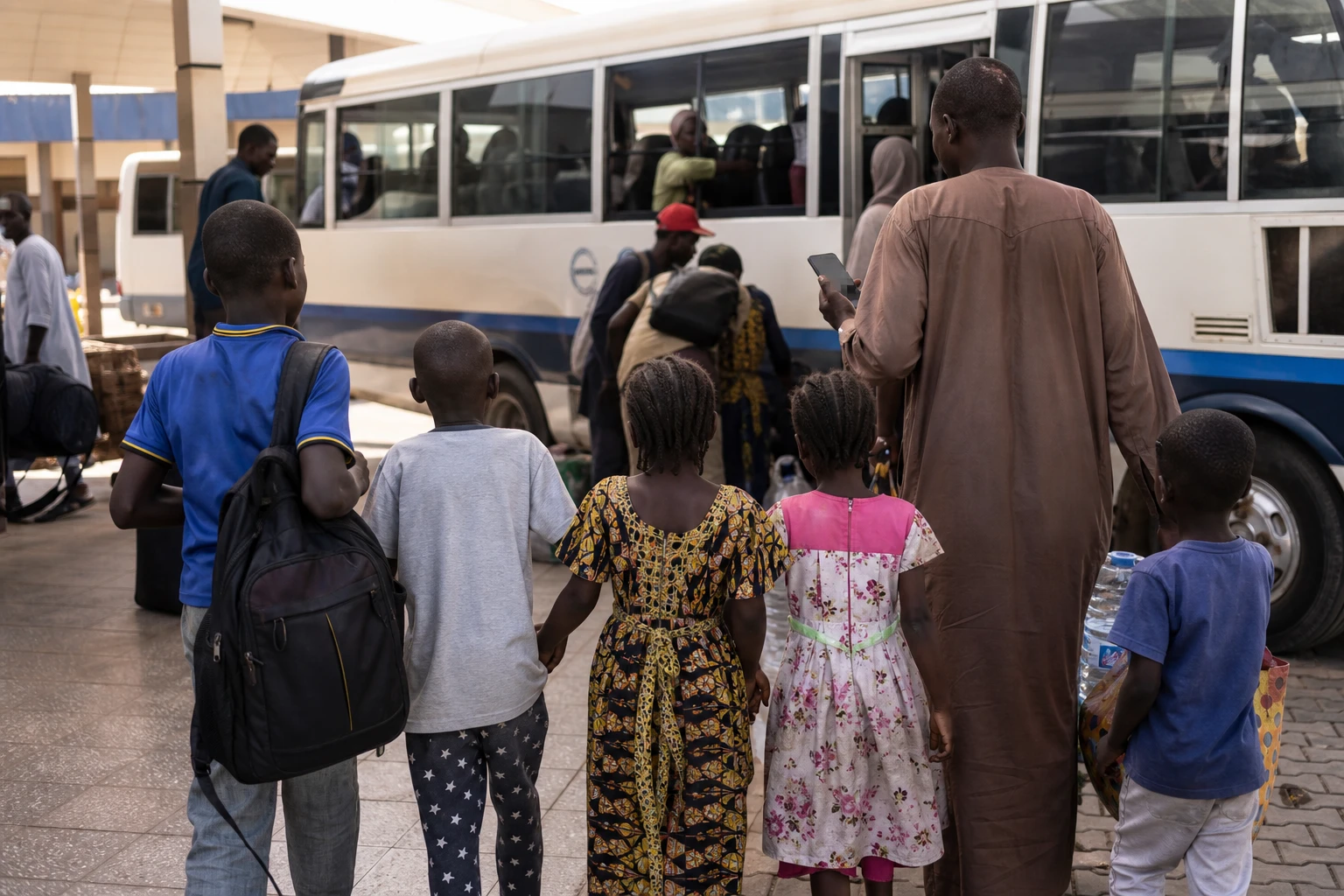
In N’Djamena, a video filmed with five children quickly spread beyond social media. Wearing military-style clothing, the minors criticise the country’s management and address President Mahamat Idriss Déby directly. Their questioning has raised a sensitive issue: how can children be protected while responding to remarks the prosecutor’s office considers potentially dangerous to public order ?
A video becomes a judicial case
The N’Djamena court prosecutor’s office confirmed on 24 September 2026 that five minors had been detained and questioned. The announcement came after a clip went viral on Chadian social media.
In the video, the children wear uniforms resembling those of the Chadian army. They also display ranks and insignia. Facing the camera, they address the head of state and mention several everyday difficulties: governance, access to water, electricity and healthcare.
They also discuss Chad’s relations with the United Arab Emirates and the treatment of opponents. The video alone does not, however, establish who made it, in what context, or whether the children spoke on their own initiative.
According to Moussa Abdelkerim Saleh, the public prosecutor at the N’Djamena High Court, some remarks could be considered “incitement to rebellion against the institutions”. The prosecutor’s office says the minors were questioned by the judicial police in the presence of their parents.
The magistrate also stressed the need to take their age into account. In his view, their status as minors requires special protection, without ruling out any responsibility if a child has been used for purposes contrary to the law. The prosecutor’s office therefore says it is seeking a balance between protecting minors and maintaining public order.
At this stage, no public information establishes that the five children have been charged, detained or referred to a court. The announced investigation is intended in particular to establish the circumstances in which the video was filmed and whether adults were involved.
Child protection at the centre of the debate
The case has prompted reactions because it brings together three distinct issues. The first concerns the video’s political content. The second is the wearing of military uniforms by minors. The third concerns how the justice system treats children in a case attracting considerable public attention.
For Mahamat Nour Ibedou, secretary-general of the Chadian Convention for the Defence of Human Rights, the judicial response appears disproportionate. He believes the children’s remarks should not automatically be equated with an attempt to overthrow the institutions.
This reaction reflects broader concern within Chadian civil society. In a public sphere where political criticism can quickly become a security matter, the questioning of minors is seen by some rights advocates as another sign of a hardening climate.
The prosecutor’s office, for its part, does not present the case as a simple expression of political views. It emphasises the possibility that the children were being exploited. This caution matters: adults may have staged the children, who may not have understood the consequences of their words or the significance of their uniforms.
The next steps in the proceedings will therefore have to distinguish between the different parties’ responsibilities. If an adult devised the video, provided the clothing or dictated the words, their potential involvement should not be assessed in the same way as that of the children filmed. This distinction is essential to ensure that an investigation into a staged video does not turn into a punishment directed primarily at minors.
An episode against a backdrop of political tension
The debate comes amid a national context marked by the end of the transition that began after the death of Idriss Déby Itno in April 2021. His son, Mahamat Idriss Déby, then took the helm of a Transitional Military Council before winning the May 2024 presidential election, according to the results proclaimed by the authorities.
This trajectory has left considerable sensitivity around questions of dissent, political succession and control of the public sphere. The Chadian authorities must also contend with tensions linked to insecurity in border areas, particularly around the Lake Chad basin and the eastern border with Sudan.
In this context, the term “rebellion” carries particular weight. Chad has experienced several decades of armed conflict and changes of power by force. However, this history cannot justify automatically treating all criticism as a military threat. The justice system will have to establish specific facts rather than rely solely on the impact of the video.
The issue also has a regional dimension. Chad belongs to the Economic and Monetary Community of Central Africa, or CEMAC, which brings together six states that share, among other things, a common currency and economic cooperation mechanisms. It also plays an important security role in the Lake Chad region and the central Sahel.
What the investigation will have to clarify
Several questions remain unanswered. Who organised the filming ? Did the uniforms come from an actual unit, or were they similar-looking clothing ? Did the children write their statements themselves ? Were their parents with them throughout the proceedings ? Finally, what protective measures will be offered to them ?
The authorities’ response will be watched beyond N’Djamena. A transparent process could reaffirm that child protection remains a priority, even when images become politically embarrassing. Conversely, a response seen as excessive would strengthen criticism of the limits placed on public expression in Chad.
The next step will therefore be less about the video’s virality than the investigation’s findings. These will need to specify the alleged acts, identify any adults involved and indicate the judicial status of the five minors. Only on that basis, and not on the images shared online alone, will it be possible to assess the case’s true significance.