
 Algeria
 Egypt
 Libya
 Morocco
 Sudan
 Tunisia
 Benin
 Burkina Faso
 Cabo Verde
 Côte d'Ivoire
 Guinea
 Guinea-Bissau
 Liberia
 Mali
 Mauritania
 Niger
 Nigeria
 Senegal
 Sierra Leone
 The Gambia
 Togo
 Cameroon
 Central African Republic
 Chad
 DR Congo
 Equatorial Guinea
 Gabon
 Republic of the Congo
 São Tomé and Príncipe
 Burundi
 Comoros
 Djibouti
 Eritrea
 Ethiopia
 Kenya
 Madagascar
 Malawi
 Mauritius
 Mozambique
 Rwanda
 Seychelles
 Somalia
 South Sudan
 Tanzania
 Uganda
 Angola
 Botswana
 Eswatini
 Lesotho
 Namibia
 South Africa
 Zambia
 Zimbabwe
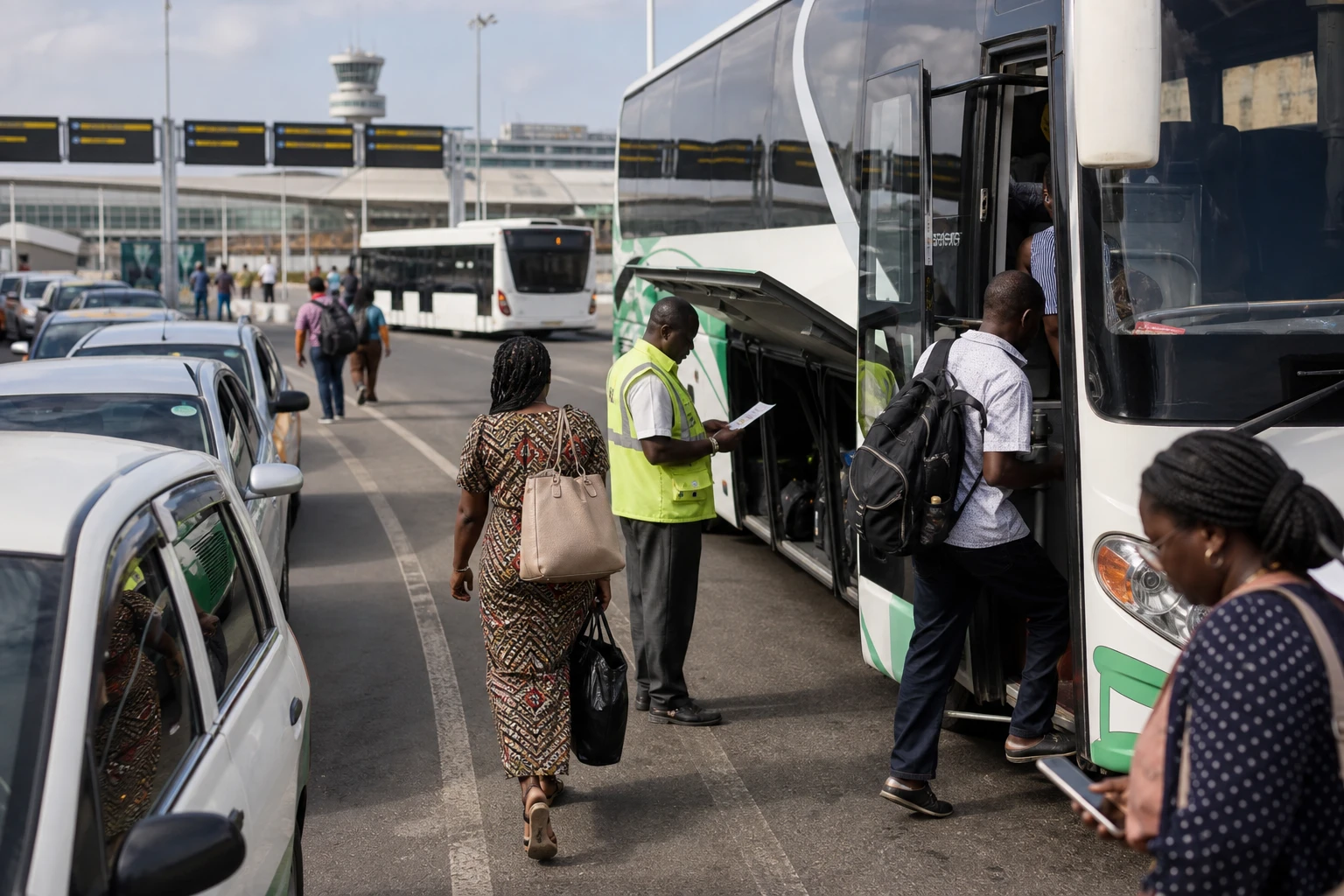
In Ghana, the debate over airfares is taking on a new dimension. The government is easing some of the costs borne by airlines while asking carriers to pass those savings on to passengers. The stakes go beyond lower fares: they concern Ghanaians’ mobility, Accra’s competitiveness and West Africa’s air connectivity.
Airlines urged to cut fares after maintenance costs fall
Ghana’s Transport Minister, Joseph Bukari Nikpe, has called on airlines to reduce their fares. The statement follows the government’s decision to abolish import duties on certain spare parts for aircraft.
The minister said the measure should have a visible effect for passengers. “We want to take this opportunity to call on all airlines, particularly the major domestic airlines, to review their operations and ensure that the Ghanaian traveller benefits from this,” he said, according to Ghanaian media.
The government is focusing in particular on carriers serving domestic routes. Africa World Airlines and PassionAir play an important role in this market, which connects Accra with Kumasi, Tamale, Takoradi and other urban centres. Lower maintenance costs could therefore help improve flight regularity and ease pressure on fares.
But these savings alone are not enough to determine the amount paid at the counter or on a booking platform. Fuel, insurance, salaries, aircraft leasing costs, load factors and airport charges also affect ticket prices.
Fare policy caught between two objectives
Ghana is seeking to modernise its aviation infrastructure. The government wants to strengthen Accra International Airport, develop regional airports and improve the country’s capacity to receive passengers. The airport is a gateway for travellers, businesses, tourism and regional trade.
However, this strategy relies on a new levy. Since 1 April 2026, the Airport Infrastructure Development Charge has been applied to passengers. It provides for a charge of $100 for some international travellers and 100 Ghanaian cedis for domestic passengers, according to details reported by local media.
The authorities present the charge as a funding tool. The proceeds are intended to support projects at Accra International Airport and other airports in the country. Announced investments include terminal upgrades, improvements to parking aprons, the rehabilitation of equipment and infrastructure development in the regions.
The government is therefore pursuing a long-term approach: accepting an additional charge today in order to have more efficient airports tomorrow. For travellers, the calculation is less theoretical. On a domestic route, 100 cedis represents a significant share of the total ticket price. For households, students, traders and workers travelling between regions, the increase could make flying less attractive than road transport.
Parliamentarians and industry professionals have criticised the measure. They fear it could make the Ghanaian market less attractive at a time when the region is seeking precisely to reduce the cost of travel. Airlines, for their part, have said that some charges would be passed directly on to passengers.
ECOWAS reform puts Accra under scrutiny
The issue in Ghana forms part of a broader reform by ECOWAS, the Economic Community of West African States. The regional organisation wants to abolish several taxes on air transport and cut passenger and security charges by 25%.
The reform stems from a shared assessment among industry players: West African airfares remain high, even though distances between regional capitals are often short. ECOWAS believes that taxes, fees and charges can account for a very large share of the final price. They hinder business travel, tourism, trade and family visits.
However, regional implementation has gone through a transitional period. The ECOWAS Commission has strengthened its monitoring with a mechanism to oversee the implementation of the common policy on civil aviation charges, taxes and fees. Ghana has also begun setting up a national committee to implement the regional act adopted by heads of state.
This creates a tension. Accra wants to reduce the costs borne by airlines while also seeking new resources to fund its airports. Consistency between these two objectives will be crucial. Lower duties on spare parts will not have their full effect if new charges significantly increase the final ticket price.
Regional competition is intensifying
Ghana is not the only West African country reviewing its model. Côte d’Ivoire has begun aligning some charges with ECOWAS rules. On routes between member states, passenger and security charges are among those due to fall by 25%.
In Togo, the strategy focuses more on attracting new operators. The authorities have sharply reduced the fees required to set up an airline in the domestic market. The announced cost has fallen from 200 million to 3.5 million CFA francs, a drop of more than 98%.
These choices show that competition is no longer just between airlines. It also involves airports and states. Countries offering predictable costs, simple procedures and reliable infrastructure can attract more routes and passengers.
Ticket prices do not depend on a single decision
Joseph Bukari Nikpe’s appeal raises a practical question: what share of an airline’s savings should go back to passengers? In a competitive market, the answer will depend on the cost structure, the number of operators and demand on each route.
On domestic routes, lower fares could support mobility between Accra and the regions. They could also help businesses maintain travel and allow families to choose air transport to save time. But if competition remains limited, abolishing a customs duty does not automatically guarantee an equivalent reduction in fares.
At regional level, ECOWAS will therefore need to monitor two outcomes: whether charges actually fall and whether those reductions are reflected in published fares. The planned launch of the aviation economic monitoring mechanism will be important in this regard.
For Ghana, the next test will be finding the right balance. The country wants to make Accra a more competitive aviation hub, fund its infrastructure and preserve access to transport for its population. Success will depend less on any single measure than on the consistency of the whole approach: taxation, maintenance, competition, airport quality and transparency over how revenues are used.



