Algeria
 Egypt
 Libya
 Morocco
 Sudan
 Tunisia
 Benin
 Burkina Faso
 Cabo Verde
 Côte d'Ivoire
 Ghana
 Guinea
 Guinea-Bissau
 Mali
 Mauritania
 Niger
 Nigeria
 Senegal
 Sierra Leone
 The Gambia
 Togo
 Cameroon
 Central African Republic
 Chad
 DR Congo
 Equatorial Guinea
 Gabon
 Republic of the Congo
 São Tomé and Príncipe
 Burundi
 Comoros
 Djibouti
 Eritrea
 Ethiopia
 Kenya
 Madagascar
 Malawi
 Mauritius
 Mozambique
 Rwanda
 Seychelles
 Somalia
 South Sudan
 Tanzania
 Uganda
 Angola
 Botswana
 Eswatini
 Lesotho
 Namibia
 South Africa
 Zambia
 Zimbabwe
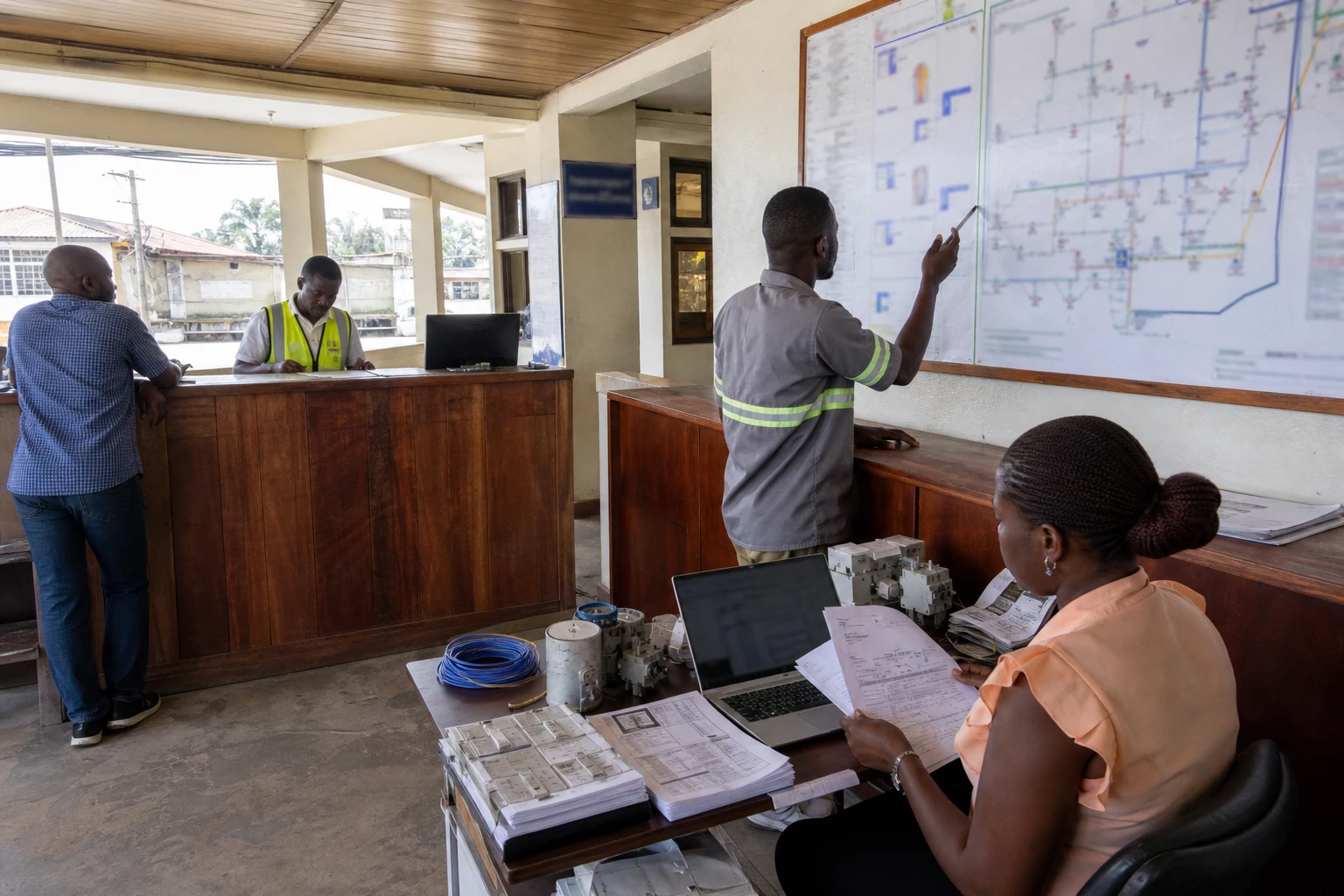
In Monrovia, the debate about electricity is no longer just about the number of connections. It is now about Liberia’s ability to provide reliable, affordable power that is distributed widely enough to support its economy. The country says national access has reached 39 %, but the gap with the 75 % target set for 2030 remains significant.
Real progress, but still highly uneven
Daniel Sanoe, deputy minister responsible for press at Liberia’s Ministry of Information, announced the rate in Monrovia on 22 September 2026. According to the government, access has risen from 32 % at the start of President Joseph Boakai’s administration in January 2024.
This official estimate is higher than the latest available figure from the World Bank. The bank puts electricity access at 34.9 % of the population in 2024, up from 32.5 % in 2023. The difference may be explained by distinct reference dates or calculation methods. Above all, it is a reminder that indicators should be compared with caution.
The national average also masks a marked geographical imbalance. The grid remains concentrated around Monrovia and the main urban centres. Access is far lower in rural areas. Liberia’s National Energy Compact states that more than half of the urban population has electricity, compared with less than 10 % in rural areas.
This divide directly affects households, schools, health centres and small businesses. It also affects agricultural and commercial activities that need a stable power supply to store, process or sell their products.
The Mission 300 bet
The Liberian government has included its target in Mission 300, an initiative led by the World Bank and the African Development Bank to connect 300 million Africans to electricity by 2030.
Liberia’s plan calls for an average of 100 000 households to be connected each year. About 60 000 connections are expected to come through the conventional grid, 15 000 through mini-grids and 25 000 through off-grid solutions, including individual solar systems.
This approach reflects the country’s geography. Much of the population lives in a limited number of urban centres, while the rest is scattered across numerous communities. In these areas, extending the national grid can be costly and time-consuming. Mini-grids and solar equipment therefore offer a faster solution for some villages and small towns.
The compact also aims to increase the share of renewables in the electricity mix to 75 % by 2030. It includes plans to develop hydropower, solar power and associated storage systems.
Generation is growing, but the grid remains under pressure
Liberia has already increased its generation capacity. On 5 June 2026, President Joseph Boakai inaugurated a 20 MW solar power plant at the Mount Coffee hydropower complex. A damaged turbine, which had cut output by about 22 MW, was also brought back into service.
The restoration of the turbine and commissioning of solar power at Mount Coffee strengthen the country’s generation base. In August 2026, the Liberia Electricity Regulatory Commission also granted the Liberia Electricity Corporation, the state-owned company responsible for operating the grid, a licence for the 20 MW solar plant.
These additions do not, however, automatically resolve supply difficulties. Demand is rising as new connections are made. Generation, transmission and distribution must all expand together.
The Liberia Electricity Corporation connected more than 63 000 households in one year, without a corresponding increase in available capacity. This tension between connections and supply can lead to load-shedding: planned power cuts to prevent the system from becoming overloaded.
The solar plant provides useful, but variable, generation. During the rainy season, its output falls because less solar radiation is available. Planning must therefore combine hydropower, solar power, storage and, in the short term, regional imports.
Power lines: the less visible challenge
Generating more power is not enough. Electricity must also be delivered to users. The Liberia Electricity Corporation is therefore considering extending power lines in Lofa and Grand Cape Mount counties.
This work directly concerns people living far from Monrovia. It requires investment in high- and medium-voltage lines, transformers, meters and maintenance. It also calls for a financial model that can support operators when revenues in rural areas remain limited.
The government is seeking, in particular, to mobilise a new agreement with the Millennium Challenge Corporation to fund some of this infrastructure. A possible signing is expected in December 2027. That date is still in the future and will depend on negotiations and project preparation.
Sector reform will also need to address technical and commercial losses. Some of the electricity generated is lost through ageing equipment. Some is not billed or collected. Without better management, every new connection could increase financial pressure on the state-owned company.
A national and West African issue
For Liberia, access to electricity is linked to economic diversification. A more reliable supply can support workshops, digital services, cold chains, health facilities and agricultural processing.
The benefits will not be the same everywhere, however. Formal businesses and neighbourhoods close to the grid will benefit more quickly from new capacity. Rural households and informal businesses will depend more on mini-grids, off-grid solar and tariffs they can afford.
The issue therefore goes beyond Monrovia’s energy policy. Liberia is a member of the Economic Community of West African States (ECOWAS), which promotes electricity trade and interconnections between its members. Imports from Côte d’Ivoire and Guinea can help stabilise supply, but they cannot replace sufficient domestic generation.
The next step will be to determine whether the announced increase to 39 % is accompanied by improved service continuity. To reach 75 % by 2030, Liberia will need to accelerate connections, strengthen its power lines and secure funding for projects. The challenge will not simply be to connect more households, but to provide them with electricity when they need it.