Algeria
 Egypt
 Libya
 Morocco
 Sudan
 Tunisia
 Benin
 Burkina Faso
 Cabo Verde
 Côte d'Ivoire
 Ghana
 Guinea
 Guinea-Bissau
 Liberia
 Mali
 Mauritania
 Niger
 Nigeria
 Senegal
 Sierra Leone
 The Gambia
 Togo
 Cameroon
 Central African Republic
 Chad
 DR Congo
 Equatorial Guinea
 Gabon
 Republic of the Congo
 São Tomé and Príncipe
 Burundi
 Comoros
 Djibouti
 Eritrea
 Ethiopia
 Kenya
 Madagascar
 Malawi
 Mauritius
 Mozambique
 Rwanda
 Seychelles
 Somalia
 South Sudan
 Tanzania
 Uganda
 Angola
 Botswana
 Eswatini
 Lesotho
 Namibia
 Zambia
 Zimbabwe

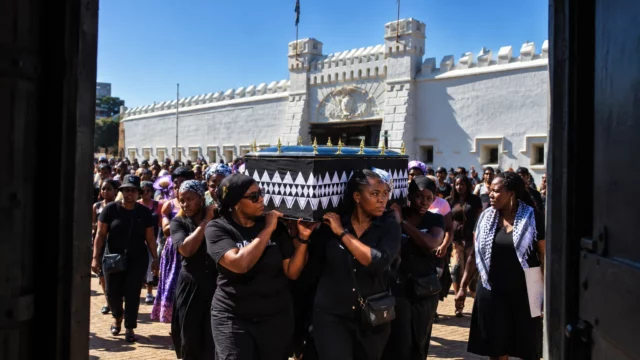
In Kempton Park, in the municipality of Ekurhuleni, families have been living for several weeks with the same fear: could a disappearance herald another grim discovery? Nine women have been found dead over a period of around two months in eastern Johannesburg. Investigators are now trying to establish whether the cases follow the same pattern or involve separate crimes.
A series of discoveries extending beyond Kempton Park
The bodies were found in several parts of Ekurhuleni, including Kempton Park, Rhodesfield, Pomona, Clayville, Olifantsfontein, KwaThema and Dawn Park. This distribution broadens the scope of the investigation. It also serves as a reminder that the places where bodies are found are not necessarily where the victims were killed.
South African police initially reported four bodies discovered around Kempton Park over a period of about two months. They noted troubling similarities: several women had been found partially undressed, with visible signs of violence, in relatively close proximity. At that point, however, the authorities had not confirmed that a serial killer was responsible.
The discovery of a ninth victim on Thursday 17 September 2026 has increased the pressure on investigators. Forensic services still have to determine the precise causes of death and establish any possible links between the different cases. A team comprising several units is working on the case.
The South African police statement says the similarities observed warrant an intensification of the investigation. It also states that the police have not, at this stage, officially attributed the murders to a single perpetrator.
Arrests, but no complete answers yet
On Monday 21 September, two women appeared before the Boksburg Magistrates’ Court in connection with the murder of one of the victims. Police said a third suspect, a man, had also been arrested. The two women, aged 31 and 38 according to information provided to prosecutors, face charges of murder, defeating the ends of justice and possession of a dangerous weapon.
The case was postponed until 1 October 2026, when a possible bail application is due to be considered. These arrests relate to one specific case. They do not yet make it possible to say that the suspects are linked to the eight other deaths reported in the region.
This distinction is essential. In a criminal investigation, geographical proximity, timing and certain similarities can guide police work. On their own, they do not constitute legal proof. South African police still have to compare autopsies, DNA analyses, CCTV footage, telephone communications and the victims’ movements.
The authorities have urged women in Kempton Park and nearby neighbourhoods to take care. They have particularly recommended greater vigilance when walking or taking part in isolated sporting activities. Security operations and roadblocks have also been reported in some areas.
Fear set against a wider crisis
The Kempton Park cases do not in themselves create the issue of violence against women in South Africa. They make it more visible and more localised. Across the country, women’s rights groups have long highlighted the difficulties victims face in reporting violence, obtaining protection and gaining swift access to justice.
The debate is therefore not solely about the possibility of a serial killer. It also concerns the institutions’ ability to detect disappearances, share information between police stations and identify victims quickly. For families, every hour counts. For investigators, early reports can provide crucial information about the routes, associates and last contacts of a missing person.
The South African organisation Missing In Southern Africa, which supports families dealing with disappearances, says there is no mandatory waiting period before reporting someone missing. This reminder is aimed particularly at relatives who sometimes hesitate to go to a police station immediately.
South Africa’s Parliament has also called for an accelerated response to the nine deaths reported in Gauteng province. In a statement published on 21 September, its committee responsible for oversight of the Presidency stressed the need to turn public plans to tackle gender-based violence into concrete measures. The question now is one of implementation: police presence, support for families, forensic analysis and judicial follow-up.
Disproportionate risks in low-income neighbourhoods
Fear is not distributed evenly. Women travelling early in the morning to a railway station, taxi rank or workplace may face greater risks in poorly lit and deserted areas. Workers in the informal economy, who are often required to keep irregular hours, do not always have access to safer alternatives.
In residential neighbourhoods, families may change routes, limit outings or arrange for someone to accompany them. But these individual solutions have their limits. They are no substitute for reliable transport, safe public spaces or a swift judicial response. They can also shift the burden of prevention onto women themselves, even though primary responsibility lies with the perpetrators and the institutions tasked with protecting the public.
A case being followed beyond Gauteng
The case is a national issue because it touches on trust in the police and the justice system. It is also a regional one. South Africa occupies a central place in southern Africa and within the Southern African Development Community, SADC, which brings several countries together for political and economic cooperation.
The authorities will need to avoid two pitfalls. The first would be to confirm too quickly that a serial killer is responsible, risking damage to the investigation and fuelling accusations without evidence. The second would be to treat the deaths as a mere succession of isolated news events, without examining any common failings.
The next steps will be decisive: autopsy results, identification of any victims who remain unknown, the Boksburg court’s decision on 1 October and any further arrests. For the families, the issue goes beyond the number of open cases. It is about whether every disappearance was taken seriously, whether every victim will be identified and whether those responsible can be held accountable in court.