Algeria
 Egypt
 Libya
 Morocco
 Sudan
 Tunisia
 Benin
 Burkina Faso
 Cabo Verde
 Côte d'Ivoire
 Ghana
 Guinea-Bissau
 Liberia
 Mali
 Mauritania
 Niger
 Nigeria
 Senegal
 Sierra Leone
 The Gambia
 Togo
 Cameroon
 Central African Republic
 Chad
 DR Congo
 Equatorial Guinea
 Gabon
 Republic of the Congo
 São Tomé and Príncipe
 Burundi
 Comoros
 Djibouti
 Eritrea
 Ethiopia
 Kenya
 Madagascar
 Malawi
 Mauritius
 Mozambique
 Rwanda
 Seychelles
 Somalia
 South Sudan
 Tanzania
 Uganda
 Angola
 Botswana
 Eswatini
 Lesotho
 Namibia
 South Africa
 Zambia
 Zimbabwe
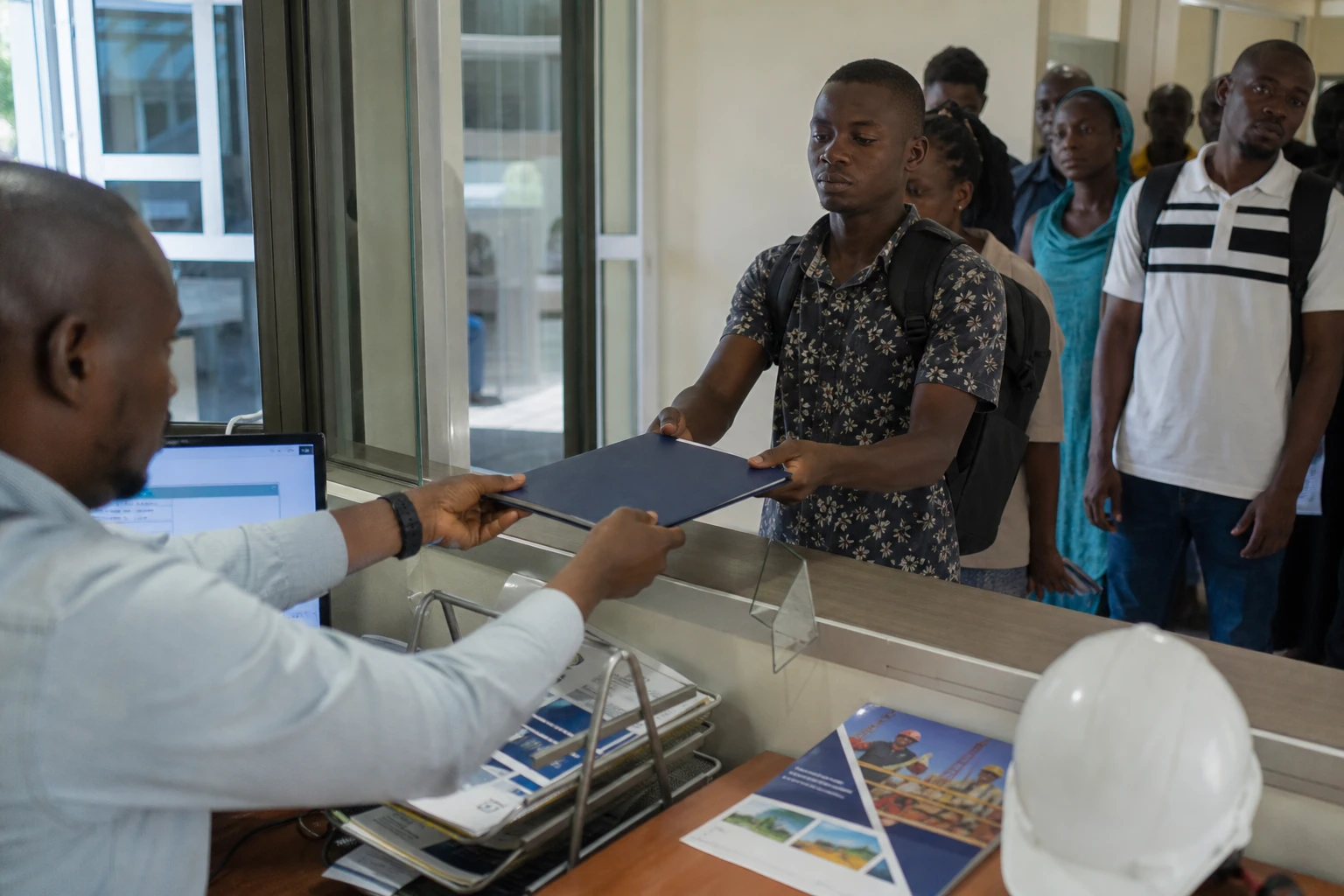
As Simandou enters its production phase, Guinea must answer a decisive question: how can it turn a vast mining construction project into lasting jobs for Guineans? The shift from heavy construction to production will reduce the workforce. It also opens a strategic contest over skills, local contracts and transparency.
The challenge after construction
The Simandou project links iron ore deposits in south-eastern Guinea to the Atlantic coast. Its infrastructure includes mines, a railway more than 600 kilometres long and port facilities. The Compagnie du TransGuinéen, established by the Guinean state and mining partners, is to operate the corridor’s shared infrastructure.
This arrangement gives the project national significance. The TransGuinéen will not be used solely to transport ore. It is also intended to facilitate the movement of passengers and goods in several parts of the country. However, its impact will depend on the ability of Guinean businesses and local workers to secure a place in the value chain.
The first iron ore shipments began at the end of 2025, after several decades of waiting. The start of production marks a turning point. During construction, the project employed more than 60,000 people in 2024 and 2025, according to figures reported by the international business press. In the long term, mining and railway operations are expected to employ fewer than 15,000 people.
The figure illustrates the risk of a “cliff effect”: a sharp fall in employment after the construction peak. Workers involved in earthworks, civil engineering, railway construction and port works will not all be retained. The priority, therefore, is to convert their skills for the permanent jobs required to operate the project.
An obligation enshrined in Guinean law
Guinea already has a legal framework to govern this transition. The Local Content Law, adopted on 22 September 2022, imposes progressive quotas for Guinean staff at companies operating in the country.
From the start of operations, Guineans must account for at least 50% of skilled workers, 25% of supervisory staff and 30% of senior management. Unskilled jobs, meanwhile, must be filled entirely by nationals. These thresholds rise after four years and again after seven years of activity.
The Mining Code also sets specific requirements for mining projects. In the first years of operation, companies must increase the proportion of Guineans among managers, supervisors and skilled workers. The aim is to ensure local content is not limited to manual jobs.
When a company says it cannot find the necessary skills, it must submit a training programme to the Authority for the Regulation and Control of Local Content. The document must provide for the gradual replacement of foreign workers by Guineans. A shortage of skills is therefore not a permanent exemption.
The Guinean Local Content Law sets out these obligations and gives the ARCCL responsibility for monitoring, oversight and evaluation.
Training for the jobs that will remain
The contract worth more than $700 million signed between Wabtec and the Compagnie du TransGuinéen puts training at the heart of railway maintenance. The agreement covers locomotives, spare parts, remote diagnostics and technical assistance. It also includes a component focused on skills development in Guinea.
Locomotive maintenance requires different profiles from those needed during construction. Electricity, mechanics, automation, signalling, data management and logistics are becoming essential. For young people trained in Conakry and in the regions crossed by the railway, these occupations could offer more stable careers than temporary construction jobs.
Wabtec describes the agreement as its largest services contract in Africa. It is worth more than $700 million. Including previously announced locomotive orders, the group’s commitments on Simandou exceed $1.2 billion, according to Wabtec’s official announcement.
The SimFer consortium, led by Rio Tinto on two of the deposit’s four blocks, is also developing technical training programmes. The company has announced an investment of $20.8 million in its Siatouro centres. These facilities are intended to prepare employees for jobs in mining and maintenance.
The question, however, is whether these programmes will meet the needs of the Guinean economy as a whole. Training designed solely for jobs at mining companies risks leaving local businesses behind. Transferable skills, by contrast, could benefit the energy, transport, industrial and digital services sectors.
Measuring the benefits in local communities
Where jobs are located will also be decisive. Skilled jobs must not be concentrated solely in Conakry or in operators’ offices. The prefectures crossed by the TransGuinéen are looking for contracts for their businesses, accessible training and opportunities for their young people.
The effects will vary between categories of workers. Managers may benefit from specialist training and mobility programmes. Construction workers, meanwhile, will need fast-track routes into maintenance, equipment operation and industrial safety. Small suppliers must also be able to access contracts for catering, transport, repairs and equipment supply.
This economic dimension goes beyond the question of wages alone. It concerns the ability of Guinean businesses to retain a share of Simandou’s spending. It also concerns the possibility of creating activity around rail, ports, agriculture, processing and subcontracting.
The government is setting out this ambition as part of Simandou 2040. The Simandou Academy is intended, in particular, to focus on engineering, infrastructure and technology. To become a national tool, the initiative will need to work with universities, vocational training centres and local businesses, not just mining operators.
Transparency will be the next test
The project could substantially increase mining’s weight in the Guinean economy. But higher output alone does not guarantee an increase in household incomes. The jobs created, their quality and their distribution will matter as much as public revenue.
For now, there is still no consolidated public picture of employment at Simandou. Citizens should be able to find out the number of permanent jobs, the proportion held by Guineans and the breakdown between workers, supervisory staff and senior management.
The ARCCL is required to publish reports, conduct audits and issue certificates of compliance. Regular publication of this data would make it possible to check whether local-content commitments are genuinely being met on the ground.
For Guinea, the stakes therefore go beyond the first shipment of ore. They will play out in the coming years, when construction jobs have disappeared and technical occupations remain. Simandou’s success will also be measured by the share of skills, businesses and income that stay in the country.