Algeria
 Egypt
 Libya
 Morocco
 Tunisia
 Benin
 Burkina Faso
 Cabo Verde
 Côte d'Ivoire
 Ghana
 Guinea
 Guinea-Bissau
 Liberia
 Mali
 Mauritania
 Niger
 Nigeria
 Senegal
 Sierra Leone
 The Gambia
 Togo
 Cameroon
 Central African Republic
 Chad
 DR Congo
 Equatorial Guinea
 Gabon
 Republic of the Congo
 São Tomé and Príncipe
 Burundi
 Comoros
 Djibouti
 Eritrea
 Ethiopia
 Kenya
 Madagascar
 Malawi
 Mauritius
 Mozambique
 Rwanda
 Seychelles
 Somalia
 South Sudan
 Tanzania
 Uganda
 Angola
 Botswana
 Eswatini
 Lesotho
 Namibia
 South Africa
 Zambia
 Zimbabwe
In Sudan, the war continues in police stations and prisons
In a country where the front line is constantly shifting, arrest sometimes becomes an extension of the fighting. In Sudan, women caught in areas retaken by the army are now paying the price of a vague accusation: having “collaborated” with the Rapid Support Forces, the RSF, the paramilitary group that has been at war with the Sudanese Armed Forces since April 2023.
The issue goes beyond the criminal question alone. It touches on how the Sudanese state is re-establishing control over cities scarred by fighting, as well as the place afforded to civilians, and especially women, in a conflict where suspicion often takes the place of investigation.
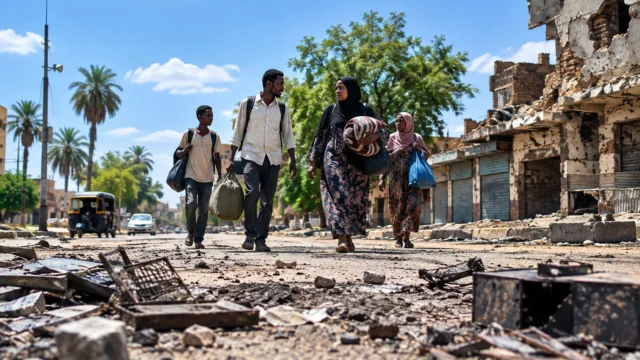
The reported detentions involve several locations, including Omdurman, El-Obeid, Kassala and Al-Qadarif, in a country whose administrative capital remains Khartoum. This geography says much about the conflict: the arrests follow the army’s recapture of territory, particularly in areas previously held by the RSF.
“Collaboration” charges target acts of survival
The women’s rights organisation SIHA says it has recorded nearly 800 women detained in various prisons on this basis. That figure is close to another benchmark cited by human rights defenders: in a February 2026 briefing to the Security Council, SIHA had already referred to more than 840 women arrested by local police and military intelligence in areas controlled by the Sudanese Armed Forces between August 2024 and December 2025. This convergence lends weight to the warning, even if detention locations and exact dates vary between waves of arrests.
The grounds for arrest often appear very broad. Women are said to have been arrested for cooking for fighters, selling tea in the street or trying to secure basic services for their neighbourhood. In one case cited by SIHA, a teacher, Kadamallah Abdel-Ghani, is said to have negotiated with RSF members in Khartoum North to allow water distribution. This kind of conduct is first and foremost a matter of civilian survival, not military participation.
This interpretation is echoed by several human rights organisations. Human Rights Watch documented arbitrary arrests by the army and affiliated forces in areas retaken from the RSF in April 2026, noting that the detention of civilians, men and women, was often based on identity, past residence or mere suspicion of allegiance. The organisation also says that in January 2026, military chief Abdel Fattah al-Burhan ordered the release of 400 women from Omdurman prison and a review of some cases.
A wartime justice system that hits women first
The problem is not just the number of women detained. It is the mechanism itself. When a neighbourhood has been under RSF control, having stayed there can itself become grounds for suspicion. Yet in a civil war, staying does not necessarily mean choosing sides. Cooking, selling tea, negotiating for water, treating a neighbour or trying to protect one’s family do not, in law, amount to armed collaboration.
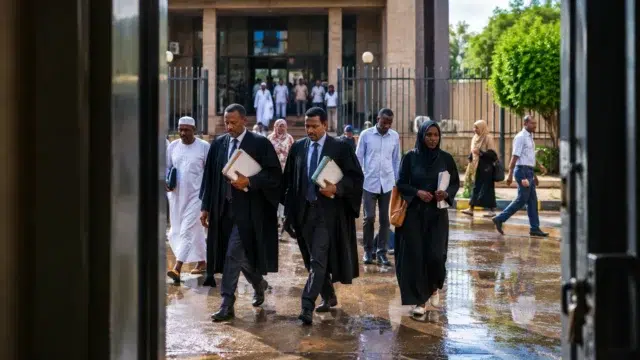
Human rights defenders also warn of another imbalance. In areas under army control, families may sometimes visit detainees and lawyers may access case files. In territory held by the RSF, by contrast, women are said to have disappeared without their relatives knowing where they are. This asymmetry sums up Sudan’s fragmentation: the law still exists, but its application depends on who controls the city, police station or prison.
The conflict in Sudan has already produced other forms of violence against women. The UN Independent International Fact-Finding Mission described arbitrary detentions, torture and other serious violations committed by both sides in September 2025. Human Rights Watch, for its part, has reported deaths in custody, ill-treatment and a crackdown that also targets aid workers and civilian volunteers. In this context, women arrested for “collaboration” often become defenceless victims in a war of reprisals.
The issue in Sudan is therefore also institutional. When the police, military intelligence, prosecutors and prisons operate within a framework upended by conflict, pre-trial detention can turn into political or social punishment. This further weakens a judicial system already damaged by war and years of impunity.
What this case says about Sudan and the region
This wave of arrests matters first and foremost for the Sudanese women affected, but it also says something broader about the war in Sudan. The conflict pits two armed forces against each other, but its effects are felt by families, neighbourhoods, informal businesses and essential services. In this country in the Horn of Africa, access to water, transport, healthcare and legal aid now depends on the local balance of power.
Regionally, Sudan remains a flashpoint for the African Union and IGAD, the intergovernmental organisation that monitors crises in the Horn of Africa. The continuation of arbitrary detentions complicates any credible end to the war, as it fuels mistrust between communities, strengthens cycles of revenge and weakens the few remaining spaces for mediation.
What happens next will depend on several developments already in view: the course of the front line, court decisions concerning the detainees and international pressure on both sides. For now, the message is clear: in Sudan, retaking cities does not automatically restore the rule of law. It can also shift the violence from the front line to the cells.