
 Algeria
 Egypt
 Libya
 Morocco
 Sudan
 Tunisia
 Benin
 Cabo Verde
 Côte d'Ivoire
 Ghana
 Guinea
 Guinea-Bissau
 Liberia
 Mali
 Mauritania
 Niger
 Nigeria
 Senegal
 Sierra Leone
 The Gambia
 Togo
 Cameroon
 Central African Republic
 Chad
 DR Congo
 Equatorial Guinea
 Gabon
 Republic of the Congo
 São Tomé and Príncipe
 Burundi
 Comoros
 Djibouti
 Eritrea
 Ethiopia
 Kenya
 Madagascar
 Malawi
 Mauritius
 Mozambique
 Rwanda
 Seychelles
 Somalia
 South Sudan
 Tanzania
 Uganda
 Angola
 Botswana
 Eswatini
 Lesotho
 Namibia
 South Africa
 Zambia
 Zimbabwe
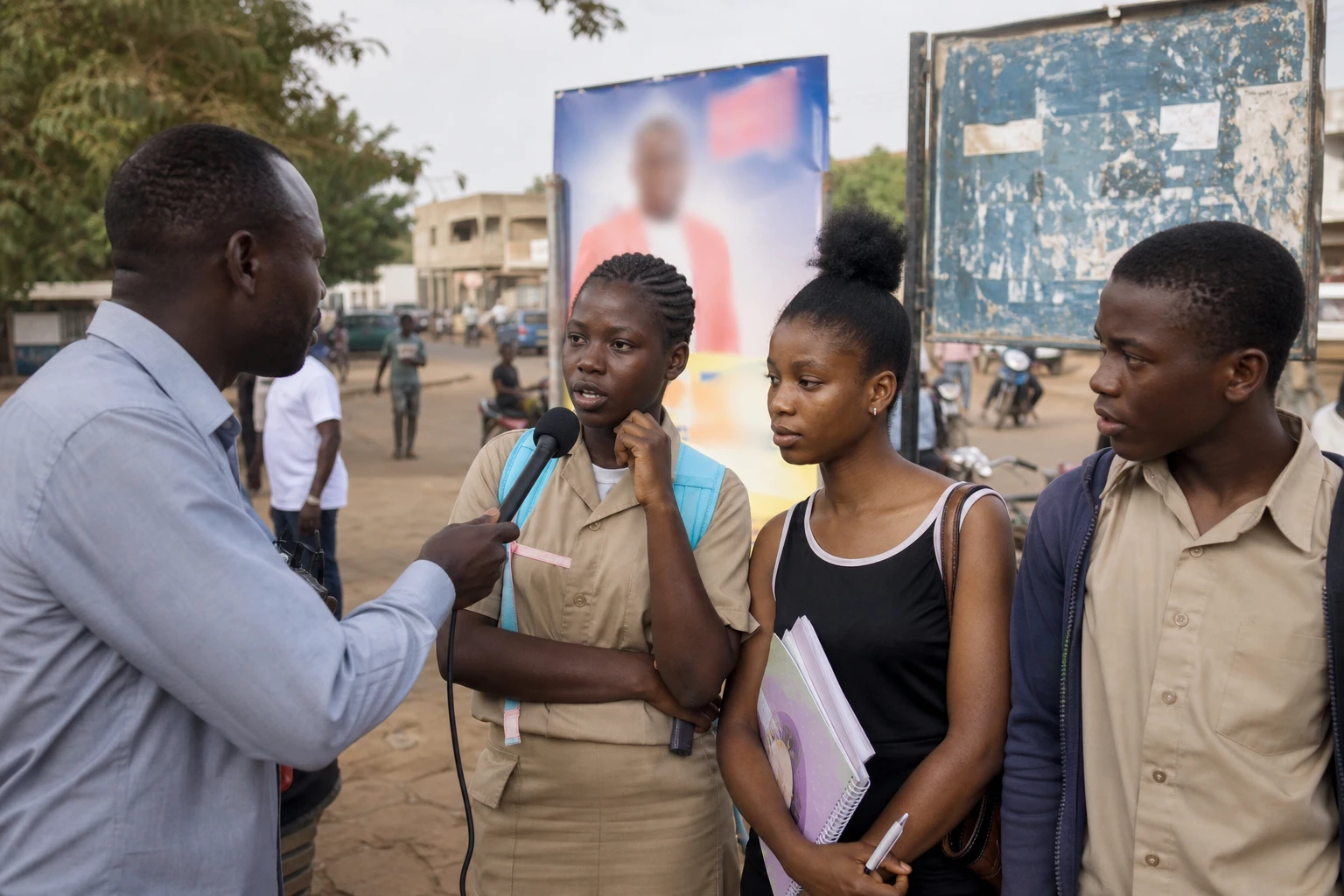
A battle over subject choices starts early in Burkina Faso’s science classrooms
In Ouagadougou, the question is not simply how to reward good marks. It is broader: how can more girls in Burkina Faso be encouraged to enter science and stay in the field? The Hakili Mousso contest starts from a simple observation. The country needs skills in mathematics, physics, chemistry, digital technology and industry. Yet girls remain less represented in these areas than boys.
The national context gives this initiative added weight. Burkina Faso’s transitional authorities have made sovereignty and skills development stated priorities. At the same time, the education system is seeking to align training and research more closely with production needs, particularly in technological fields. The Hakili Mousso ceremony is therefore part of a political moment in which schools are seen not only as places to earn qualifications, but as a pool of talent that can serve the economy and public services.
First edition brings together 84 candidates selected on science results
The first edition of Hakili Mousso brought together 84 young women who passed their baccalaureate in the 2026 session. They were selected on the basis of their results in science subjects and an age limit of 21. After a week of immersion and preparation at the National Scientific Lycée, the finalists sat their exams in Ouagadougou before awards were presented on Saturday 19 September 2026. The authorities described the contest as a way to identify and encourage female talent.
The results offer a useful snapshot of the standard achieved. In chemistry, Inès Nikiema came first with 18.73 out of 20. In physics, Aminata Traoré scored 15 out of 20. In mathematics, Adjaratou Bama topped the table with 14.25 out of 20. The top three in each subject received cash and material prizes. The overall winners received 2 million FCFA, a motorbike, a laptop and various gifts from partners. Their teachers and mentors were also recognised.
Prime Minister Rimtalba Jean Emmanuel Ouédraogo chaired the ceremony on behalf of the head of state. He emphasised a clear political message: girls belong in science, technology and industry. The message was aimed at pupils as well as families and teachers. In his view, the obstacle is not a lack of talent, but subject choices and sustained support. His remarks gave the contest a significance beyond the awards ceremony itself.
The real challenge: tackling a measurable gender gap
Burkina Faso’s authorities gave a precise figure to illustrate the problem. In 2025-2026, girls accounted for 36.7% of enrolment in science streams, compared with 59.5% in non-science streams. The gap is not abstract. It reflects different educational paths, subject choices that are sometimes shaped at an early age and, often, a shortage of visible role models for teenage girls interested in science. Hakili Mousso aims to address this imbalance through example, networking and public recognition.
This kind of initiative reflects a broader analysis by UNESCO. The organisation says girls and women continue to face barriers in STEM fields — science, technology, engineering and mathematics. It also notes that the gap is not just a matter of academic results, but of longer-term factors: social norms, gradual drop-out and a lack of guidance towards scientific careers. UNESCO also notes that women make up only about 35% of STEM graduates and around 25% of people employed in related fields.
In this context, the Burkinabè contest seeks to do more than reward excellence. It aims to create a ripple effect. A visit to Telecel’s data centre, a meeting with senior women in telecommunications and accounts from young candidates all serve the same purpose: to showcase real professions already present in Burkina Faso and open to women trained locally. The message is therefore not just about education. It is also about the economy and careers.
A sovereignty agenda that also depends on girls
The language used by the authorities is not neutral. They speak of sovereignty, technological development and national skills. This reflects a broader direction pursued by Burkina Faso since the military transition: strengthening domestic capacity, promoting local talent and reducing dependencies considered costly. In this approach, girls are not merely a group to be supported. They are also a strategic resource for the country.
For urban families, particularly in Ouagadougou, the contest could open up concrete opportunities: scholarships, mentoring, visibility and greater confidence in fields sometimes seen as highly selective. For pupils from the regions, the stakes are even higher. Access to female role models in science varies widely across areas, schools and the support available. A national contest could therefore serve as a bridge between the capital and the rest of the country, provided support continues beyond a single ceremony.
Teachers and mentors have not been overlooked. Their awards highlight an often underestimated truth: academic performance also depends on support. When a pupil chooses science, she rarely does so alone. She needs a teacher, a supportive environment and sometimes a family that believes in her. By honouring these people, Hakili Mousso recognises that the effort to bring more girls into science takes place in classrooms, but also through day-to-day support.
Significance for Burkina Faso and West Africa
The Burkinabè example resonates beyond Ouagadougou. Across West Africa, states are seeking to broaden their scientific and technological base, as digital transformation, energy, telecommunications and light industry require better-trained professionals. In the region, getting more girls into STEM is becoming as much a matter of competitiveness as of equality. Burkina Faso is testing one approach: establishing a national contest, giving it political visibility and linking it to practical work experience.
What happens next will show whether Hakili Mousso remains a showcase or becomes a genuine talent pipeline. The first test will be how the winners are supported: their post-baccalaureate choices, scholarships, enrolment and continued participation in science streams. That is where the initiative’s real impact will be measured. For now, it has put a powerful idea into Burkina Faso’s public debate: science is not an exclusive domain. It can also be a field in which young women in Burkina Faso see a future for themselves.



