Algeria
 Egypt
 Libya
 Morocco
 Sudan
 Tunisia
 Benin
 Burkina Faso
 Cabo Verde
 Côte d'Ivoire
 Ghana
 Guinea
 Guinea-Bissau
 Liberia
 Mali
 Mauritania
 Niger
 Nigeria
 Senegal
 Sierra Leone
 The Gambia
 Togo
 Cameroon
 Central African Republic
 DR Congo
 Equatorial Guinea
 Gabon
 Republic of the Congo
 São Tomé and Príncipe
 Burundi
 Comoros
 Djibouti
 Eritrea
 Ethiopia
 Kenya
 Madagascar
 Malawi
 Mauritius
 Mozambique
 Rwanda
 Seychelles
 Somalia
 South Sudan
 Tanzania
 Uganda
 Angola
 Botswana
 Eswatini
 Lesotho
 Namibia
 South Africa
 Zambia
 Zimbabwe
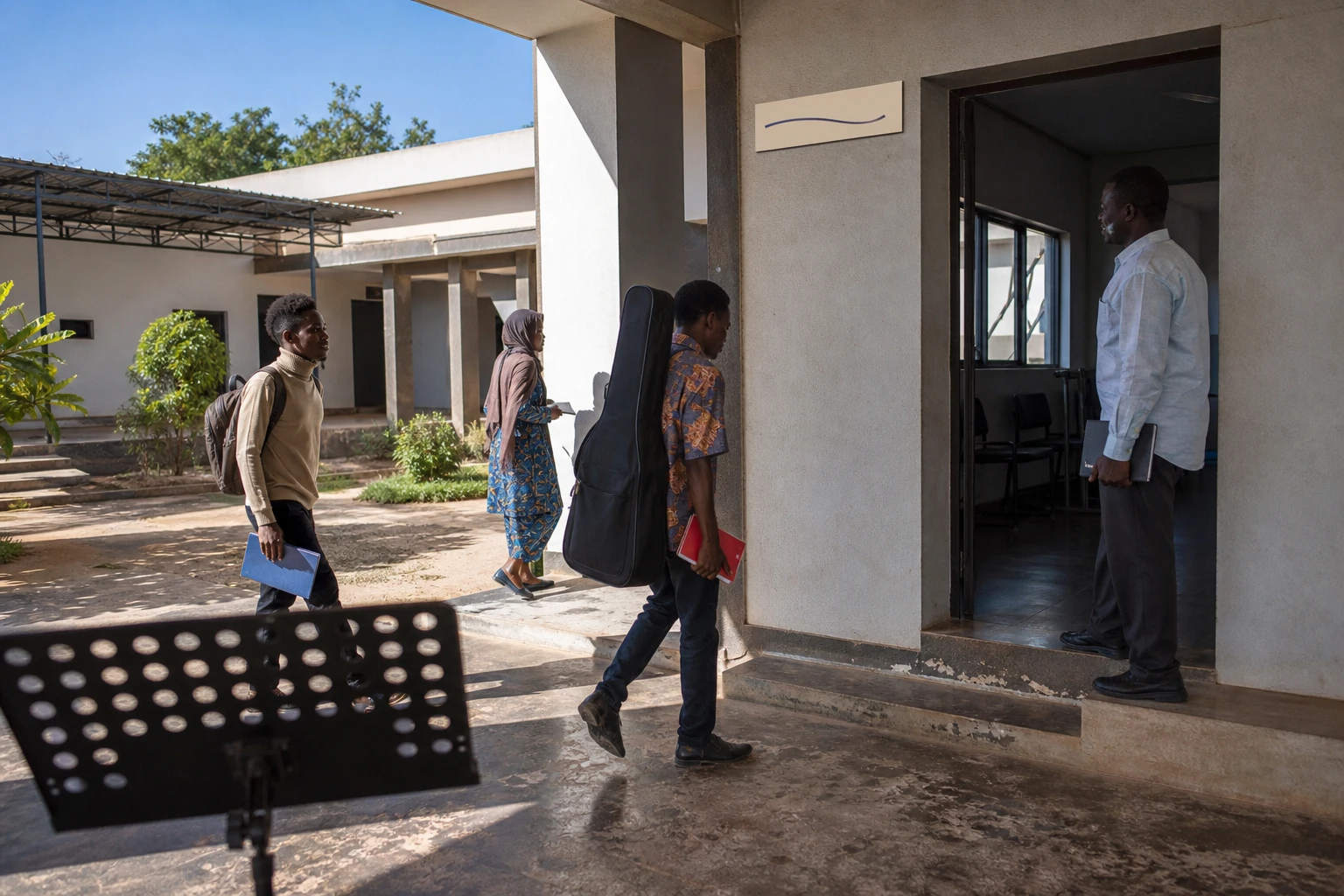
A classroom for aspiring musicians in N’Djamena
In many African countries, music often begins at home, in the neighbourhood, at church or mosque, or in informal rehearsals. In Chad, this tradition is now taking a step forward with the opening in N’Djamena of an institution designed to teach music in a structured and sustained way. The initiative aims to turn a passion into a profession, at a time when arts education is gaining ground in debates on youth training and cultural employment.
Chad’s capital is home to most of the country’s cultural institutions, performance venues and few training opportunities. The country belongs to CEMAC, the Economic and Monetary Community of Central Africa, which is also working on a subregional cultural strategy and on the links between culture, education and social cohesion. In this context, the opening of a music school in N’Djamena is about more than local cultural life. It is part of a broader effort to structure arts professions in Central Africa.
The project was launched on 16 September 2026 in N’Djamena by the Djamah-Afrik association, with an Académie Chad Jazz Education presented as Chad’s first music school. The initiative concludes a three-year pilot project and announces the enrolment of 30 Chadian students in a formally organised music course. It was launched with a jazz concert attended by the project’s partners and supporters.
This is a significant step because it addresses a longstanding weakness in Chad’s cultural system: training often remains fragmented and dependent on individual initiatives, festivals or one-off workshops. Local jazz figures had already stressed in recent years the need to professionalise young musicians rather than leave them to learn on their own. Yet the country has a strong musical history, shaped by groups and figures who have brought styles to audiences in N’Djamena, across Central Africa and throughout the diaspora. The new school is therefore entering fertile ground, but one that remains poorly structured.
The choice of music is no coincidence. UNESCO says arts and cultural education can strengthen creativity, literacy, critical thinking and collaboration. It also notes that these disciplines are often insufficiently integrated into education policies. In Chad, this issue is even more pressing, as ongoing reforms focus mainly on literacy, basic schooling and the quality of learning. In this context, a music school is not simply a leisure facility: it is also a means of training, guidance and socialisation for young people often seeking concrete opportunities.
The social impact is twofold. For families, the school may offer a more clearly defined course of study than an improvised artistic path, which is often seen as uncertain. For young people, it creates a setting in which instrumental practice, listening, arranging and performing can be developed methodically. The benefits could also extend to the informal cultural sector, which is widespread in N’Djamena, by creating new teachers, technicians, studio facilitators and performing musicians. In other words, the initiative’s value goes beyond the opening concert: it affects the entire music-making chain.
The undertaking remains fragile, however. Chad still faces major educational challenges, with school coverage and quality rated as low by the African Development Bank, and reforms continuing under the Programme for the Renewal of the Chadian School. This is a reminder that a music school cannot solve everything, but it can open up a practical path in a landscape where specialised training remains rare. If the project proves sustainable, it could become a signal to other subregional capitals, where culture is also seeking to move beyond one-off events and towards lasting transmission.
Across the continent, the opening of this institution reflects a broader trend: African culture is no longer confined to stages or festivals; it is being organised, taught and professionalised. In CEMAC capitals and elsewhere, the question is no longer simply how to celebrate talent, but how to provide artists with schools, programmes and career opportunities. In N’Djamena, the first cohort announced will soon show whether this promise can take root for the long term.