
 Algeria
 Egypt
 Libya
 Morocco
 Sudan
 Tunisia
 Benin
 Burkina Faso
 Cabo Verde
 Côte d'Ivoire
 Ghana
 Guinea
 Guinea-Bissau
 Liberia
 Mali
 Mauritania
 Niger
 Nigeria
 Senegal
 Sierra Leone
 The Gambia
 Togo
 Cameroon
 Central African Republic
 Chad
 Equatorial Guinea
 Gabon
 Republic of the Congo
 São Tomé and Príncipe
 Burundi
 Comoros
 Djibouti
 Eritrea
 Ethiopia
 Kenya
 Madagascar
 Malawi
 Mauritius
 Mozambique
 Rwanda
 Seychelles
 Somalia
 South Sudan
 Tanzania
 Uganda
 Angola
 Botswana
 Eswatini
 Lesotho
 Namibia
 South Africa
 Zambia
 Zimbabwe
An outbreak no longer confined to the east
In the Democratic Republic of the Congo, Ebola is no longer just a health crisis centred in the east. The virus has crossed a new threshold, with a case reported in Sud-Ubangi in the west of the country, bringing the alert to seven affected provinces. For health teams, the challenge is no longer only to treat patients in the epicentre. They must also contain an outbreak spreading across an immense territory, with roads, rivers and porous borders.
This development also changes how the risk is viewed by the Congolese. In Kinshasa, the government is monitoring a response that has been under way since May 2026. But the pressure is now shifting towards more remote areas, where surveillance is more fragile and health services more limited. The country is therefore responding to an outbreak involving mobility, local insecurity and cross-border transmission.
Ituri remains the epicentre, but the map is expanding
As of 16 September 2026, the Democratic Republic of the Congo reported 7,404 confirmed cases and 3,577 deaths, according to the European update drawing on national data current to 15 September. The previous day, the World Health Organization had reported 6,757 confirmed cases and 3,267 deaths as of 7 September, showing how quickly the situation is evolving and how figures are continually revised as surveillance improves.
Ituri remains the centre of gravity. The province still has the highest number of cases, far ahead of North Kivu. But this is no longer a picture of a single outbreak. Health authorities now count cases in six other provinces: North Kivu, South Kivu, Haut-Uele, Tshopo, Bas-Uele and Sud-Ubangi. In the latter, one case and one death have been reported.
The virus responsible is Bundibugyo ebolavirus, an Ebola variant for which no specific approved vaccine exists. The WHO says the response therefore relies on testing, contact tracing, patient isolation, protection for health workers and community engagement. In a country as vast as the DRC, this is a demanding system to sustain over time.
Why the spread is worrying health authorities
The move to a seventh province does not simply mean more cases. It complicates logistics, coordination and the control of transmission chains. When an outbreak appears in the west of the country, far from Ituri, the response must cover areas where infrastructure, epidemiological surveillance and access to healthcare are not always comparable to those in major urban centres.
WHO data also show that transmission remains active in several health zones. As of 7 September, the agency had recorded 61 affected health zones in six provinces, with cases still reported in the previous 21 days in 51 zones. It also highlighted the risk of regional spread through informal border crossings. This is a sensitive issue in Central Africa, where unofficial crossings often escape conventional health controls.
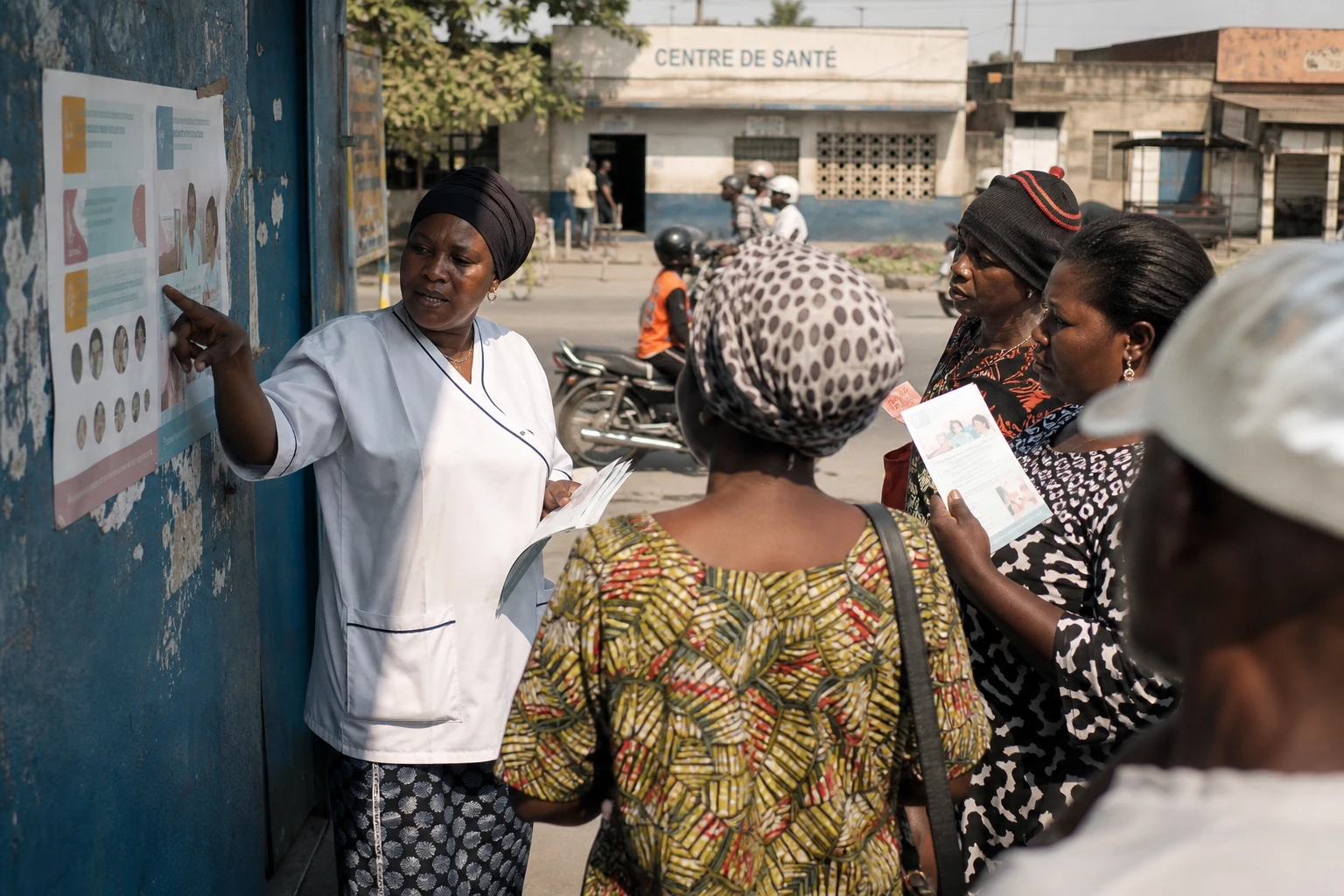
On the ground, health teams face another obstacle: mistrust, sometimes fuelled by insecurity and rumours. The WHO stresses a simple point: communities must be involved in the response if the disease is to recede. Without local trust, contact tracing falls apart, patients reach treatment centres too late and the curve rises again.
An alert for the Congo, but also for the region
The impact of this outbreak extends beyond the DRC. The affected provinces border or lie close to several routes for human and commercial movement towards Uganda, South Sudan and the Central African Republic. The WHO speaks of a persistent risk of cross-border spread and calls for stronger coordination at official posts and along informal routes. The stakes for Central Africa are clear: an outbreak that is not contained in eastern Congo can quickly become a regional issue.
The Congolese response is also part of a broader effort to strengthen African health preparedness. The WHO Regional Office for Africa is monitoring the outbreak as a continental emergency, while Kinshasa is leading the response from the capital alongside technical partners and provincial authorities. The current episode is a reminder of a familiar reality for the continent’s health systems: in the face of Ebola, speed of detection matters as much as the capacity to provide treatment.
What needs to be watched in the coming days is clear: the number of cases in Sud-Ubangi, the pressure in Ituri and North Kivu, and the results of surveillance at the borders. If the trend remains contained in the provinces already affected, the response can still regain the upper hand. If new outbreaks emerge, the DRC will have to expand a system already stretched across several hundred kilometres.



