Algeria
 Egypt
 Libya
 Morocco
 Sudan
 Tunisia
 Benin
 Burkina Faso
 Cabo Verde
 Côte d'Ivoire
 Ghana
 Guinea
 Guinea-Bissau
 Liberia
 Mali
 Niger
 Nigeria
 Senegal
 Sierra Leone
 The Gambia
 Togo
 Cameroon
 Central African Republic
 Chad
 DR Congo
 Equatorial Guinea
 Gabon
 Republic of the Congo
 São Tomé and Príncipe
 Burundi
 Comoros
 Djibouti
 Eritrea
 Ethiopia
 Kenya
 Madagascar
 Malawi
 Mauritius
 Mozambique
 Rwanda
 Seychelles
 Somalia
 South Sudan
 Tanzania
 Uganda
 Angola
 Botswana
 Eswatini
 Lesotho
 Namibia
 South Africa
 Zambia
 Zimbabwe
In Lockland, bicycles have become a tool for settling in
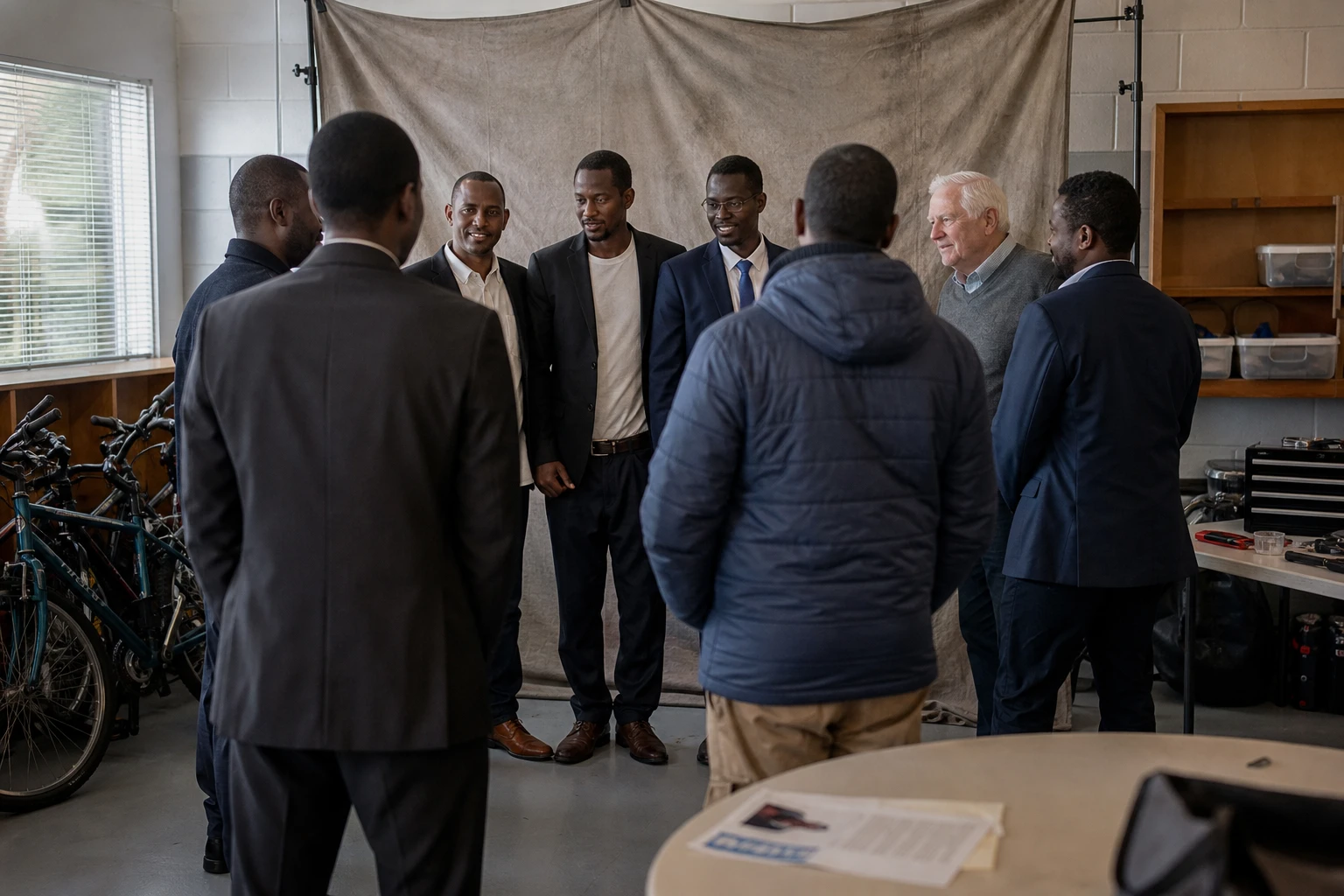
In Ohio, a simple bicycle can do more than shorten a journey. It can connect a home, an English class, a food bank and a first symbolic income in a city where everything is too far away for someone walking miles every day. In Lockland, this very practical approach has come to shape the lives of part of the Mauritanian diaspora, which has arrived in large numbers in recent years.
The case is of interest well beyond this town on the outskirts of Cincinnati. It shows how integration is often built through ordinary, locally led solutions when institutions are slow to respond to the pace of migration. It also serves as a reminder that Mauritania’s history does not end at its national borders: it continues in the diaspora’s experiences of exile, mobility and survival.
A diaspora shaped by decades of fractures in Mauritania
Mauritanians living in Lockland are part of a longer history. Departures began in the 1990s, after campaigns of repression targeting black Mauritanian communities, involving arrests, expulsions and documented violence. More recently, new arrivals have joined communities already established in the United States.
This background matters. In Mauritania, official and international reports continue to identify structural discrimination against Haratine and Afro-Mauritanian groups, as well as persistent vulnerabilities related to civil registration, forced labour and hereditary forms of servitude. In 2024, the US Department of Labor still reported that some children of Haratine or sub-Saharan African descent struggled to obtain birth certificates, undermining their access to school and social rights.
Mauritania has nevertheless strengthened some legal tools. A national plan to combat trafficking for 2024-2026 has been approved, and a centralised special court is now to handle cases involving slavery, human trafficking and migrant smuggling. But the gap between legislation and everyday reality remains wide, particularly in the informal sector and rural areas.
In Lockland, integration is shaped by distance
In this town, the sudden growth of the Mauritanian community caught volunteers off guard. One evening in 2023, an English-learning meeting drew far more people than expected: the small room at the Christian centre next to the bicycle shop was surrounded by queues of men looking for a place, a service or simply a chance to keep going.
The problem was simple. Homes, shops, food distributions and classes were not clustered together. For many men, getting between them meant walking several kilometres. The bicycle therefore immediately took on a social role: helping people travel faster, but also reach further in their daily lives. Locally, this mobility made it possible to attend a class, go to the mosque, unload pallets or help welcome other users at a food bank.
The scheme remained informal, but it grew. A makeshift workshop was set up around donated bicycles, which the recipients repaired themselves. According to a local Cincinnati radio station, around 300 Mauritanians were able to receive or repair a bicycle through the scheme. The story shows something simple: integration comes not only through employment, but also through the ability to get around, understand the city and make oneself useful there.
What the figures say — and what they do not
Available data confirm the scale of the movement. Before 2023, there were already about 8,000 Mauritanians in the United States, according to immigration data cited by WVXU, with significant concentrations in the Cincinnati area and Columbus. Thousands more arrived afterwards, particularly via the US southern border, where applications for asylum by Mauritanians have increased.
But the figures do not tell the whole story. They say nothing about the trauma experienced before departure, administrative delays, waiting for work authorisation or reliance on volunteers for the simplest everyday tasks. In practice, many newcomers remain in limbo for months while their cases make their way through the US court system.
This uncertainty has very tangible effects. For families, it slows access to housing, transport and financial stability. For host cities, it means responding quickly to everyday needs: language, travel, food, clothing and access to documents. And for migrants themselves, it turns an ordinary object, the bicycle, into their first infrastructure for integration.
A Mauritanian and African perspective
It would be reductive to view this story solely as a local episode of migration to the United States. It also reflects internal tensions in Mauritania, a Sahelian state in West Africa that left ECOWAS in December 2000 and is regionally associated primarily with the Arab Maghreb Union and the African Union. Institutional borders do not prevent human mobility or erase the political consequences of forced departure.
The African Union’s texts also set out a continental framework designed to protect displaced people and promote the movement of Africans. The 1969 OAU Refugee Convention and the Protocol on the Free Movement of Persons show that migration is an African issue too, not just a transatlantic one. In this sense, the experience of Lockland illustrates a continental paradox: when protection and mobility do not work well enough at home or in the region, journeys become longer and solutions are improvised elsewhere.
For Mauritania, the issue is also political. As long as inequalities in access to civil registration, education, justice and land continue to be documented, Mauritanians will keep seeking protection elsewhere. For host cities such as Lockland, the question is the reverse: how to turn a sudden influx into an everyday presence, without romanticising hardship or overlooking the organisational capacity of newcomers. A bicycle is not a comprehensive solution. But it shows that successful integration often begins with a very simple opportunity: to get around without being held back by distance.