
 Algeria
 Egypt
 Libya
 Morocco
 Sudan
 Tunisia
 Benin
 Burkina Faso
 Cabo Verde
 Côte d'Ivoire
 Ghana
 Guinea
 Guinea-Bissau
 Liberia
 Mali
 Mauritania
 Niger
 Nigeria
 Senegal
 Sierra Leone
 The Gambia
 Togo
 Cameroon
 Central African Republic
 Chad
 DR Congo
 Equatorial Guinea
 Gabon
 Republic of the Congo
 São Tomé and Príncipe
 Burundi
 Comoros
 Djibouti
 Eritrea
 Kenya
 Madagascar
 Malawi
 Mauritius
 Mozambique
 Rwanda
 Seychelles
 Somalia
 South Sudan
 Tanzania
 Uganda
 Angola
 Botswana
 Eswatini
 Lesotho
 Namibia
 South Africa
 Zambia
 Zimbabwe
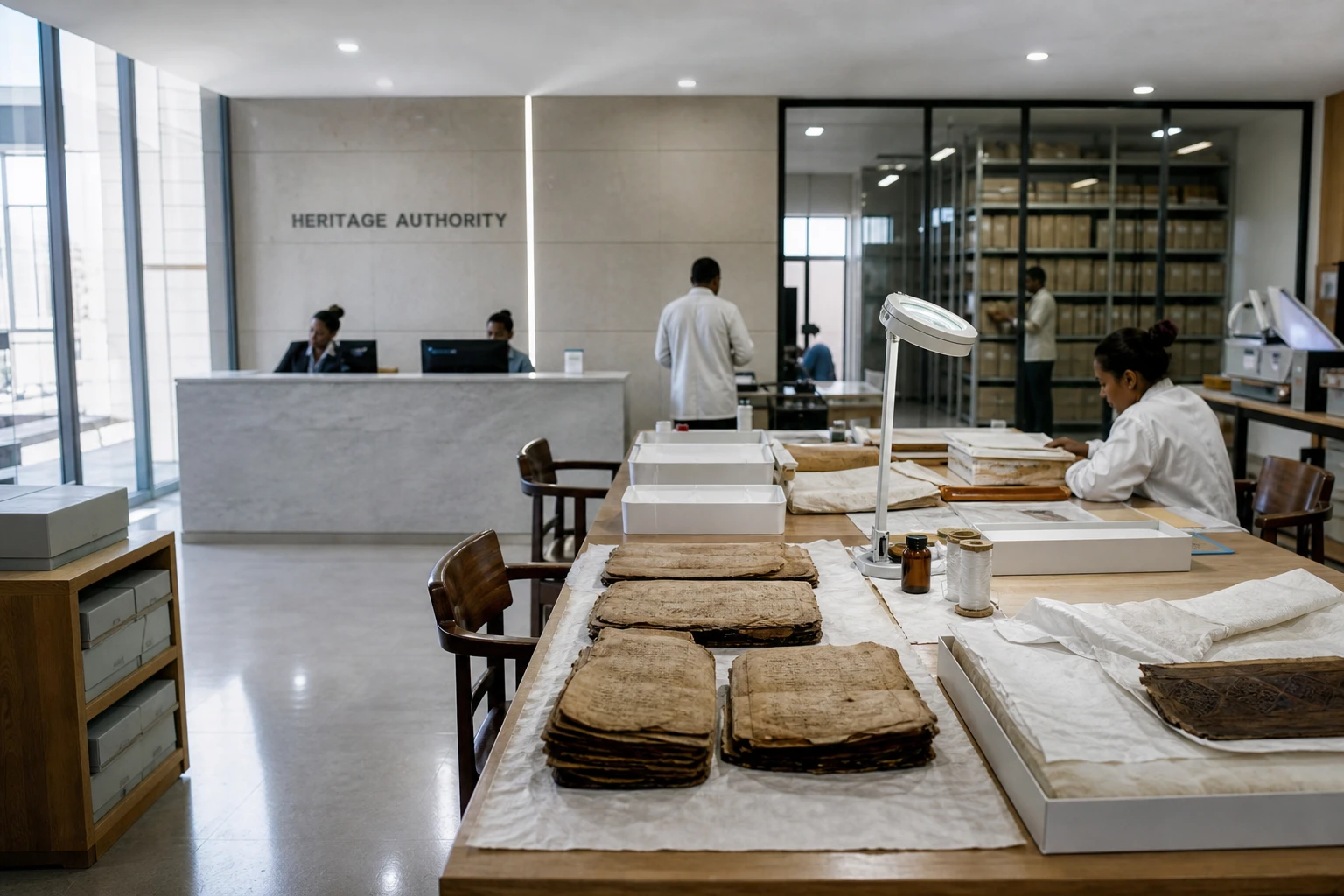
A manuscript, and far more than a display piece
In Addis Ababa, the question is not simply who can buy a rare manuscript. It touches on memory, cultural sovereignty and how Ethiopian history circulates beyond the country. When a liturgical work associated with Emperor Tewodros II appears on an international market, it reopens an old wound: the artefacts taken after the Maqdala campaign in 1868.
The debate therefore extends beyond the narrow circle of rare-book specialists. In Ethiopia, manuscripts in Ge’ez are not scholarly curiosities. They connect churches, monasteries, family archives and the state to a long, written and illustrated history. This is also why written heritage has become a public issue, on a par with listed sites and national museums.
What happened in Abu Dhabi
The Abu Dhabi International Book Fair was held from 13 to 18 September 2026 at ADNEC Centre Abu Dhabi. It was in this setting that the work, described by its seller as an exceptional Ethiopian manuscript, was offered for sale at an indicative price of €250,000. The dates of the fair were confirmed by Emirati organisers, explaining the international visibility of the sale.
According to the sales description consulted, the manuscript, written in Ge’ez, is believed to date from the first third of the 18th century and contains the Gospels of Luke and John, with a richly decorated binding and extensive painted ornamentation. The seller links it to the library of Tewodros II and then to the capture of Maqdala by British troops under General Charles Napier in 1868. This provenance fits the historical context documented by several British museum institutions and by academic research into the Maqdala manuscripts.
That is the sensitive point: an object linked to wartime plunder cannot be treated as an ordinary item of international trade, especially when its Ethiopian provenance is public and asserted. Ethiopian institutions have accordingly considered that the sale should be blocked. The daily newspaper Capital reports that the Ethiopian Heritage Authority has begun high-level discussions to prevent the sale. The same outlet says its director-general, Abebaw Ayalew, rejected the idea of a commercial buyback.
Why Addis Ababa rejects the “preferential price” approach
The heart of the disagreement is as political as it is legal. On one side, the dealer is proposing a commercial solution, presented as a gesture of goodwill. On the other, Addis Ababa argues for the return of heritage, not a transaction. In the Ethiopian authorities’ view, paying to recover an object originating in a context of dispossession would amount to normalising the market circulation of contested heritage.
This position is also supported by a stronger institutional framework than a few years ago. The country has a legal framework to combat the illicit export of cultural property and is pursuing a growing number of repatriation efforts. Addis Media Network recently reported on increased diplomatic efforts to bring treasures held abroad back to the country, while the government emphasises the place of heritage in its tourism and national strategy.
Ethiopian civil society and researchers also play a role in this case. The British-Ethiopian historian Alula Pankhurst, cited by the Ethiopian press, argues that this kind of object should not be reduced to a commodity and should be returned to the National Museum of Ethiopia. This view resonates widely, as heritage is no longer an issue reserved for diplomats: it concerns schools, universities, churches and public archives.
The figures cited by the authorities show the scale of the task. According to Ethiopian media reporting statements by the Heritage Authority, 17 spiritual manuscripts have recently been returned and more than 67 illegally exported objects are said to have been repatriated since the campaign began seven years ago. These figures should be read as institutional tallies, but they confirm a clear trend: Ethiopia has made the return of its works an ongoing policy, not just a slogan.
An Ethiopian case, but an African question
The case resonates far beyond Addis Ababa. Across the continent, it is a reminder that restitution is not just about bronzes, statues or masks. Manuscripts, liturgical books and archives have the same historical value. They tell the stories of states, religions, languages and knowledge. Their dispersal deprives African countries of tools for research, education and transmission.
The Ethiopian case is particularly sensitive because it is part of a long history of intellectual and religious resistance. Ge’ez, a Semitic liturgical language, remains a marker of cultural continuity. Illuminated manuscripts are not merely objects of admiration from a prestigious past; they also help explain dynasties, scholarly exchange and monastic networks in the Horn of Africa. This is therefore an issue of knowledge, but also of national dignity.
What happens next will be determined on two fronts. First, Addis Ababa’s ability to maintain diplomatic and legal pressure on private holders. Second, the priority that the AU, museum networks and African heritage institutions give to the restitution of manuscripts. For Ethiopia, as for other African countries, the battle is no longer just about objects. It is about the right to keep, study and pass on its own memory.



