Algeria
 Egypt
 Libya
 Morocco
 Tunisia
 Benin
 Burkina Faso
 Cabo Verde
 Côte d'Ivoire
 Ghana
 Guinea
 Guinea-Bissau
 Liberia
 Mali
 Mauritania
 Niger
 Nigeria
 Senegal
 Sierra Leone
 The Gambia
 Togo
 Cameroon
 Central African Republic
 Chad
 DR Congo
 Equatorial Guinea
 Gabon
 Republic of the Congo
 São Tomé and Príncipe
 Burundi
 Comoros
 Djibouti
 Eritrea
 Ethiopia
 Kenya
 Madagascar
 Malawi
 Mauritius
 Mozambique
 Rwanda
 Seychelles
 Somalia
 South Sudan
 Tanzania
 Uganda
 Angola
 Botswana
 Eswatini
 Lesotho
 Namibia
 South Africa
 Zambia
 Zimbabwe

In Darfur, the war has not only burned the roads. It has also dried up the fields.
In western Sudan, the rainy season was expected to bring relief to villages and replenish groundwater. This year, it has mostly left behind cracked earth, sparse pastures and families with no reserves to fall back on. Darfur is experiencing one of its most severe droughts in several decades, just as the war makes every harvest more precarious and every displacement more arduous.
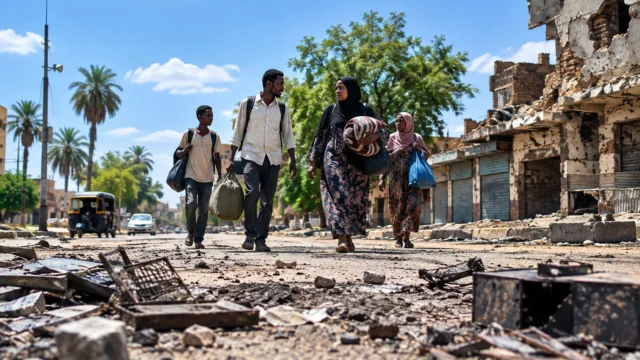
This climate shock is hitting a region already overwhelmed by emergencies. In Sudan, the conflict between the Sudanese Armed Forces and the Rapid Support Forces, which began in April 2023, has displaced millions and disrupted agricultural, commercial and health networks. The International Organization for Migration estimates that about 5.66 million people have been displaced within Darfur, accounting for a major share of the country’s internally displaced people.
Drought strikes a country already on the brink
The health and food situation deteriorated further in 2026. The Integrated Food Security Phase Classification indicates that about 19.5 million Sudanese people face high levels of acute food insecurity, or 41% of the population analysed. The same system reports that more than 8.9 million people have been displaced within the country and that nearly 40% of health facilities are no longer functioning.
Against this backdrop, the World Food Programme says Sudan remains the world’s largest hunger and displacement crisis. Its country portal also describes a country where entire areas are at risk of famine, as the agency tries to maintain assistance across all 18 Sudanese states despite funding and access constraints.
The situation in Darfur is even more acute. FEWS NET’s operational analyses describe late or insufficient rainfall in north-western Darfur during the June-to-September 2026 rainy season, with direct consequences for pastures, supply routes and pastoral livelihoods. The same report warns that severe drought would reduce pasture regeneration and exacerbate tensions over water and land.
In Darfur, weather and war reinforce each other
The issue is not limited to rainfall. In Darfur, drought is hitting a landscape already fractured by decades of conflict, repeated displacement and attacks that continue to weaken the most isolated communities. The United Nations has already warned of escalating violence and displacement around el-Fasher, Tawila and other parts of western Sudan, where humanitarian access remains severely restricted.
The link between climate and food security is very tangible here. When rains arrive late, less is planted. When roads are cut off or dangerous, traders cannot deliver goods quickly enough. When families flee, they leave behind some of their stocks, livestock and tools. The result is predictable: lower local production, greater dependence on aid, increased pressure on urban markets and more competition for water and pasture.
The El Niño phenomenon has also affected water balances in East Africa, according to UN agencies specialising in food security. But in Sudan, this climate factor is compounded by something much more consequential: the collapse of crisis governance. Where a stable state might cushion the effects of a poor rainy season, Sudan is bearing the combined impact of war, disrupted services and falling yields.
What this means for Sudanese people, and what the region must watch
For rural households in Darfur, drought means smaller harvests, lower incomes and more displacement. For families already living in camps or makeshift sites, it means greater dependence on food aid, even as humanitarian agencies report cuts, delays and blocked access. In cities, meanwhile, it means greater pressure on markets, health services and informal support networks.
The effects also extend beyond Sudan. Darfur borders Chad, where the arrival of displaced people and Sudanese refugees is already putting pressure on communities along the frontier. Each new wave of people fleeing increases demand for water, land and food on the Chadian side, in a Sahelian zone also exposed to climate shocks. The Sudanese conflict is therefore multiplying vulnerabilities across the Sahel basin and the Horn of Africa.
The African perspective on the crisis is clear: this is not simply a rainfall crisis, but an entanglement of climate, security and food sovereignty. In Sudan, the question is no longer just whether the next season will be better. Above all, it is whether humanitarian corridors will remain open, whether aid will reach cut-off areas and whether crops for the next season can still be protected. In Darfur, the ability to hold out until the next harvest has become the front line.