Algeria
 Egypt
 Libya
 Morocco
 Sudan
 Tunisia
 Benin
 Burkina Faso
 Cabo Verde
 Côte d'Ivoire
 Ghana
 Guinea
 Guinea-Bissau
 Liberia
 Mali
 Mauritania
 Niger
 Nigeria
 Senegal
 Sierra Leone
 The Gambia
 Togo
 Cameroon
 Central African Republic
 Chad
 DR Congo
 Equatorial Guinea
 Gabon
 Republic of the Congo
 São Tomé and Príncipe
 Burundi
 Comoros
 Djibouti
 Eritrea
 Ethiopia
 Madagascar
 Malawi
 Mauritius
 Mozambique
 Rwanda
 Seychelles
 Somalia
 South Sudan
 Tanzania
 Uganda
 Angola
 Botswana
 Eswatini
 Lesotho
 Namibia
 South Africa
 Zambia
 Zimbabwe
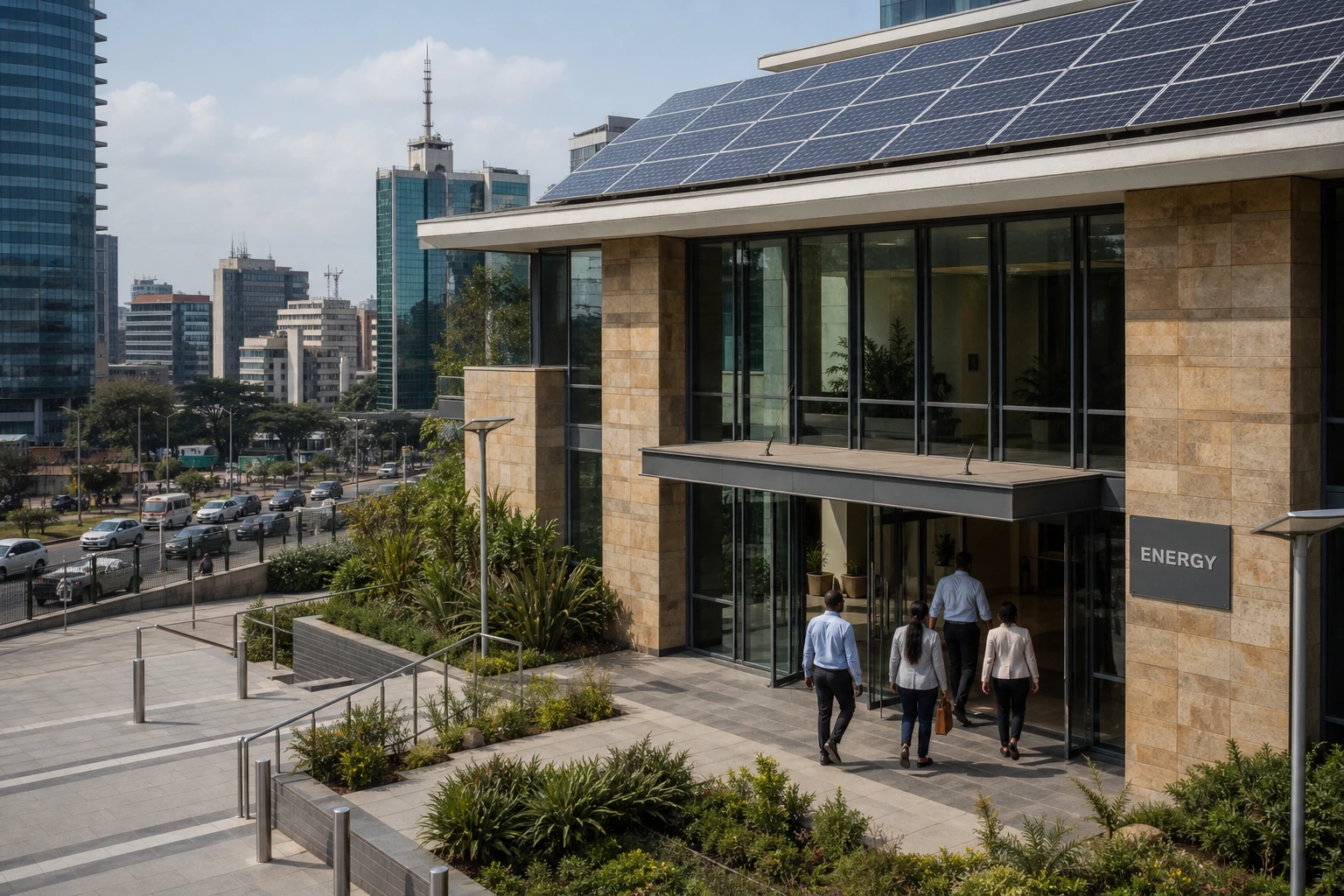
Nairobi attracts equipment makers, not just projects
In Nairobi, clean energy is no longer just something sold as a project. It is also taking root as a local business, with technical teams, offices and commercial functions. For Kenya, this shift points to something broader: the market is attracting not only investors, but is now establishing regional bases for the whole of East Africa.
This trend builds on a well-established trajectory in Kenya. The country is part of the East African Community, an integrated area where the movement of goods, services and skills remains a stated objective. Energy plays a central role, as electricity interconnections and common policies are intended to support investment and trade across the region. Nairobi thus benefits from a twofold advantage: an active domestic market and a geographical position that allows it to reach Uganda, Tanzania, Rwanda, Burundi, South Sudan, Somalia and the DRC, EAC partners.
Two successive openings, one clear signal
Recent developments confirm this trend. Exergy announced the opening of Exergy East Africa Ltd. in Nairobi on 14 September 2026. The Italian group plans to use its local presence to expand its geothermal activities and heat recovery solutions in the region. The following day, GoodWe officially announced the opening of a regional office in the Kenyan capital. The Chinese manufacturer of inverters and storage solutions says it wants to bring technical support, training and demonstrations closer to its partners. Neither company disclosed the cost of these establishments.
The messages conveyed by the two announcements point in the same direction. Exergy speaks of a permanent presence in one of the continent’s most dynamic markets for geothermal energy, renewables and energy efficiency. GoodWe, for its part, emphasises “localisation”, meaning the ability to serve customers on the ground rather than remotely. This is no minor consideration. It indicates that value is also shifting towards service, maintenance, training and project support, not just equipment sales.
This movement has not come out of nowhere. Kenya has already welcomed other recent establishments. AlphaESS described Nairobi as its African “operational hub” when it opened its local subsidiary, while Solaire Africa set up its regional headquarters there to coordinate sales, design and after-sales service. The centre of gravity is therefore no longer just the Kenyan market itself. Nairobi is becoming a base from which to sell, troubleshoot and train across several countries.
A market underpinned by its electricity mix and geothermal energy
Nairobi is attracting so much interest partly because Kenya’s electricity system provides a credible environment. According to the International Renewable Energy Agency, Kenya had just over 3 GW of renewable capacity at the end of 2024, and Kenya Power says renewables accounted for 90% of the generation mix in the financial year ended 30 June 2025. Another Kenya Power publication put the figure at more than 92% the previous year. The difference between the two figures reflects changes in the system, but both confirm the same reality: the country relies heavily on clean sources, including geothermal, hydropower, wind and solar.
Kenya’s energy ministry describes geothermal energy as a strategic resource, central to energy security and green industrialisation. The 2025-2035 energy policy document highlights the intention to strengthen local capacity and national expertise to accelerate development of the sector. The country is therefore banking on a relatively rare combination on the continent: an already renewable generation base, recognised expertise and a stated ambition to make this resource an industrial driver.
This matters greatly to foreign suppliers. Geothermal energy requires advanced skills, specialised equipment and long-term on-the-ground monitoring. Kenya, Africa’s leading geothermal producer according to the ministry, offers companies an environment in which they can test, train and demonstrate, then replicate their work in neighbouring countries. That is what gives Nairobi value as a platform, not merely as a commercial destination.
What this means for Kenya and the region
For Kenya’s economy, these openings are first and foremost a vote of confidence. They strengthen the local ecosystem of installers, distributors, engineering firms and maintenance providers. They also create skilled value-added work, with demand for technical support, product demonstrations, training and project management. In a capital such as Nairobi, this kind of establishment nourishes a service sector that extends beyond energy alone.
For users, the effect is more indirect, but real. A regional office or local subsidiary shortens response times, improves the availability of spare parts and makes it easier to adapt equipment to local conditions. This is a significant issue in areas where the grid remains uneven or off-grid solutions continue to play an important role, particularly for households, small businesses and some industrial sites. GoodWe highlighted this when presenting its new off-grid inverter as a response to the needs of households and small businesses facing unreliable power supplies.
The trend also has regional significance. For several years, the EAC has been working to harmonise energy policies and strengthen cross-border transmission lines, in order to facilitate electricity trading and investment. In this context, Kenya is already playing a leading role, backed by its interconnections with neighbouring countries and its position in regional geothermal production. The new offices in Nairobi therefore say something about East Africa itself: a market where clean technologies are no longer merely arriving, but seeking to establish a lasting presence. This trend will be worth watching in the coming months, as other equipment makers may follow the same path to the Kenyan capital.