Algeria
 Egypt
 Libya
 Morocco
 Sudan
 Tunisia
 Benin
 Cabo Verde
 Côte d'Ivoire
 Ghana
 Guinea
 Guinea-Bissau
 Liberia
 Mali
 Mauritania
 Niger
 Nigeria
 Senegal
 Sierra Leone
 The Gambia
 Togo
 Cameroon
 Central African Republic
 Chad
 DR Congo
 Equatorial Guinea
 Gabon
 Republic of the Congo
 São Tomé and Príncipe
 Burundi
 Comoros
 Djibouti
 Eritrea
 Ethiopia
 Kenya
 Madagascar
 Malawi
 Mauritius
 Mozambique
 Rwanda
 Seychelles
 Somalia
 South Sudan
 Tanzania
 Uganda
 Angola
 Botswana
 Eswatini
 Lesotho
 Namibia
 South Africa
 Zambia
 Zimbabwe
When the state returns, it all starts at a service desk
In areas where security is improving, the return of the administration is no minor detail. It is often the first tangible sign that civilian life is resuming, with schools, health centres, civil registration and justice. In Burkina Faso, this step is now at the heart of public policy.
The debate is all the more sensitive because the country remains engaged in a profound regional realignment. Since 29 January 2025, Burkina Faso, Mali and Niger have left ECOWAS, the Economic Community of West African States, and are moving forward within the framework of the AES, the Alliance of Sahel States. In this new environment, the Burkinabè state’s ability to deliver visible services in retaken territories has become a political as well as an administrative marker.
A review session to assess the state’s presence
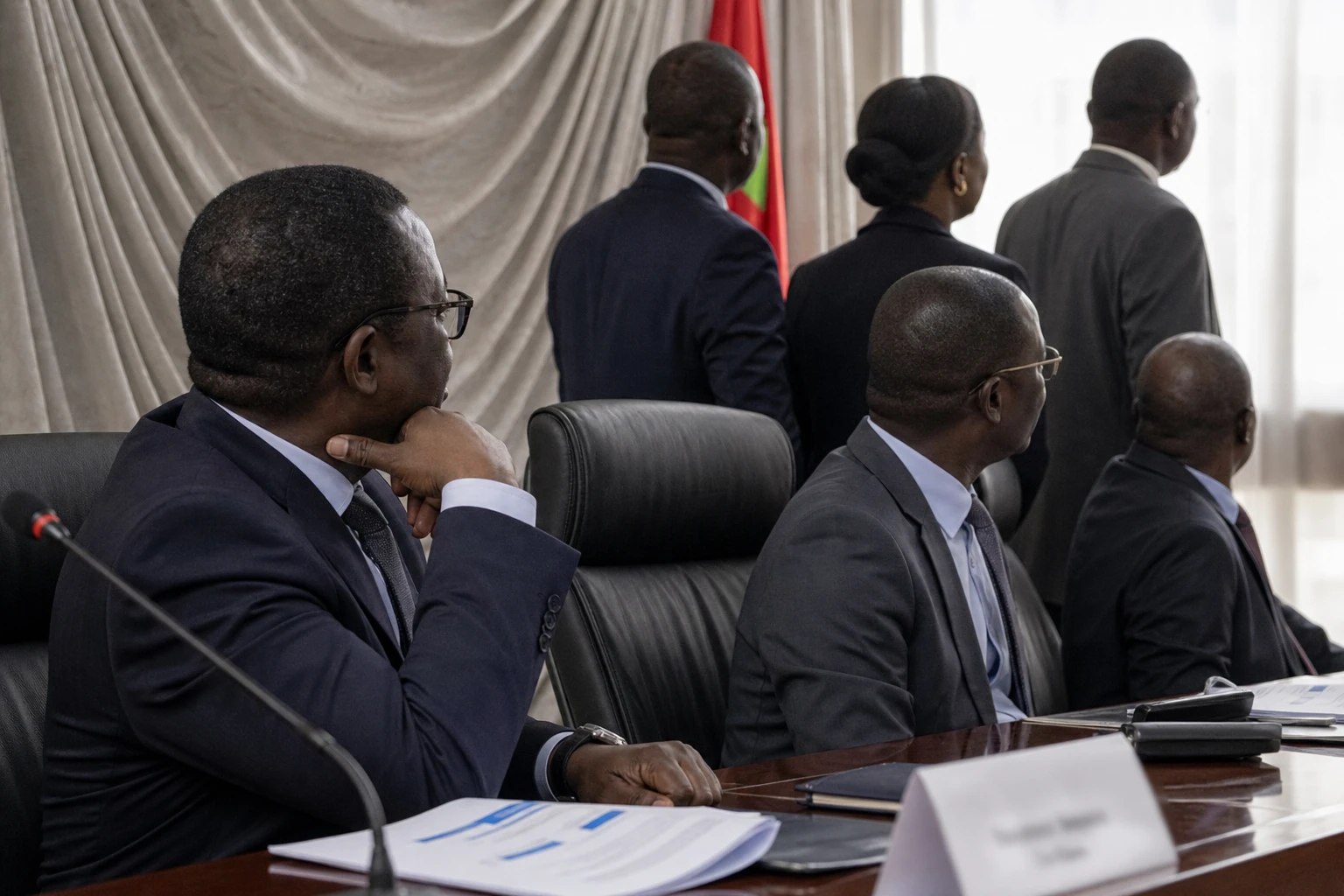
On Monday 14 September 2026 in Ouagadougou, Prime Minister Rimtalba Jean Emmanuel Ouédraogo chaired the ordinary session of the National Council for the Modernisation of Administration and Good Governance, the CN-MABG. Participants examined three documents: the annual report on implementation of the National Strategy for the Modernisation of Public Administration, the report on the state of governance in Burkina Faso and the overall report on the performance of public bodies, all for 2025.
The head of government set out a simple principle: when combat forces retake an area, the administration must be able to establish itself there for the long term. The message concerns health, education, justice, civil registration and social services—in other words, the functions that give people immediate access to their rights.
The defence ministry said the proportion of the territory under government control rose from 73.56% in December 2025 to 74.53% on 30 June 2026. The authorities specify that this figure refers to pacified, retaken and secured areas, where people and the public administration are gradually returning. This point remains central because it directly links security to the practical functioning of the state.
Modernising to serve, not just to count
Burkina Faso’s government also wants to change how public action is assessed. In 2025, the overall performance of administrative bodies was put at 85.38%. But the executive considers this indicator insufficient if it says nothing about the real impact on people’s lives. In other words, filling in a dashboard is no longer enough; the authorities must show what difference it makes at school, in civil registration records, at court or at the health centre.
This requirement forms part of a process already under way since 2025. At the first session of the CN-MABG, the authorities had already announced new priorities for 2026, including more effective human resources management, a single virtual service desk and wider promotion of public service values. The 14 September meeting therefore confirms an established reform agenda rather than an isolated announcement.
The task is nonetheless a major one. The authorities continue to cite difficulties with human resources, infrastructure, information systems and governance. They also highlight concerns about the authenticity of certain documents in public procurement. Digitalisation is presented as a response on this front, provided it remains accessible to users, including in rural areas and among less connected populations.
What this means for the rest of the country and the region
For residents of retaken areas, the stakes are immediate. Without a functioning town hall, civil registration officers, teachers or healthcare workers, the return of security remains incomplete. Local administrations therefore face a twofold urgency: follow the army into the field, then stabilise public services over the long term. In a country where population displacement has disrupted the usual channels for schooling, healthcare and identity documents, this consolidation phase weighs on trust in the state.
For the authorities, the benefits are also political. The reconquest is measured not only by control of a road or a regional capital. It is measured by the state’s ability to become predictable, present and useful again. This is where administrative modernisation meets the security question. The administration is no longer merely a management apparatus; it is becoming an instrument for restoring public authority.
The regional context reinforces this logic. With its effective departure from ECOWAS and the growing influence of the AES, Burkina Faso is seeking to show that it can build its own tools for governance and administrative sovereignty. Across West Africa, this trajectory is being closely watched because it affects the movement of services and public officials, as well as standards and technical cooperation. The issue in Burkina Faso therefore goes far beyond a simple performance report.
A reform that will also test the credibility of the state’s return
The next test will be a practical one: will administrations follow security forces into pacified areas at the same pace? Will decentralised services be able to reopen with staff, resources and reliable digital tools? And, above all, will people see a difference in their daily lives, in Ouagadougou as well as in the most exposed provinces?
In Burkina Faso, the answers to these questions will say far more than an annual review. They will show whether territorial reconquest is genuinely accompanied by a lasting return of the state, or whether the public presence remains too uneven between urban centres, secure routes and the most vulnerable rural areas.