
 Algeria
 Egypt
 Libya
 Morocco
 Sudan
 Tunisia
 Benin
 Burkina Faso
 Cabo Verde
 Ghana
 Guinea
 Guinea-Bissau
 Liberia
 Mali
 Mauritania
 Niger
 Nigeria
 Senegal
 Sierra Leone
 The Gambia
 Togo
 Cameroon
 Central African Republic
 Chad
 DR Congo
 Equatorial Guinea
 Gabon
 Republic of the Congo
 São Tomé and Príncipe
 Burundi
 Comoros
 Djibouti
 Eritrea
 Ethiopia
 Kenya
 Madagascar
 Malawi
 Mauritius
 Mozambique
 Rwanda
 Seychelles
 Somalia
 South Sudan
 Tanzania
 Uganda
 Angola
 Botswana
 Eswatini
 Lesotho
 Namibia
 South Africa
 Zambia
 Zimbabwe
An uncontested re-election, but expectations remain
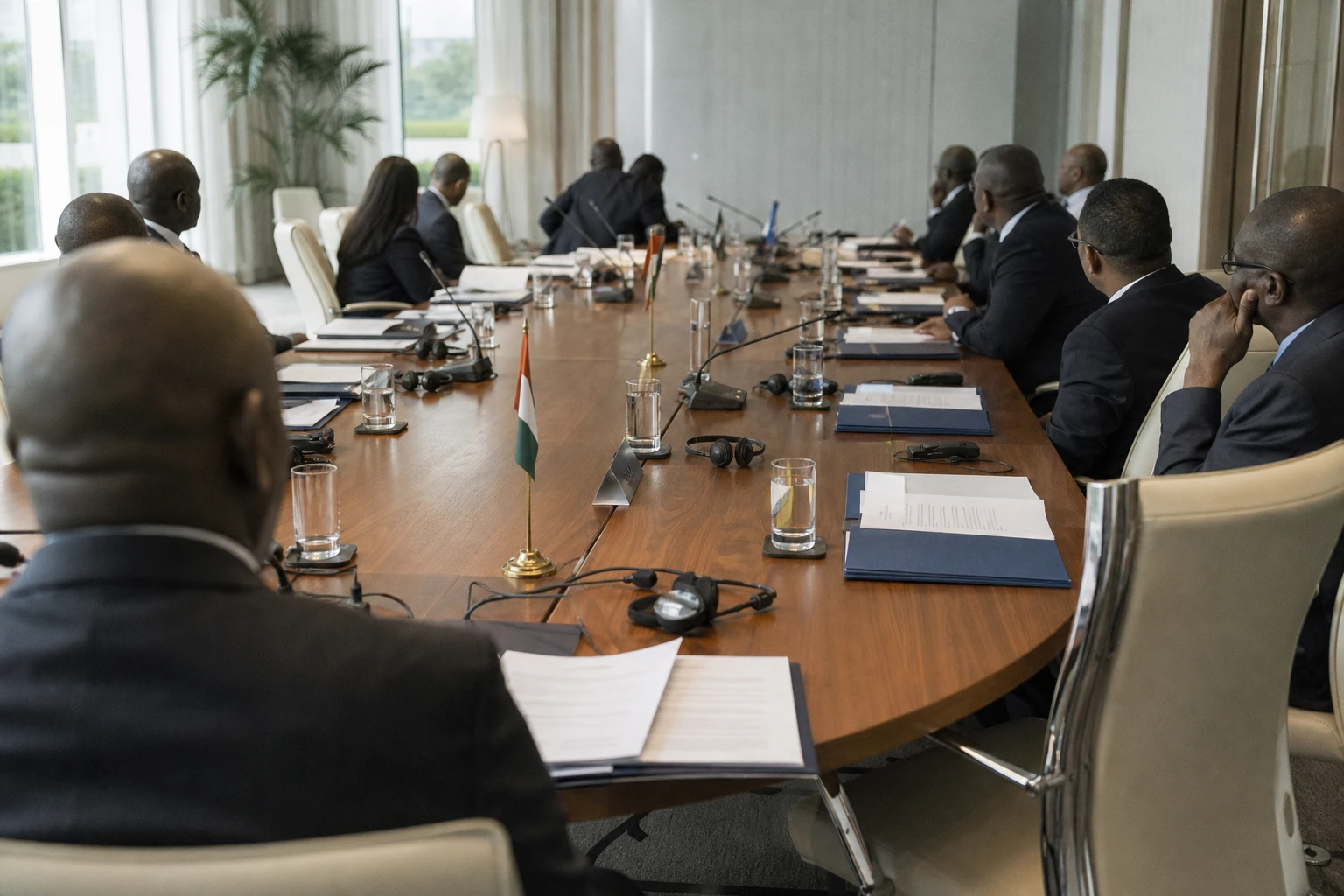
In Yamoussoukro, Côte d’Ivoire’s political capital, football has not only chosen a president. It has also renewed a method, an agenda and a promise: to turn continental momentum into a lasting foundation. Yacine Idriss Diallo, the sole candidate, was elected to a new term at the helm of the Ivorian Football Federation (FIF), following a process that began in August 2026 and was confirmed by the campaign launched in Abidjan on 2 September.
The vote comes as the country is still buoyed by memories of the Elephants’ triumph at the 2023 Africa Cup of Nations, played in 2024 on Ivorian soil. That victory restored a level of visibility to Ivorian football that few on the continent would dispute today. But it also set a higher bar: that of a sport which must no longer live only for its nights of glory.
From continental title to rebuilding the day-to-day
Idriss Diallo’s first term began as the federation emerged from a crisis. In 2022, the FIF was coming out of a long period of institutional turmoil, following a normalisation process led by FIFA. The election won that year brought a period of deadlock to a close, without erasing divisions over governance, the domestic league and club funding.
Four years later, the outgoing president’s record rests first and foremost on the national team. The argument is a strong one: Côte d’Ivoire won AFCON 2023 and reclaimed a prominent place in the African football imagination. At the same time, Idriss Diallo has gained influence in the continent’s governing bodies, having been co-opted onto the CAF Executive Committee in April 2025.
This institutional standing matters. It gives the FIF a stronger voice in African debates on competitions, calendars and governance. In a West Africa structured around ECOWAS, sporting competition is also a source of regional prestige. Ivorian football therefore speaks not only to its supporters; it also measures itself against its neighbours on the Gulf of Guinea and across West Africa.
The domestic league remains the real challenge
The sticking point has remained the same for years: local football. The national team draws crowds, titles, sponsors and symbolic capital. The league, by contrast, still struggles to fill stadiums and retain its talent. Several Ivorian observers are blunt: the public has drifted away from the stands, the best prospects leave for Europe early, and the domestic product remains fragile.
The FIF has nevertheless tried to put money back at the heart of the game. In 2022, the basic monthly salary for Ligue 1 players was set at 160,000 CFA francs per player, a decision presented as a social minimum to help professionalise the league. In 2026, Idriss Diallo’s campaign promised to go further: the annual subsidy for Ligue 1 would rise to 140 million CFA francs, compared with 70 million for Ligue 2, with increases also announced for Division 3 and women’s football.
These figures point to something essential: the issue is not limited to prestige; it concerns the clubs’ economic survival. In a league where ticketing revenues remain low and the informal economy around matches often outweighs official income, the question is not simply how to distribute more money. Clubs also need to learn to generate their own resources, sell more effectively, develop players better and build greater loyalty.
Women’s football and young players: work still to be done
The first term also focused on young people and women, but did not resolve every blind spot. Côte d’Ivoire’s women’s team has returned to the continental top level, and CAF highlighted the Ivorians’ return to African competition in 2026. Yet sporting results remain inconsistent, and the gap with the best-structured nations is still clear.
In this area, the promise is not only sporting. It is social. Strengthening women’s competitions, professionalising coaching and investing in development mean broadening the base of Ivorian football rather than concentrating all its value in the men’s senior team. It also gives depth to a system that too often lives according to the rhythm of major tournaments alone.
Player development will remain central. Côte d’Ivoire continues to produce players who make their mark on the biggest stages, but individual success is not enough to sustain a strong league. The next term will therefore have to balance the urgency of results with the long-term work of building structures. That is where the difference between a golden interlude and a lasting model will be decided.
What the election says about Ivorian and African football
Yacine Idriss Diallo’s re-election says something about the current moment in Africa. The continent’s federations are no longer judged only on their trophies. They are also judged on their ability to run a league, protect clubs, fund the next generation and negotiate a clearer place in the governing bodies. CAF has demonstrated this by bringing more national leaders into its working bodies.
For Côte d’Ivoire, the challenge is now easy to state, but difficult to meet: retain its standing without living in the memory of the 2024 triumph. The country, whose capital is Yamoussoukro, has proved that it can host, win and attract. It must now prove that it can sustain that success. Idriss Diallo’s second term will be judged on this: on its ability to turn a national victory into a credible system for clubs, women players, young people and Ivorian football as a whole.



