Algeria
 Egypt
 Libya
 Morocco
 Sudan
 Tunisia
 Benin
 Burkina Faso
 Cabo Verde
 Côte d'Ivoire
 Ghana
 Guinea-Bissau
 Liberia
 Mali
 Mauritania
 Niger
 Nigeria
 Senegal
 Sierra Leone
 The Gambia
 Togo
 Cameroon
 Central African Republic
 Chad
 DR Congo
 Equatorial Guinea
 Gabon
 Republic of the Congo
 São Tomé and Príncipe
 Burundi
 Comoros
 Djibouti
 Eritrea
 Ethiopia
 Kenya
 Madagascar
 Malawi
 Mauritius
 Mozambique
 Rwanda
 Seychelles
 Somalia
 South Sudan
 Tanzania
 Uganda
 Angola
 Botswana
 Eswatini
 Lesotho
 Namibia
 South Africa
 Zambia
 Zimbabwe
In Kankan, security is no longer just a street-level concern
In this Upper Guinea city, fear does not travel alone. It moves alongside rumours, armed robberies, nearby borders and camps linked to gold mining. When a municipality now asks residents to report the arrival of visitors from elsewhere, it touches on a longstanding balance: that of a trading city where hospitality is part of local identity, but where insecurity is driving the authorities to tighten surveillance.
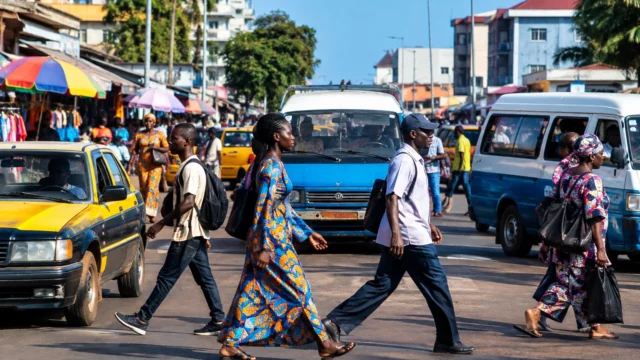
Kankan is no peripheral town. It is the regional capital of Upper Guinea, the country’s second-largest city by population and a crossroads linked to Mali, in a region covering 72,145 km² and home to more than 2.4 million people in 2022. The city also lies at the heart of a mining and agricultural area through which seasonal workers, traders, gold miners and families from several localities pass. This mobility fuels the local economy. It also makes the authorities’ work more difficult when security deteriorates.
What the municipality says, and why it is divisive
The new municipal notice imposes two obligations that have sparked debate: every head of household hosting someone from another locality must immediately inform the neighbourhood chief, and it is now forbidden to put up a foreign visitor without first notifying the same local authority. The measure forms part of an informal effort to register people present in neighbourhoods, already outlined in other security initiatives taken in Kankan in recent months.
Local authorities say they are acting after the murder of a man whose decapitated body was found in Salamani on 18 August 2026, a crime that deeply affected the public. Local sources confirmed the discovery of the body, while administrative officials said an investigation was under way. At the same time, the municipality cites the presence of workers from Mali, Burkina Faso and Côte d’Ivoire, showing how security concerns are intertwined with the everyday reality of regional mobility.
For some civil society groups and residents, the problem is not the stated aim. It is the method. By referring to systematic checks on visitors and a ban on hosting people without reporting them, local authorities are giving a general restriction the shape of a community-policing measure. In a city where hospitality, or “sérè”, remains a strong social value, many see this as a dangerous shift from prevention to suspicion.
A local response within an already restrictive national framework
Guinea already has a legal framework governing the entry and stay of foreign nationals. The Ministry of Security and Civil Protection says foreign visitors must meet specific conditions for entry, residence and, in some cases, accommodation. Official legislation also provides that a foreign national’s presence may be refused or restricted if it threatens public order. In other words, the issue is not new. What is changing in Kankan is the level of constraint imposed on neighbours and neighbourhood chiefs.
The local decision also runs up against a broader principle: free movement in West Africa. ECOWAS, of which Guinea is a member, is mandated to facilitate the movement of people across the region. Its founding protocol seeks to progressively abolish barriers to that freedom. In this context, a municipal measure requiring every host to report their guests may be seen as an emergency response, but also as a sign of administrative unease in an already strained regional space.
The inference is straightforward: Kankan is not legislating against ECOWAS, but it is testing the scope for local authorities to act when security is perceived as inadequate. West Africa has for several years faced particular tensions between free movement and border security, especially after the coups in Mali, Burkina Faso and Niger, followed by the three countries’ effective departure from ECOWAS in January 2025. This reshaping of the region makes every control measure more sensitive than before.
Gold mining, porous borders and an economy of movement
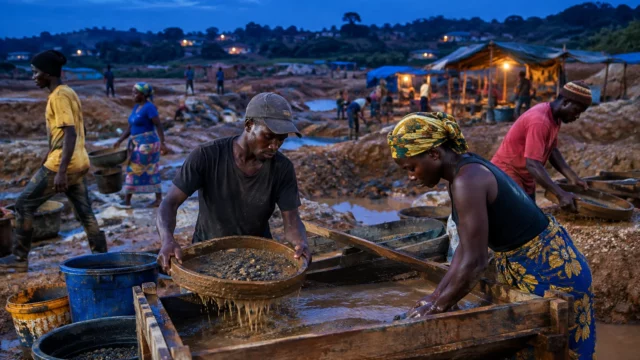
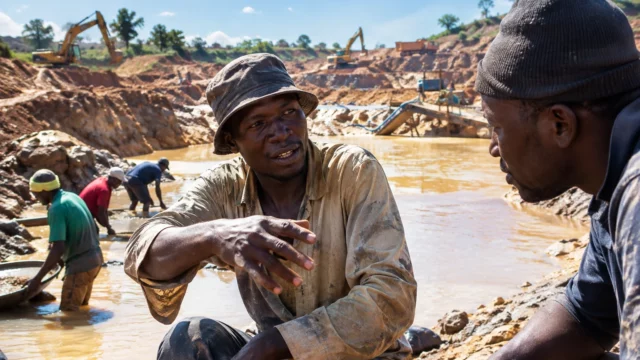
Life in Upper Guinea revolves around fields, markets and gold-mining sites. National statistics show that the Kankan region accounts for a large share of the population and has an economy structured around agriculture, livestock farming and gold mining. Research by the African Development Bank and Guinean sources highlights that the area attracts young people from other parts of the country as well as neighbouring African states. Mining camps, often temporary, mean a constant flow of people.
The problem is therefore not solely criminal. It is also territorial. Kankan lies in a border area where movement to and from Mali remains heavy, and where technical work on the demarcation of the shared border is still under way between the two states. Guinean authorities themselves acknowledge that the issues concern agricultural land, gold-mining sites and other resources on both sides of the border.
In this context, Kankan’s municipal authorities are seeking to regain control over what they can see: who arrives, who hosts them, who moves around and where they sleep. The logic is administrative. It is also political. The more exposed the city feels, the more it asks its local intermediaries, the neighbourhood chiefs, to take on a role akin to neighbourhood policing. But this approach could undermine trust between residents, internal migrants and foreign visitors, even as the city’s livelihood depends on these movements.
What the case says about Guinea and West Africa
The episode in Kankan goes beyond a municipal matter. It shows how, in West Africa, local security, regional mobility and the informal economy are so intertwined that they can produce administrative responses that are sometimes heavy-handed. A border, mining and trading city cannot be governed as a closed space. But nor can it ignore residents’ calls for protection when violence recurs.
At continental level, the case recalls a broader debate: how to improve security without disrupting the movement of people or turning neighbours into suspects by default. The issue matters to ECOWAS and, more broadly, to the African Union, which champions intra-African mobility as a driver of integration. In Kankan, the next test will not be just how the notice is enforced. It will be how it is received in neighbourhoods, at work sites and in neighbouring municipalities, where the line between vigilance and excessive control is measured every day.