Algeria
 Egypt
 Libya
 Morocco
 Sudan
 Tunisia
 Benin
 Burkina Faso
 Cabo Verde
 Ghana
 Guinea
 Guinea-Bissau
 Liberia
 Mali
 Mauritania
 Niger
 Nigeria
 Senegal
 Sierra Leone
 The Gambia
 Togo
 Cameroon
 Central African Republic
 Chad
 DR Congo
 Equatorial Guinea
 Gabon
 Republic of the Congo
 São Tomé and Príncipe
 Burundi
 Comoros
 Djibouti
 Eritrea
 Ethiopia
 Kenya
 Madagascar
 Malawi
 Mauritius
 Mozambique
 Rwanda
 Seychelles
 Somalia
 South Sudan
 Tanzania
 Uganda
 Angola
 Botswana
 Eswatini
 Lesotho
 Namibia
 South Africa
 Zambia
 Zimbabwe
A political case that goes beyond one name
In Abidjan, a judicial summons can quickly become a test of democratic breathing space. In a country where the opposition and the authorities keep a close eye on each other as political deadlines approach, every period in police custody is read as a signal. It says something about the relationship between public speech, justice and electoral competition in Côte d’Ivoire.
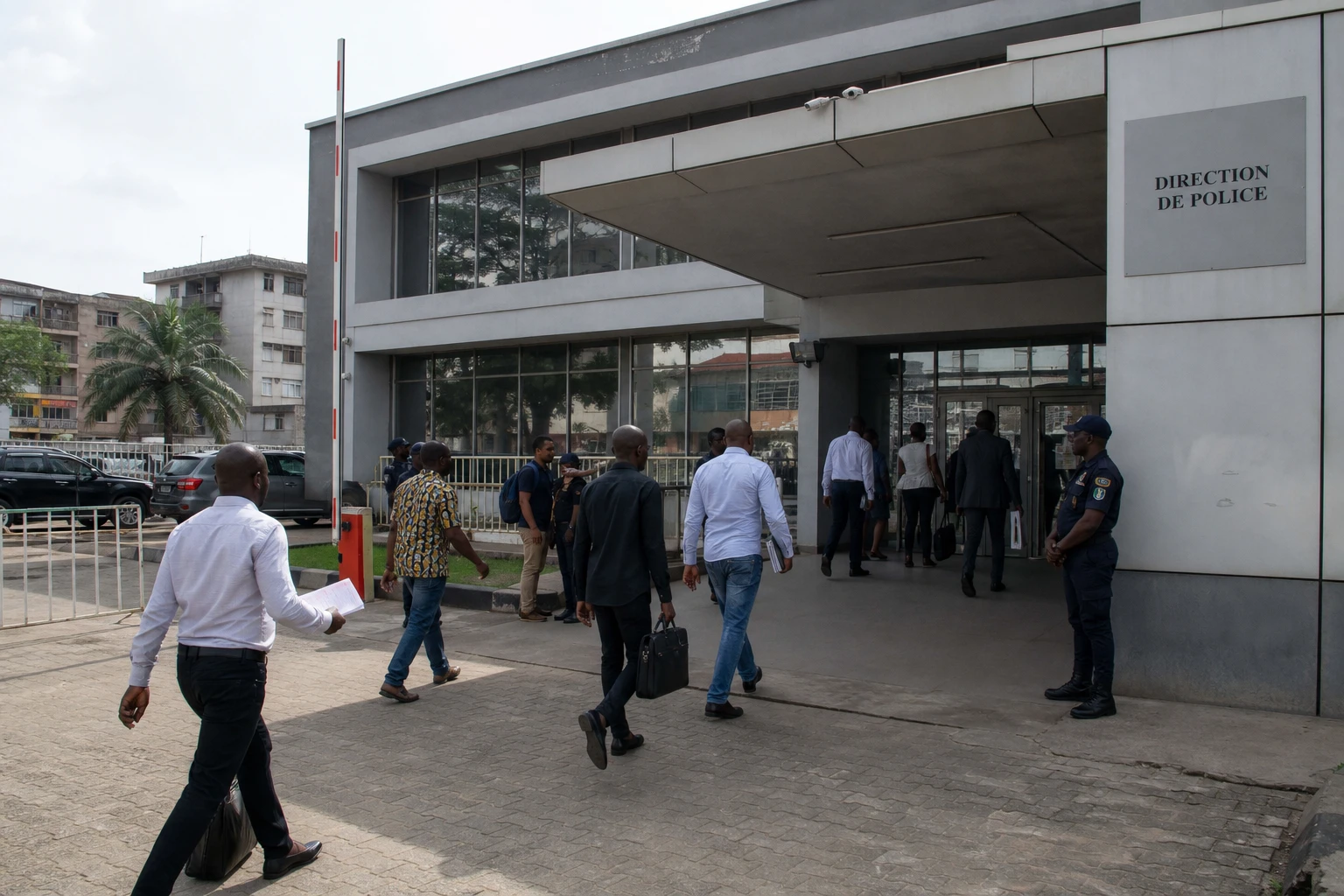
The case of Justin Koné Katinan has emerged against this backdrop. The fourth vice-president of the PPA-CI, Laurent Gbagbo’s party, was questioned on 9 September 2026 at Abidjan police headquarters in Abobo, following a complaint lodged by the ruling RHDP. The proceedings concern remarks made at a PPA-CI forum on 3 September, and involve accusations of defamation, insults and the dissemination of false news.
An election context that remains sensitive
Côte d’Ivoire has only just emerged from the 2025 presidential election period. The Independent Electoral Commission had set the vote for 25 October 2025, and the presidency subsequently confirmed Alassane Ouattara’s re-election. In this kind of period, any proceedings targeting an opposition figure take on immediate political significance, particularly in a country that remains ECOWAS’s main institutional and economic hub in West Africa.
This context matters all the more because, in recent months, the Ivorian authorities have repeatedly issued messages about public order, the circulation of false information and the responsibility of political actors. Back in September 2025, the National Security Council warned of hateful and subversive statements circulating after the publication of the final list of presidential candidates. The current episode extends this tension between public security and freedom of expression.
What has been established in the case
The known facts are specific. Justin Koné Katinan appeared on 9 September 2026 at Abidjan police headquarters, on the instructions of the public prosecutor. The RHDP accuses him over statements made at the PPA-CI’s 52nd forum, held on 3 September in Cocody. According to several Ivorian media outlets, the complaint was lodged on 7 September and concerns remarks deemed defamatory.
The following day, the PPA-CI publicly denounced an offensive against its officials. The party speaks of an instrumentalised justice system and an attempt to criminalise political speech. For his part, government spokesman Amadou Coulibaly distanced himself from the proceedings. He stressed that the executive had not initiated the complaint and defended freedom of expression which, he said, must go hand in hand with responsibility.
One more sensitive point remains. According to information reported by one of Justin Koné Katinan’s lawyers, the extension of his time in police custody is said to be linked to a second line of investigation, relating to public-order disturbances mentioned in connection with the 2025 presidential election. At this stage, the precise nature of these alleged events has not been made public. They must therefore be presented as attributed information, not as a fully established fact.
The real question: where does debate end and criminal law begin?
In Côte d’Ivoire, this case touches a fine line. On one side, the authorities argue that freedom of expression does not mean anything goes. On the other, the opposition sees the legal pursuit of public statements as a way to shrink the space for political debate. The boundary is all the more fragile because the accusations concern highly charged subjects: illegal gold mining, security, alleged corruption and the effects of electoral competition.
The choice of subject for the forum was no coincidence. Illegal gold mining remains a major issue in Côte d’Ivoire. The authorities describe it as a phenomenon that degrades forests, pollutes water, weakens communities and fuels illicit networks. In Yamoussoukro, in early September 2026, a national workshop even adopted an action plan to strengthen the fight against this trafficking, with official figures reporting more than 8,500 operations conducted since 2021, 4,665 people referred to the courts and more than one billion CFA francs seized.
In this context, Katinan Koné’s remarks touch on a sensitive point in Ivorian public debate: who can identify networks, complicity and responsibility without crossing the line into a criminal offence? For the authorities, the case for protecting public order remains central. For the opposition, the risk is the selective use of criminal proceedings. This dispute goes beyond Katinan himself. It speaks to how Côte d’Ivoire has, for several years, balanced institutional stability with the opening up of political space.
An Ivorian issue with West African implications
This case matters beyond the domestic political front. In West Africa, ECOWAS closely monitors countries emerging from tense elections or periods of distrust between governing majorities and opposition parties. Côte d’Ivoire, given its size, economic weight and diplomatic standing, often serves as a regional barometer. A case such as this is therefore not only judicial; it also shapes political assessments of the country’s stability.
What happens next will depend on a judicial timetable that remains far from transparent, as well as on how each camp chooses to address its supporters. If the investigation remains confined to specific facts, it can be presented as a matter of ordinary law. If it expands to encompass a political interpretation of dissent, tensions between the RHDP and the PPA-CI risk hardening further. In a country where the next major battles will be fought as much in the courts as at the ballot box, the significance of this detention already extends well beyond Abobo.