Algeria
 Egypt
 Libya
 Morocco
 Sudan
 Tunisia
 Benin
 Burkina Faso
 Cabo Verde
 Côte d'Ivoire
 Ghana
 Guinea-Bissau
 Liberia
 Mali
 Mauritania
 Niger
 Nigeria
 Senegal
 Sierra Leone
 The Gambia
 Togo
 Cameroon
 Central African Republic
 Chad
 DR Congo
 Equatorial Guinea
 Gabon
 Republic of the Congo
 São Tomé and Príncipe
 Burundi
 Comoros
 Djibouti
 Eritrea
 Ethiopia
 Kenya
 Madagascar
 Malawi
 Mauritius
 Mozambique
 Rwanda
 Seychelles
 Somalia
 South Sudan
 Tanzania
 Uganda
 Angola
 Botswana
 Eswatini
 Lesotho
 Namibia
 South Africa
 Zambia
 Zimbabwe
A pressured crossroads
In Labé, in Middle Guinea, the road is more than a strip of tarmac. It is a commercial artery. When it is blocked, drivers, passengers, traders and markets in Conakry immediately feel the impact. Since 7 September 2026, transporters on several Guinean routes say they have reached breaking point over road checks they consider abusive.
The movement began in a strategic area. Labé lies at the heart of routes to Senegal and Gambia, two important outlets for trade in the north of the country. In this part of Guinea, roads carry both local commerce and regional flows. The Guinean authorities themselves acknowledge that the smooth operation of road corridors is a major economic concern, particularly on inter-state routes linked to ECOWAS, the Economic Community of West African States.
What the drivers are protesting
According to several unions and Guinean media outlets, the strike began on the Labé-Senegal and Labé-Gambia routes before spreading to other journeys. By 8 September, transport services in Labé were already disrupted. On 9 September, the movement had spread to other routes, including those to Conakry, Mamou, Kankan and Nzérékoré, as solidarity widened the stoppage.
Transporters speak of “road harassment”, repeated checks and informal payments demanded at every checkpoint. Some even describe “systematic extortion”. A driver quoted by the local press says the levies can reach very high amounts on some routes. These figures should remain attributed to witnesses, as they vary depending on the route, vehicles and reported checkpoints.
The complaint is not directed at the traffic police alone. Drivers also cite customs and the gendarmerie among the services present along the routes. In Labé, a meeting between unions, the governor’s office and representatives of the security forces failed to ease tensions on 9 September. Talks then continued in Conakry, a sign that the issue has moved up a level.
Why the strike matters beyond Labé
Inter-city transport in Guinea plays a role that is often underestimated. It connects the capital, Conakry, with the major cities inland. It also links Guinea to its neighbours. When drivers in Labé stop operating, passengers wait, goods pile up and traders delay deliveries. The first impact is immediate for households. The second affects the small distribution networks that supply cities and prefectures.
The disruption comes in a region where the state and its partners have nonetheless put forward several projects to improve access. The Guinean government and the African Development Bank have highlighted the Labé-Mali-Kédougou inter-state road as a way to reduce transport costs and facilitate trade with Senegal. In 2026, the authorities also announced new funding for the northern corridor and the Labé-Tougué-Bafing-Koubia road. In other words, the country knows its roads are worth more than their local function: they structure sub-regional trade.
The problem goes deeper than the confrontation of the day. Several Guinean laws and official statements have long referred to persistent obstacles to movement, the failure to apply certain transit rules and non-compliance with vehicle weight limits. In 2026, the government even launched a national road safety strategy. This shows that the issue is not new. It involves control of road space, efforts to combat informal practices and the state’s ability to enforce the same rules across the country.
Conakry’s response and the political stakes
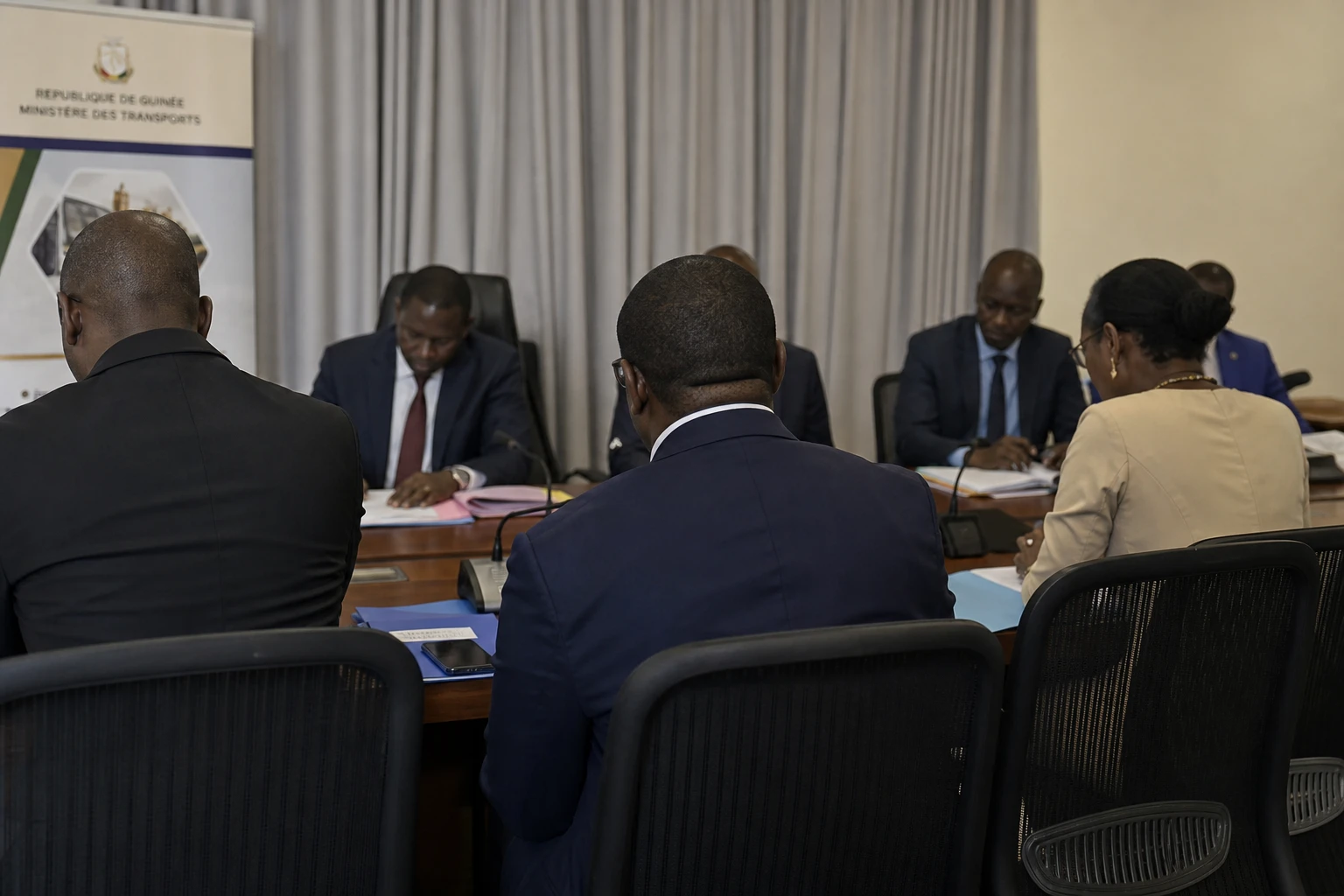
In Conakry, Transport Minister Ousmane Gaoual Diallo said he wanted to investigate allegations of extortion and illegal roadblocks. He also reiterated that checks on overloading and enforcement of the Highway Code would be carried out firmly. The message is clear: the state promises to investigate abuses, but is not abandoning the idea of strict regulation of road transport.
This position leaves the government walking a narrow line. On the one hand, it must respond to public anger in a vital sector. On the other, it wants to show that road discipline will not be relaxed. For drivers, the real question is simple: can a public check remain legitimate if it feels repetitive, costly and unpredictable? For the authorities, the stakes are just as clear: without credible rules, the road becomes a place for arbitrary levies, and trust disappears.
The issue also extends beyond Guinea. The Labé-Senegal and Labé-Gambia corridors form part of the West African ECOWAS area, where the free movement of people and goods remains a central principle, often tested in practice. When a cross-border route is blocked, the disruption does not stop at the neighbouring prefecture. It affects trade between states, food prices and the country’s logistics reputation.
What to watch in the coming days
The next steps will unfold in Conakry and along the affected routes. If the talks lead to verifiable measures at checkpoints, the strike could be defused. If nothing changes, transporters already have a powerful lever: bringing mobility to a halt. In a country where Conakry accounts for a large share of administrative and commercial activity, this ability to block traffic is a reminder that roads are also a place where power is contested.
For Guinea, the dispute points to something broader. It shows that infrastructure upgrades are not enough if practices on the ground remain contested. It also serves as a reminder that a road corridor is never just a construction project. It is a daily compact between the state, enforcement agencies, drivers and road users. When that compact frays, the entire local and regional economic balance is shaken.