
 Algeria
 Egypt
 Libya
 Morocco
 Sudan
 Tunisia
 Benin
 Burkina Faso
 Cabo Verde
 Côte d'Ivoire
 Ghana
 Guinea
 Guinea-Bissau
 Liberia
 Mali
 Mauritania
 Niger
 Nigeria
 Senegal
 Sierra Leone
 The Gambia
 Togo
 Cameroon
 Central African Republic
 Chad
 Equatorial Guinea
 Gabon
 Republic of the Congo
 São Tomé and Príncipe
 Burundi
 Comoros
 Djibouti
 Eritrea
 Ethiopia
 Kenya
 Madagascar
 Malawi
 Mauritius
 Mozambique
 Rwanda
 Seychelles
 Somalia
 South Sudan
 Tanzania
 Uganda
 Angola
 Botswana
 Eswatini
 Lesotho
 Namibia
 South Africa
 Zambia
 Zimbabwe
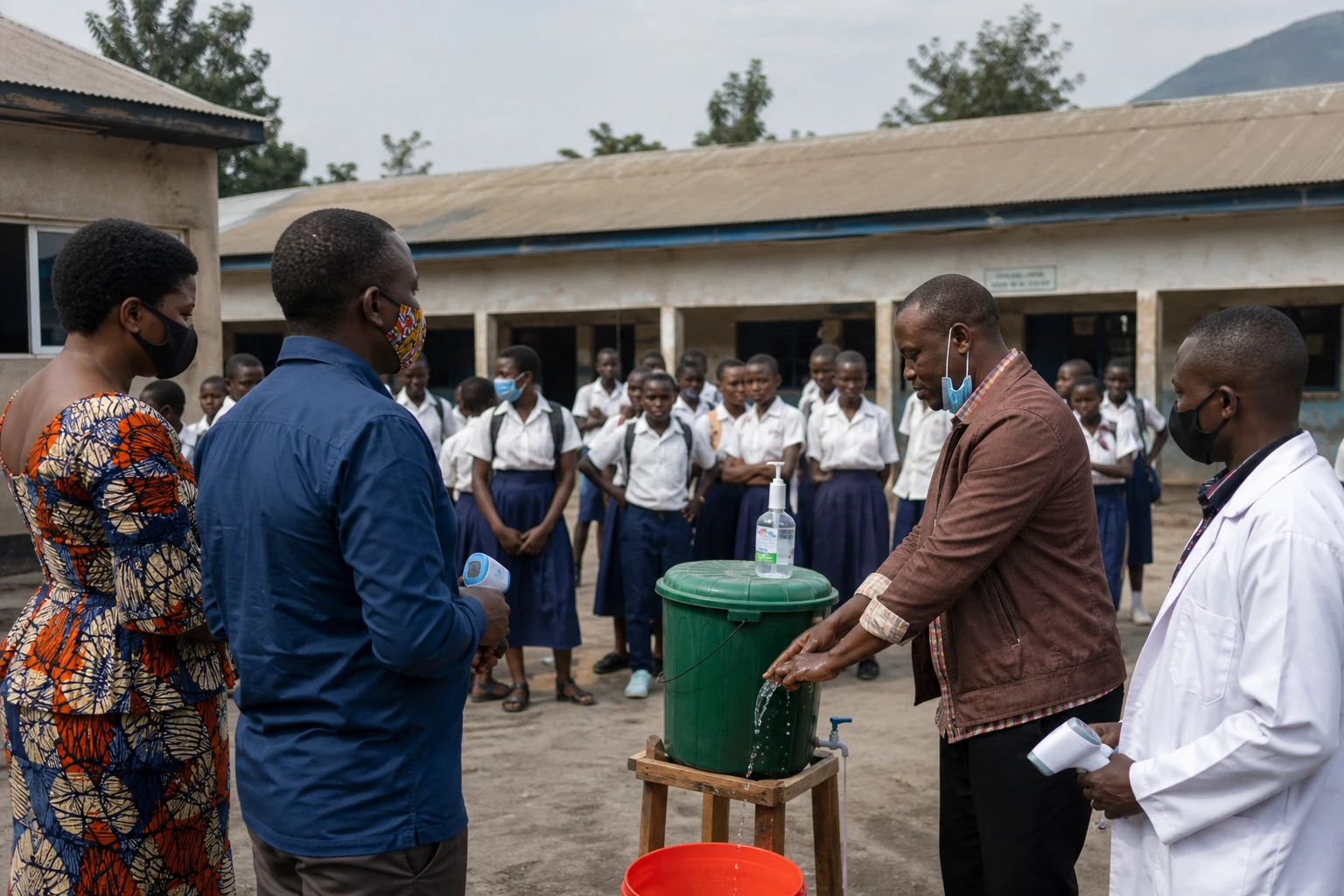
In Beni, school remains a health front as well as a place of learning
In the east of the Democratic Republic of the Congo, the start of the school year is never just about exercise books and uniforms. In Beni, it also means buckets, thermometers, more frequent handwashing than elsewhere, and a very real concern: how can lessons continue while an Ebola epidemic is still circulating in the region? Pupils, parents and teachers are facing this dual imperative. Learning, yes. Staying safe, above all.
This issue is part of a broader national context. Since May 2026, DR Congo has been facing a new outbreak of Ebola caused by the Bundibugyo virus, declared in the east of the country. In Kinshasa, the government launched a revised 180-day plan on 4 September with support from the WHO, Africa CDC and the United Nations system. In the eastern provinces, the authorities must contend with insecurity, population displacement and unequal access to health services. These are very local constraints, but their effects extend far beyond the borders of North Kivu and Ituri.
Survivors on the front line to reduce fear
In Beni, Ebola survivors visited schools at the start of the school year to talk to pupils about prevention, vigilance and transmission. Their message is simple: the disease is not a distant story; it has affected families, neighbours and teachers in the city. One of the aims of this initiative is to build trust. The most effective campaigns do not come only from posters or instructions handed down from above. They also rely on people who have lived through the disease, speak frankly and can address fears through their own experience.
This approach is not new in DR Congo. During previous outbreaks, particularly in the Beni area, survivors have already acted as community representatives to combat stigma and spread public health messages. For several years, the WHO has highlighted the role of former patients in building community engagement. In a context where rumours spread quickly and social isolation can discourage people from reporting their illness, their voices matter as much as medical protocols.
The initiative also has practical value. In Ituri, the 2026 school year went ahead despite concerns. In some schools, officials cited contactless thermometers, soap and handwashing facilities. But resources remain uneven. Teachers say they go without water for several days, and sometimes lack basic equipment to check pupils’ temperatures. In other words, prevention often relies on simple equipment, but its day-to-day availability remains precarious.
A health response under pressure in a region already battered
The available figures show the scale of the challenge. In early September 2026, figures released by health authorities and cited by international partners reported several thousand confirmed cases and thousands of deaths in the outbreak, which had spread rapidly since mid-May. The WHO said the epidemic had expanded quickly, while UNICEF warned of a sharp decline in the use of essential health services in the worst-affected areas. Between April and June 2026, the use of basic health services fell by 42% in Ituri’s main transmission hotspots.
This decline has immediate consequences. When families delay consultations, vaccinations or births at health facilities, the health costs go beyond Ebola alone. Children risk missing other vital care. Pregnant women avoid health centres. Frontline workers face more demanding conditions. For an already fragile province, the epidemic acts as a multiplier of vulnerability, not merely as an infectious disease crisis.
The challenge is even more pronounced in eastern DR Congo, where insecurity complicates contact tracing, community surveillance and the logistics of mobile teams. The WHO has said the response now relies more heavily on local communities, with adapted treatment centres and dialogue mechanisms closer to residents. This shift is important. It shows that the fight against Ebola in DR Congo depends not only on laboratories and vaccines. It also depends on access to villages, the flow of information and the ability to remain present in areas that are sometimes difficult to reach.
What the case of Beni reveals about DR Congo and the continent
The case of Beni is a reminder of a constant in DR Congo: the response to epidemics is stronger when it brings together institutions, communities and survivors. The Congolese government, provincial authorities, the WHO, UNICEF and Africa CDC are working together, but experience on the ground shows that no strategy can endure without local ownership. This is particularly true in schools, where a poorly understood instruction can fuel fear, rejection or absenteeism.
At regional level, DR Congo plays a central role in health security in Central Africa and the Great Lakes. Population movements, trade and proximity to Uganda make containing the epidemic essential beyond Congo’s borders alone. Africa CDC and the WHO have also coordinated a continental response and mechanisms for co-operation with neighbouring countries. In this context, every school kept safe, every case isolated in time and every trust restored becomes a link in the chain of regional health stability.
Perhaps the most lasting significance of this period is this: the fight against Ebola is not only a hospital battle. It is also about education, memory and social ties. In Beni, survivors are reminding pupils that a community can learn to protect itself without giving up on school. For DR Congo, the challenge is to hold both fronts at once. And for Central Africa, it is to turn this experience into lasting capacity to respond to future health emergencies.



