Algeria
 Egypt
 Libya
 Morocco
 Sudan
 Tunisia
 Benin
 Burkina Faso
 Cabo Verde
 Côte d'Ivoire
 Ghana
 Guinea
 Guinea-Bissau
 Liberia
 Mali
 Mauritania
 Niger
 Nigeria
 Senegal
 Sierra Leone
 The Gambia
 Togo
 Cameroon
 Central African Republic
 Chad
 DR Congo
 Equatorial Guinea
 Gabon
 Republic of the Congo
 São Tomé and Príncipe
 Burundi
 Comoros
 Djibouti
 Eritrea
 Ethiopia
 Kenya
 Madagascar
 Malawi
 Mauritius
 Mozambique
 Rwanda
 Seychelles
 Somalia
 South Sudan
 Tanzania
 Angola
 Botswana
 Eswatini
 Lesotho
 Namibia
 South Africa
 Zambia
 Zimbabwe
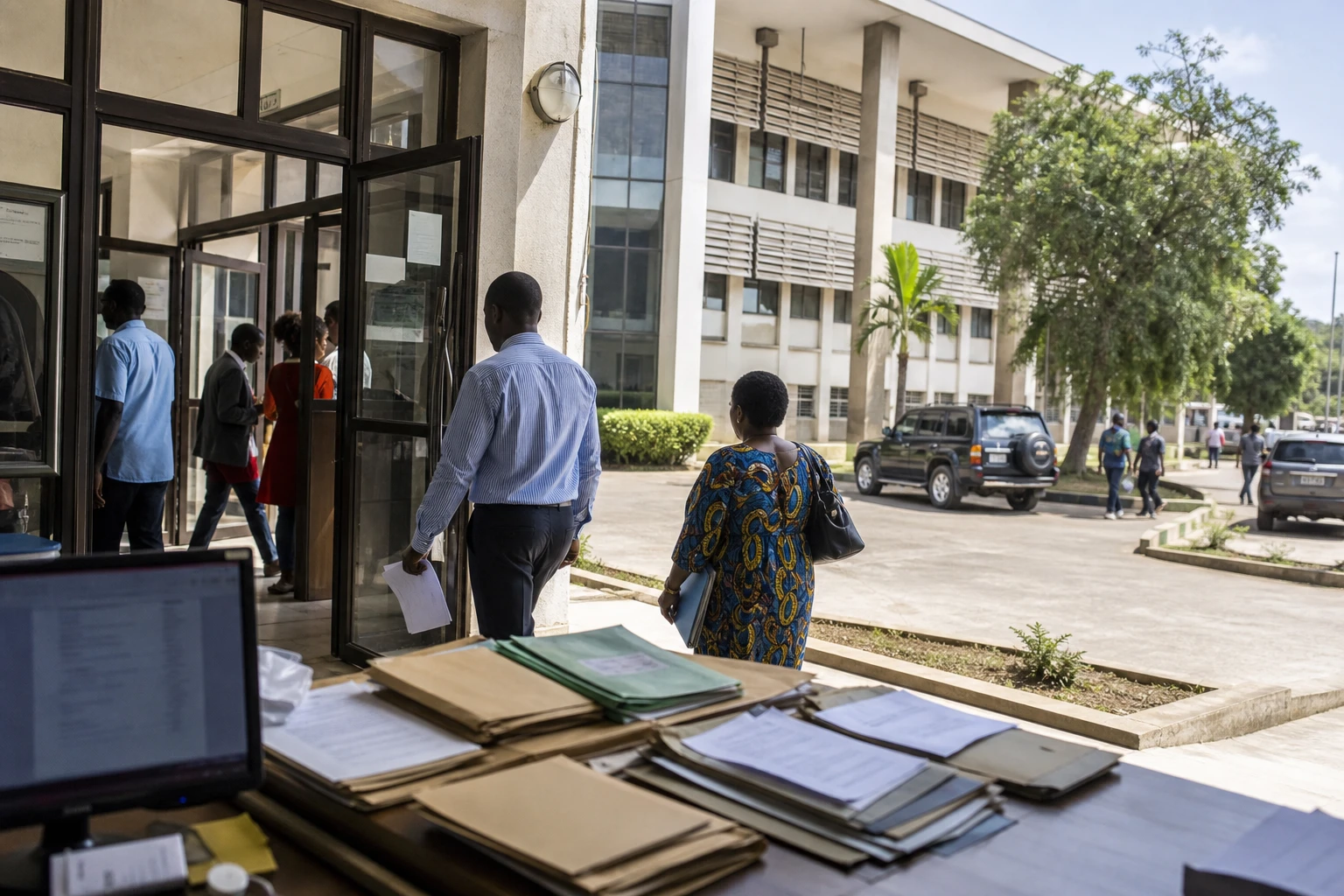
Reparations must finally move beyond announcements
In Kisangani, in the east of the Democratic Republic of the Congo, war victims are no longer asking for promises. They are waiting for visible services: a school that is standing, a health centre that works, a water point that does not break down at the first power cut. That is the challenge behind the collective reparations now announced in Ituri, Tshopo, Haut-Uele and Bas-Uele.
The case is rooted in a longstanding but still relevant legal framework. In 2022, the International Court of Justice set the amount owed by Uganda to the DRC at $325 million, payable in five annual instalments of $65 million from 1 September 2022. The ICJ ruling thus turned a wartime dispute into a quantified reparation obligation, with a precise deadline and a payment mechanism spread over time.
In this context, the Special Fund for the Distribution of Compensation to Victims of Uganda’s Illicit Activities in the DRC, known by its French acronym FRIVAO, must prove that it can manage sensitive public funds without losing them in administrative channels. Congolese authorities have already acknowledged the need to overhaul the system. In autumn 2025, and then in early 2026, they referred to a recovery plan, an audit and a resumption of activities on a stricter footing.
On 9 September 2026, the Congolese Ministry of Justice announced that $120 million had been allocated to collective reparations. The sum is divided into four tranches of $30 million, one for each of the provinces concerned: Ituri, Tshopo, Haut-Uele and Bas-Uele. The Congolese Press Agency reported the announcement, specifying that this first phase targets communities directly affected by illicit activities attributed to Uganda during the 1998-2003 war.
The choice of these provinces is no coincidence. Tshopo, including Kisangani, remains associated with the aftermath of the Six-Day War. Ituri still bears the weight of repeated violence and displacement. Haut-Uele and Bas-Uele also suffered the indirect effects of that period of war, in areas where access to basic infrastructure remains fragile. In practice, collective reparations must therefore address very tangible needs, going far beyond symbolic recognition of harm.
Transparency, oversight and the practical use of funds
The heart of the debate is no longer just reparations. It has become a budgetary, administrative and political issue. In recent months, several Congolese sources have reported allegations of mismanagement, disputed disbursements and a lack of traceability for some of the funds already received. A judicial proceeding has even been launched over financial transactions linked to FRIVAO, evidence that governance now weighs as heavily as compensation itself.
The government says it wants to prevent a repeat of these failings. In Kisangani in spring 2026, the justice minister of state presented a recovery plan for the fund and warned of manipulation and massive embezzlement estimated at $53 million in some institutional exchanges. At the next stage, the authorities emphasised the validation of priority projects with local stakeholders, in order to tie reparations to communities’ actual needs rather than decisions imposed from above.
The announced approach also changes the relationship between Kinshasa and the provinces. Beneficiaries are to take part in choosing and monitoring projects. This is essential in a country as large as the DRC, where the distance between central decision-making and local realities often produces ill-suited programmes. If the mechanism delivers on its promises, the funds could finance infrastructure useful to civilians: primary healthcare, schools and drinking water, as well as economic activities or commemorative initiatives for traumatised communities.
This approach aligns with a broader logic already evident in the DRC’s reparation policy. The country has established other public instruments for victims of sexual violence or crimes against peace and the security of humanity, signalling that reparations are becoming an acknowledged part of public policy. But a reparation mechanism is legitimate only if it is transparent, accountable and useful. Otherwise, it fuels mistrust rather than reducing it.
For victims, the announced second phase, covering individual reparations, is still awaited. It will depend on audits, verification of records and validation of eligible claimants. For the Congolese state, the stakes go beyond FRIVAO alone: they concern the credibility of the entire compensation management chain, in a country where reparations are also a test of governance. At regional level, the case is also a reminder that an international ruling can have tangible effects, provided it is implemented rigorously at national level. In the Great Lakes region and within the African Union, the monitoring of these reparations will therefore shape perceptions of reparative international law among the societies that have borne the heaviest cost of war.