Algeria
 Egypt
 Libya
 Morocco
 Sudan
 Benin
 Burkina Faso
 Cabo Verde
 Côte d'Ivoire
 Ghana
 Guinea
 Guinea-Bissau
 Liberia
 Mali
 Mauritania
 Niger
 Nigeria
 Senegal
 Sierra Leone
 The Gambia
 Togo
 Cameroon
 Central African Republic
 Chad
 DR Congo
 Equatorial Guinea
 Gabon
 Republic of the Congo
 São Tomé and Príncipe
 Burundi
 Comoros
 Djibouti
 Eritrea
 Ethiopia
 Kenya
 Madagascar
 Malawi
 Mauritius
 Mozambique
 Rwanda
 Seychelles
 Somalia
 South Sudan
 Tanzania
 Uganda
 Angola
 Botswana
 Eswatini
 Lesotho
 Namibia
 South Africa
 Zambia
 Zimbabwe
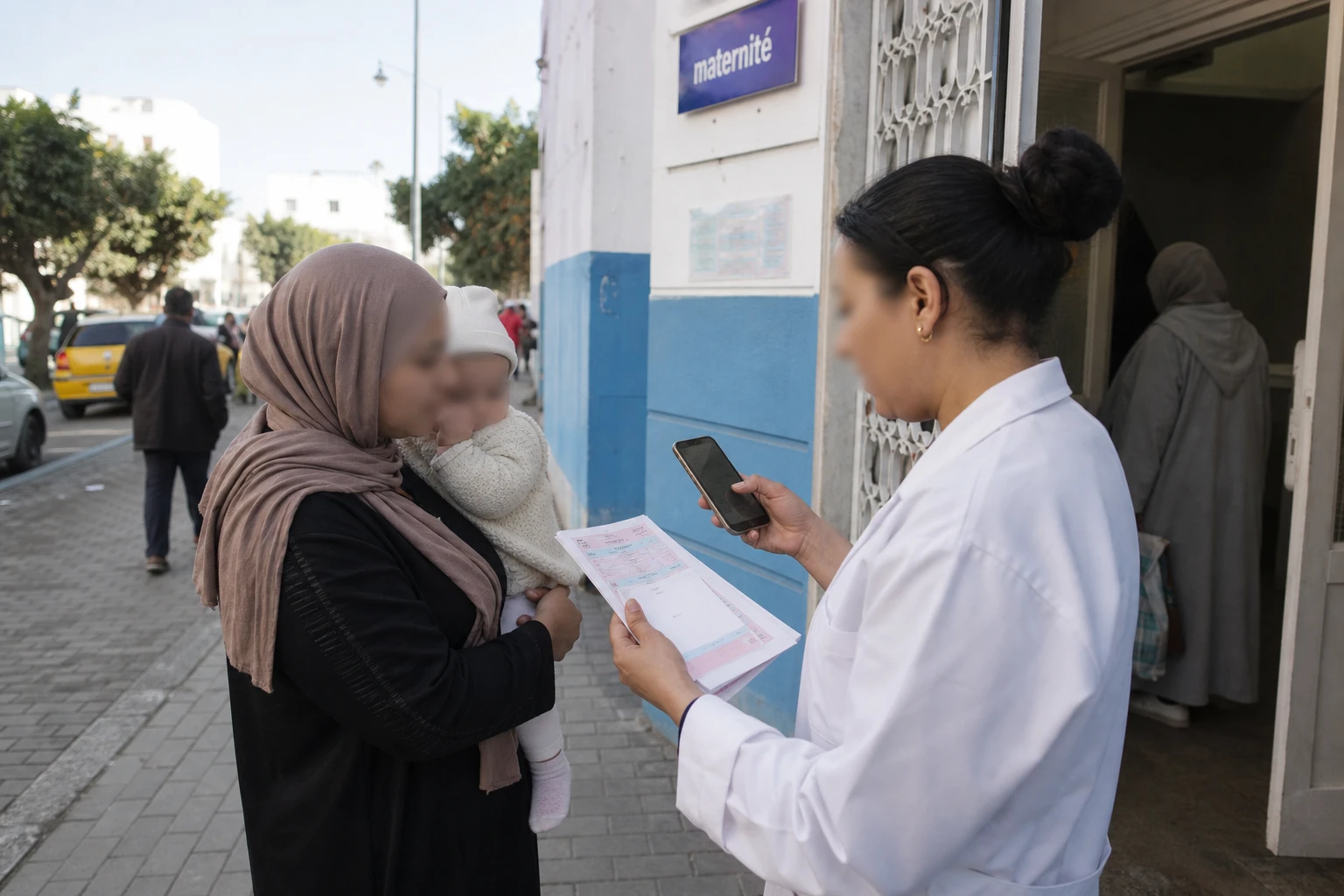
When a newborn’s follow-up stops at the edge of the page
In Tunisia, the question is no longer just how to provide treatment. It is also how to ensure information reaches the right people at the right time, from pregnancy to maternity care, the health centre and paediatric follow-up. That is where a care pathway succeeds or breaks down, especially in the first weeks of life, when every appointment matters.
Tunisia’s Ministry of Health is now working on a digital platform designed to link mothers, newborns and children in a single continuum of care. The principle is simple, but implementation is more demanding: enable health professionals to retrieve medical histories, share the right data and reduce gaps between the different levels of the system.
This project comes at a time when maternal and neonatal health remains as much an organisational challenge as one of outcomes. Data from the 2023 MICS survey show that 89.2% of mothers received at least one postnatal check-up within two days of giving birth, but disparities persist according to location, living standards and level of education. For newborns, postnatal checks within two days reached 95.4%, a slight decline from 2018.
Modernisation as part of Tunisia’s health reform
Tunisia is not starting from scratch. The country has already embarked on a digital transformation of its health system, deploying electronic medical records, digitising archives, introducing teleradiology and remote services, and developing remote-monitoring solutions. The Ministry of Health presents this approach as a way to improve patient histories, data-sharing and continuity of care.
The World Health Organization is also supporting this transformation. In its country monitoring, it says it is backing implementation of the national digital health transformation strategy, including integrated platforms focused on primary care, to improve real-time data collection and clinical decision-making. In other words, digitisation is not conceived as a simple software tool, but as one component of the system’s architecture.
This approach follows a longer-standing trajectory. As early as 2000, the WHO reported that Tunisia had a strategy for integrated maternal and child health care, formally adopted by the ministry. The country is therefore already familiar with the language of integration; what is new today is the digital tool intended to link the different parts of the chain.
What the platform could change in practice
If it works, the Integrated Mother-and-Child Health Platform could address a common weakness in fragmented systems: the loss of information between antenatal appointments, childbirth, the postnatal period and infant follow-up. The WHO also recommends community health records for women, newborns and children, to preserve care histories and improve communication between families and health professionals.
The expected benefits concern health teams first. A well-connected record avoids repeating the same tests, makes it easier to refer patients to the appropriate level of care and helps identify the risk of complications earlier. For mothers, it could reduce unnecessary trips. For newborns, it could improve the monitoring of vaccinations, nutrition and early check-ups. For the administration, it could strengthen the quality of data used to guide policy.
But the challenge goes beyond technology. The WHO points out that digitising health records raises questions about integration with existing systems, equitable access and adoption by health workers. In Tunisia, this issue is particularly sensitive between major cities, where facilities are better connected, and some inland or rural areas, where access to services remains more unequal. The 2023 MICS survey already shows clear regional disparities in postnatal follow-up.
The real test: linking data, not just entering it
The main risk is familiar from many digital health reforms: creating screens without changing practices. A platform does not improve care simply by existing. It must be connected to the actual workflows of maternity units, dispensaries, regional hospitals and frontline teams, with clear rules for entering, sharing and protecting data.
Tunisia nevertheless has favourable conditions. The country has already made progress in digitising public facilities, modernising information systems and aligning with international coding standards, notably with WHO support. This foundation could speed up the integration of a tool dedicated to mothers and children, provided it does not become yet another stand-alone application.
UNICEF, which works alongside the Tunisian authorities on child health, for its part stresses that continuity of care also depends on the ability to link the data needed to make decisions at the right time. In Tunisia, this directly concerns maternal health, infant nutrition, vaccinations and early follow-up for newborns — areas where coordination between public-sector actors remains decisive.
A Tunisian issue, but also a Maghreb and African one
Beyond Tunis, this issue is part of a broader movement in North Africa and across the continent: making primary care the foundation of more coherent health coverage. The WHO promotes this approach in its frameworks for digital health and integrated care, emphasising interoperability, data quality and practical clinical use.
For Tunisia, the issue is also political in the institutional sense. It concerns the state’s ability to document, guide and monitor care pathways without multiplying breaks between government departments, hospitals and local facilities. In a region where health systems are evolving at unequal rates, the success of a tool focused on mothers and children could provide a useful benchmark, provided that it is used on the ground.
Its continental significance ultimately rests on an often-overlooked truth: digital health is credible only if it improves the service delivered. In Tunisia, the window of opportunity is open. The technical foundations are in place, partners are involved and needs have been documented. The remaining task is to turn a promise of integration into daily practice, from the first antenatal examination through the child’s early years.