Algeria
 Egypt
 Libya
 Morocco
 Sudan
 Tunisia
 Benin
 Burkina Faso
 Cabo Verde
 Côte d'Ivoire
 Ghana
 Guinea
 Guinea-Bissau
 Liberia
 Mali
 Mauritania
 Niger
 Nigeria
 Sierra Leone
 The Gambia
 Togo
 Cameroon
 Central African Republic
 Chad
 DR Congo
 Equatorial Guinea
 Gabon
 Republic of the Congo
 São Tomé and Príncipe
 Burundi
 Comoros
 Djibouti
 Eritrea
 Ethiopia
 Kenya
 Madagascar
 Malawi
 Mauritius
 Mozambique
 Rwanda
 Seychelles
 Somalia
 South Sudan
 Tanzania
 Uganda
 Angola
 Botswana
 Eswatini
 Lesotho
 Namibia
 South Africa
 Zambia
 Zimbabwe
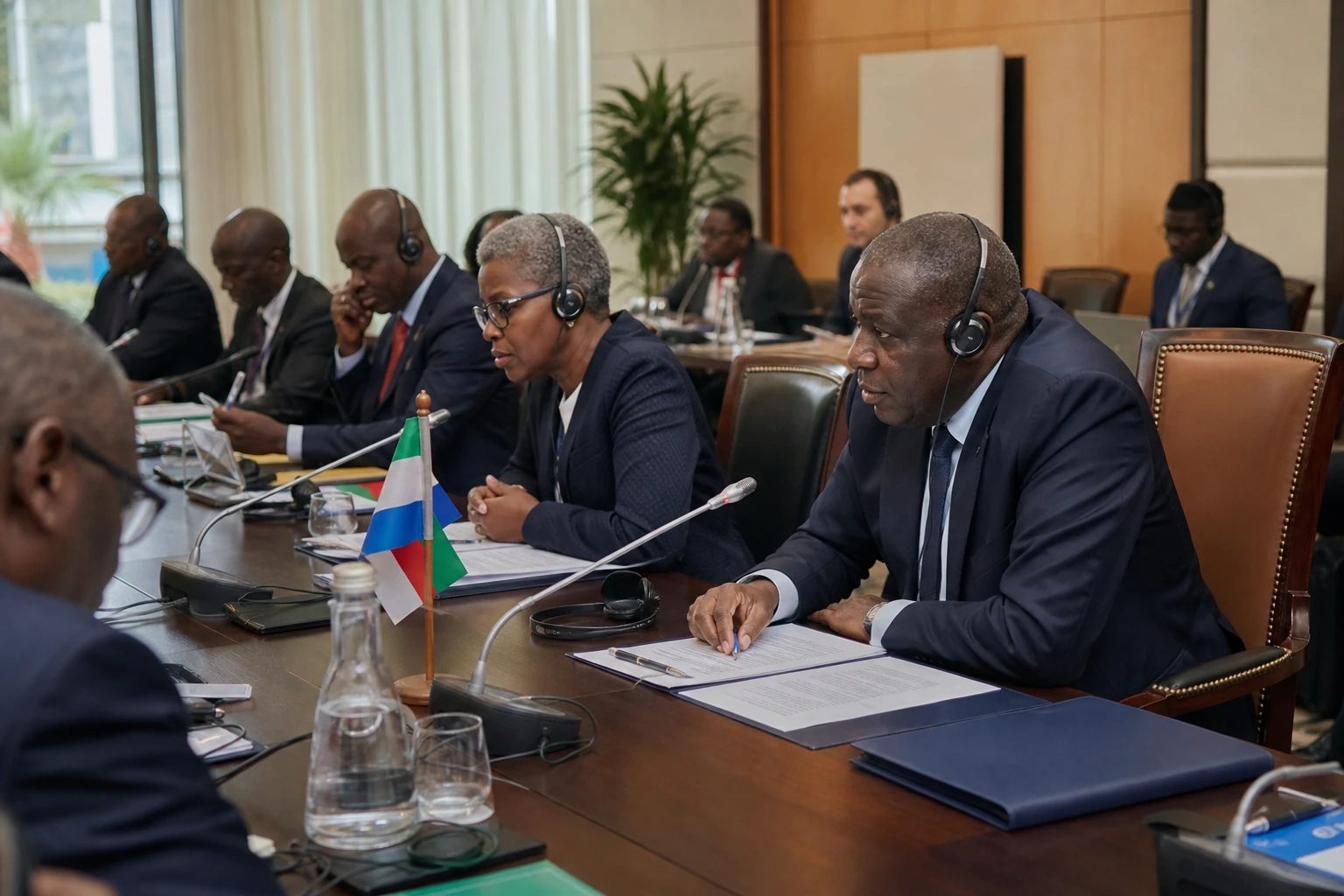
The weight of debt now at the centre of the political agenda
In Senegal, the economic debate is no longer only about recovery. It has become first and foremost a question of solvency, budgetary room for manoeuvre and social priorities. Addressing the National Assembly in Dakar, Prime Minister Ahmadou Al Aminou Lô put the restoration of public finances at the heart of his general policy statement, explaining that the state must first put its debt in order before launching the major projects announced by the executive.
The context is difficult, but not unique. For several months, Senegal has been negotiating a new 36-month programme with the International Monetary Fund, presented on 1 September 2026 as a staff-level agreement worth about $2.2 billion. The IMF says the programme aims to achieve macroeconomic stability, debt sustainability and growth driven by the private sector. In Dakar, these words point to a very tangible reality: the state must finance its day-to-day spending, pay its arrears and honour its social commitments without stifling economic activity.
This phase also forms part of the country’s recent trajectory, in which the debt issue has taken on unprecedented scale following the revision of public accounts and the discovery of unconsolidated liabilities. The Senegalese government now refers to a “Senegal Debt Treatment Plan”, described as nearly finalised and designed to avoid a sudden shock to the national economy, vulnerable households and financial stability in the West African Economic and Monetary Union, WAEMU, which brings together eight countries sharing the CFA franc.
What the prime minister announced to MPs
On 8 September 2026, Ahmadou Al Aminou Lô set out his first major policy direction before a National Assembly in which the majority belongs to Pastef, the party of President Bassirou Diomaye Diakhar Faye and his predecessor as prime minister, Ousmane Sonko. The official note from the Prime Minister’s Office confirms that he delivered his general policy statement that day and outlined five major commitments, as well as the method that should guide government action.
The thrust of his argument is simple: the state cannot pile up projects without first securing its finances. According to APS, the head of government said that public accounts must be put back on track before major projects can begin. He also recalled that the state owes Senegalese companies about 1,900 billion CFA francs. The message is aimed at both MPs and the business community: without clearing arrears, public procurement slows, projects stall and suppliers’ confidence erodes.
The speech also sought to explain the nature of the IMF case. The prime minister argued that this is not a conventional restructuring but a reprofiling of the debt — in other words, an adjustment to repayment terms to make debt servicing more sustainable. This distinction matters politically. It allows the executive to talk about recovery without creating the impression of a country placed under trusteeship. But it does not change the essential point: Senegal must loosen a real budgetary stranglehold.
Several sources agree on the level of indebtedness. The Prime Minister’s Office puts consolidated public debt at close to 132% of GDP at the end of 2024, or more than 23,500 billion CFA francs. The IMF has also confirmed, in its exchanges with the press and in its working documents, total debt estimated at 132% of GDP at the end of 2024. The newspaper Le Soleil reports the same calculation and specifies that the deficit was also revised to 13.7% of GDP.
A budgetary trade-off that hits households and businesses first
The debate is technical, but its effects are social. When a government devotes a growing share of its resources to debt servicing, it reduces its capacity to fund roads, electricity, hospitals, schools and social safety nets. This is the dilemma the prime minister laid before the National Assembly: launching new projects without restoring public finances would expose the country to wider financial instability.
Senegalese businesses are on the front line. The payment arrears reported by the government weigh on the cash flow of suppliers, construction SMEs, subcontractors and the informal economy surrounding public projects. In a country where much urban activity depends on the pace of public spending, a late payment can quickly become a delayed wage, the loss of temporary jobs and a fall in turnover. Fiscal recovery is therefore not only a matter for ministries; it affects daily life in Dakar’s neighbourhoods as well as in towns inland.
The regional dimension is just as important. Senegal remains a central player in WAEMU and ECOWAS, two blocs where regional debt markets play an increasingly important role. The IMF notes that Dakar has relied increasingly on the regional market to finance its needs, often with shorter maturities in 2026, owing to limited access to external financing. The same assessment notes that this dependence can weigh on the monetary union’s financial stability. In other words, Senegal’s pressure is not only national; it spills over into financing conditions across the region.
For external partners, the challenge is twofold. On the one hand, they must support a country of reference in West Africa. On the other, they must prevent an overly abrupt correction from choking off the recovery. That is why the new agreement in principle with the IMF emphasises, beyond adjustment, higher social spending, greater budget transparency and growth driven by the private sector. The World Bank and the African Development Bank are also expected to play a supporting role.
The signal Dakar is sending to West Africa
Senegal’s case matters beyond Senegal. In a West Africa where several states are under budgetary pressure, Dakar’s choice will be a test. The country is trying to reconcile three objectives that are rarely compatible: restoring creditors’ confidence, preserving social peace and maintaining a vision of economic transformation towards 2050. The success or failure of this phase will say much about the ability of West African states to put their finances right without giving up on public investment.
The timeline to watch is clear. The IMF agreement remains subject to approval by the Fund’s management and then its Executive Board, and it also depends on corrective measures linked to the case of misreporting of debt information. At the same time, the Senegalese government must show that it can mobilise revenue, clear its arrears and restart investment without placing the bulk of the burden on the most vulnerable households. Only then can the general policy statement of 8 September 2026 be seen as a turning point rather than a simple announcement of austerity.