Algeria
 Egypt
 Libya
 Morocco
 Sudan
 Benin
 Burkina Faso
 Cabo Verde
 Côte d'Ivoire
 Ghana
 Guinea
 Guinea-Bissau
 Liberia
 Mali
 Mauritania
 Niger
 Nigeria
 Senegal
 Sierra Leone
 The Gambia
 Togo
 Cameroon
 Central African Republic
 Chad
 DR Congo
 Equatorial Guinea
 Gabon
 Republic of the Congo
 São Tomé and Príncipe
 Burundi
 Comoros
 Djibouti
 Eritrea
 Ethiopia
 Kenya
 Madagascar
 Malawi
 Mauritius
 Mozambique
 Rwanda
 Seychelles
 Somalia
 South Sudan
 Tanzania
 Uganda
 Angola
 Botswana
 Eswatini
 Lesotho
 Namibia
 South Africa
 Zambia
 Zimbabwe
In Tunis, defending a journalist also exposes the fragility of public debate
In the Tunisian capital, the mobilisation of dozens of journalists was about more than a colleague who had been arrested. It raised a broader question: how far can a Tunisian journalist investigate, speak and travel without risking criminal proceedings that spiral beyond their control? For many media professionals, the troubling answer lies in the growing number of cases in which journalistic work is treated as an offence.
The case of Mohamed Yousfi, editor-in-chief of investigative outlet Alqatiba, comes amid an already difficult period for the Tunisian press. Since the political turning point of 2021, when President Kaïs Saïed suspended and then dissolved parliament and began ruling by decree, unions, rights advocates and several media outlets have reported a marked deterioration in the public climate.
An arrest that crystallises several fault lines
Mohamed Yousfi was arrested on Friday 4 September 2026 in Tunis, at the entrance to the offices of radio station Express FM, as he was about to take part in a programme about the water crisis. According to the National Syndicate of Tunisian Journalists, he was subsequently placed in pre-trial detention. The financial police targeted him in an investigation into suspected foreign funds, money laundering and illicit enrichment, while his lawyer says no concrete evidence has been presented so far.
The legal framework matters here as much as the timing. The investigation invokes laws relating to financial crime, but it is also taking place in a country where Decree-Law No. 2022-54 on information and communication systems is regularly denounced by journalists as an additional tool of pressure. Adopted on 13 September 2022, the law has been used for two years to bring prosecutions over the dissemination of information online, which the SNJT considers a direct threat to press freedom.
The journalist’s health and the response from media professionals have shaped the case
The case has also taken on a human dimension. The SNJT says Mohamed Yousfi’s health deteriorated after an appendicitis operation, to the point that his lawyers reportedly had to interrupt an interrogation to give him medication. The organisation shared the account of a journalist in pain at the very moment the proceedings were intensifying. These details are attributed to the union, but they have heightened the sense of urgency among his colleagues.
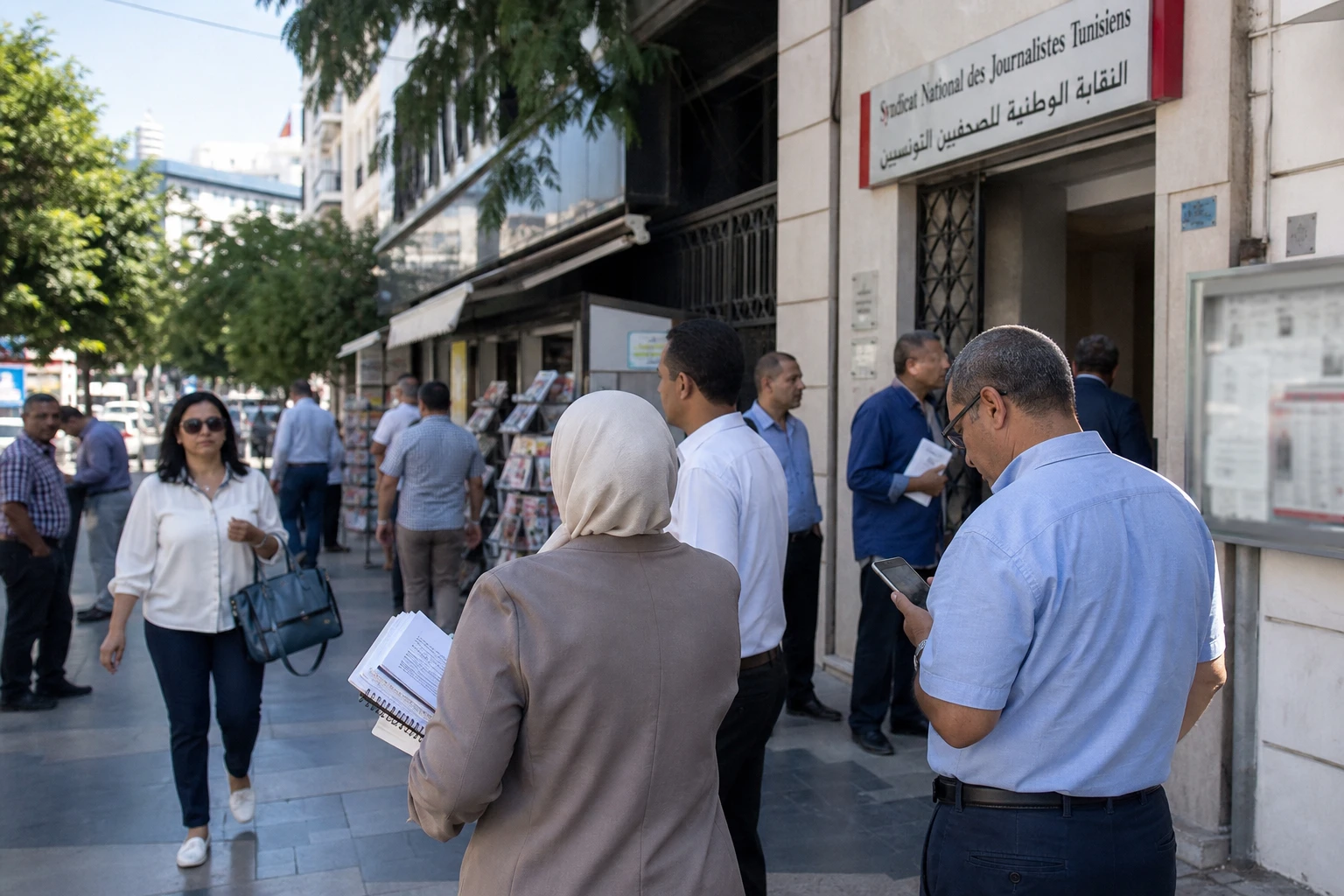
In Tunis, journalists gathered outside a professional body with a simple message: pre-trial detention must not become a pre-emptive punishment for investigative work. Reporters Without Borders (RSF) called for the journalist’s immediate release, saying the case did not justify keeping him in prison. The Committee to Protect Journalists (CPJ), meanwhile, condemned the use of financial accusations to target a prominent critic of the Tunisian authorities.
What the case reveals about Tunisia under Kaïs Saïed
The Yousfi case cannot be viewed in isolation. It follows a series of prosecutions targeting journalists, lawyers, opposition figures and activists. Media personalities such as Mourad Zeghidi and other professionals have already been convicted or detained in cases where financial or digital laws have been used against critical voices. Tunisian unions say they see a pattern: shifting public debate from the political arena to the criminal courts.
The issue in this case therefore goes beyond the journalist himself. For independent newsrooms, it concerns the right to cover sensitive subjects such as water, corruption and the management of public resources. For citizens, it concerns access to verified information at a time when water shortages, social tensions and distrust of institutions make public debate more necessary than ever. In practice, prolonged pre-trial detention can deter investigations, delay publication and push media outlets towards self-censorship.
The case must also be read in a broader institutional context. Tunisia retains checks and balances, active unions and a well-organised civil society, but the space for expression has narrowed. The debate in Tunis is therefore also a regional one: in several North African countries, the independent press is struggling to withstand increasingly broad criminal laws, often justified in the name of security, public morality or the fight against disinformation.
A North African and continental significance
For many African observers, Tunisia remains a political laboratory in the most tangible sense: a country where freedoms won after 2011 served as a point of reference, before becoming the subject of documented backsliding. When a journalist is arrested as he is about to speak about the water crisis, the message extends beyond the media sector. It touches on a state’s ability to accept dissent at a time when economic, water and social crises demand greater transparency.
Across Africa, the case also points to a shared reality: laws designed to regulate digital activity, combat fraud or protect security can become tools against the press if applied without adequate safeguards. This is the point emphasised by the SNJT, RSF and CPJ, each from its own perspective. The next development to watch is not only judicial but political: how the Tunisian authorities respond will show whether a journalist’s detention remains an exceptional and contested measure, or becomes a routine way of managing dissent.