Algeria
 Egypt
 Libya
 Morocco
 Sudan
 Tunisia
 Benin
 Burkina Faso
 Cabo Verde
 Côte d'Ivoire
 Ghana
 Guinea
 Guinea-Bissau
 Liberia
 Mali
 Mauritania
 Niger
 Nigeria
 Senegal
 Sierra Leone
 The Gambia
 Togo
 Cameroon
 Central African Republic
 Chad
 DR Congo
 Equatorial Guinea
 Gabon
 Republic of the Congo
 São Tomé and Príncipe
 Burundi
 Djibouti
 Eritrea
 Ethiopia
 Kenya
 Madagascar
 Malawi
 Mauritius
 Mozambique
 Rwanda
 Seychelles
 Somalia
 South Sudan
 Tanzania
 Uganda
 Angola
 Botswana
 Eswatini
 Lesotho
 Namibia
 South Africa
 Zambia
 Zimbabwe
A useful step, but a test for the Comorian grid
In Comoros, adding megawatts is not enough. The real challenge is less visible, but more decisive: getting electricity to homes, public services and small businesses without losing too much along the way. It was against this backdrop that the Union of the Comoros commissioned a new series of solar installations on 5 September in Ouani, on Ndzuwani, spread across Grande Comore, Anjouan and Mohéli.
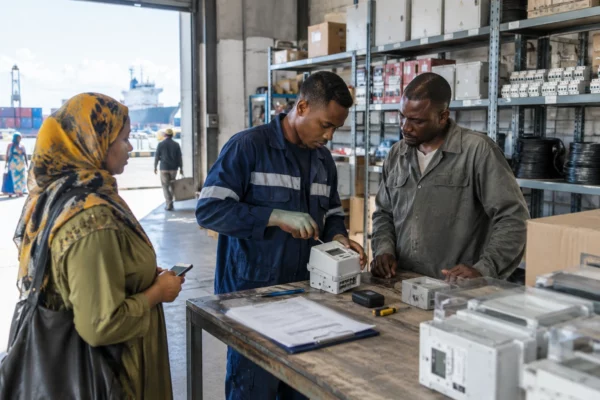
The project comprises three photovoltaic plants with a total capacity of about 20 MW, complemented by 16 MWh of battery storage and nearly 30 kilometres of medium-voltage lines. Funding, provided by the Abu Dhabi Fund for Development, amounts to about 84.4 million UAE dirhams. Operations and maintenance have been entrusted to Global South Utilities, in an arrangement led with Masdar.
What Comoros’ energy figures show
The move is significant because it comes as the electricity system remains fragile. According to the Union of the Comoros’ National Energy Compact, the country’s installed capacity stood at about 53 MW in 2024, but only 22 MW was actually available. Solar accounted for 11.3 MW at the time. In other words, the newly added capacity represents a substantial increase at national level.
The same document highlights a very high dependence on imported fuels. Diesel-fired thermal generation remained dominant, with an estimated average production cost of $0.76 per kWh, compared with an average selling tariff of $0.43. The gap fuels public utility SONELEC’s reliance on subsidies, estimated at $22 million a year, or about 2% of GDP.
The weakness of the grid is another key issue. The National Energy Compact points to high technical and commercial losses, linked to ageing infrastructure and insufficiently modernised management. The problem is therefore not only generation. It also lies in the country’s ability to transmit, distribute and secure electricity across its three islands.
Grande Comore, Anjouan, Mohéli: one promise, different realities
The distribution of the new plants says much about Comoros’ geography. The project provides for 12.86 MW on Grande Comore, 4.05 MW on Anjouan and 3.1 MW on Mohéli. Storage is intended to help smooth out solar intermittency and secure supply during peak hours. This is particularly important in an archipelago where outages affect public services as well as craft and commercial activities.
In Moroni, the capital, the issue is also political. President Azali Assoumani presents the infrastructure as a step towards a “more energy-sovereign” and “economically stronger” Union of the Comoros. The official message emphasises reliability, growth and improved living conditions. But on the ground, reliable electricity is above all a basic lever for hospitals, schools, water supplies, food preservation and small-scale local processing.
The presence of new power lines is important in this respect. Without a grid, solar power remains partly isolated local generation. With these lines, the country hopes to better connect generation to transmission and then to end-user services. That is where the difference between a symbolic inauguration and a genuine structural gain will be determined.
A Comorian perspective, with regional significance
Comoros is part of a region where islands are seeking energy solutions suited to land constraints, the cost of importing fuel and climate vulnerability. The country has been a member of the African Union since 1975 and of the Indian Ocean Commission, an intergovernmental organisation that also brings together Madagascar, Mauritius and Seychelles, with Réunion represented by France. This political geography is a reminder that energy is a national issue for Comoros, but also an island and regional one.
Comoros’ energy agenda is also relevant to the African Union’s Agenda 2063, which emphasises integration, resilience and infrastructure. Here, the transition does not depend on a large continental grid, but on a series of modular solutions: solar power, storage, distribution and maintenance. This is a configuration similar to that of several African island states, which are often compelled to innovate with small-scale systems that can have a major social impact.
The issue’s continental significance also lies in its financing model. The Comorian project illustrates the growing role of Gulf partnerships in African infrastructure, particularly in clean energy. For Moroni, the challenge will be to turn this external contribution into lasting local capacity: technical skills, maintenance, reduced losses and better grid governance. Only then will the 20 MW of solar power make a real difference to the daily lives of Comorians.