Algeria
 Egypt
 Libya
 Morocco
 Sudan
 Tunisia
 Benin
 Burkina Faso
 Cabo Verde
 Côte d'Ivoire
 Ghana
 Guinea
 Guinea-Bissau
 Liberia
 Mali
 Mauritania
 Niger
 Nigeria
 Senegal
 Sierra Leone
 The Gambia
 Togo
 Cameroon
 Central African Republic
 Chad
 DR Congo
 Equatorial Guinea
 Gabon
 Republic of the Congo
 São Tomé and Príncipe
 Burundi
 Comoros
 Djibouti
 Eritrea
 Ethiopia
 Kenya
 Madagascar
 Malawi
 Mauritius
 Mozambique
 Rwanda
 Seychelles
 Somalia
 South Sudan
 Tanzania
 Uganda
 Angola
 Botswana
 Eswatini
 Lesotho
 Namibia
 South Africa
 Zambia
Stability restored, but jobs remain too precarious
In Zimbabwe, the macroeconomic recovery is not yet showing up sufficiently in payslips. The figures are improving, but a large share of Zimbabweans continue to rely on low-productivity activities, often without contracts or protection. This is now the real test of the recovery: turning price and exchange-rate stability into regular incomes, in Harare and the provinces alike.
The country is moving forward in a regional environment where SADC, the Southern African Development Community, is urging its members to strengthen productive integration and value chains. For Zimbabwe, that means one simple thing: without reliable energy, passable roads, irrigation and predictable rules for businesses, it will remain easier to sell into neighbouring markets than to capture them. The government is also aligning its work with Vision 2030 and the National Development Strategy 2, which covers the period 2026-2030.
What the report says: reforms to expand employment
In its Zimbabwe Growth and Jobs Report, published in Harare on 4 September 2026, the World Bank says ambitious reforms could support the creation of up to 230,000 new jobs by 2040. The institution also says that accelerating structural reforms could lift real GDP by 10.7% above a baseline scenario in 2030, and by 26.9% in 2040, while workers’ real incomes would rise by more than 30% over the same period.
The diagnosis is clear. According to the report, local-currency inflation returned to single digits in early 2026, for the first time since 1997, and real growth averaged close to 6% between 2021 and 2025. But this improvement has yet to create enough productive jobs. About 80% of the workforce is employed in the informal sector, with a median income of $130 a month, and nearly half the population lives below the international poverty line.
The solution rests on three levers: investing in basic infrastructure, making the business environment more predictable and attracting more private investment. The World Bank highlights bottlenecks in electricity, transport and irrigation. Its message is clear: without these foundations, growth may show up in the statistics, but it does not circulate effectively through the real economy.
A labour market dominated by informal work
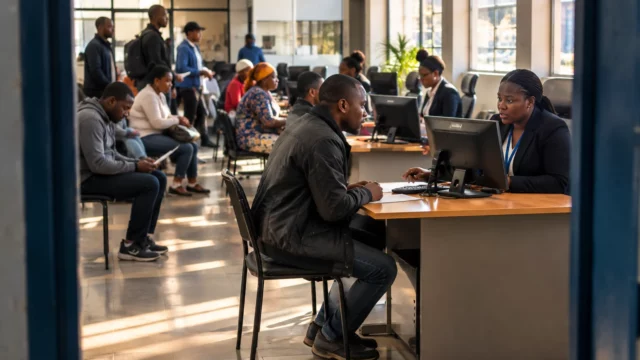
National data confirm this fragility. According to ZIMSTAT’s Quarterly Labour Force Survey, non-agricultural informal employment accounted for 43.6% of jobs in the third quarter of 2024, compared with 30% for non-agricultural formal employment. Agriculture still accounted for 20.3% of total employment, showing that a large share of the workforce remains exposed to climate shocks, low margins and seasonal work.
This structure explains why the current recovery is not enough. An economy can grow quickly, but if new jobs are created mainly in subsistence trading and low-productivity services, households will not achieve lasting improvements. Zimbabwe is facing precisely this situation: workers are gradually leaving agriculture, but not moving quickly enough into industry, processing or better-paid services.
The contrast is also evident in public policy. The government is preparing its National Development Strategy 2 as a roadmap for 2026-2030, while the Reserve Bank of Zimbabwe says it has kept inflation in single digits for several months in 2026 and is targeting lasting exchange-rate stability. The central bank also forecasts growth of at least 5% for 2026, driven by metal prices, gold and mining exports.
Debt, financing and shifting priorities
But the greatest constraint remains financial. The IMF says Zimbabwe is pursuing a ten-month Staff-Monitored Programme to consolidate its macroeconomic gains, strengthen budget management and make progress towards arrears clearance and debt restructuring. In July 2026, the institution welcomed the broad achievement of quantitative targets, while stressing the need to protect social spending and contain fiscal risks.
This is decisive. Until arrears to multilateral creditors are settled, the country remains shut out of normal access to concessional financing. Yet these resources are essential to build roads, modernise the electricity grid, develop irrigation and reduce the costs that hold back private hiring. In other words, debt directly limits the country’s ability to create the jobs it says it wants to protect.
What this means for Zimbabwe and the region
The stakes go beyond the projection of 230,000 jobs. Zimbabwe is testing an idea relevant to all of southern Africa: monetary stabilisation, if not accompanied by productive reforms, can improve indicators without improving lives. Conversely, better-targeted infrastructure and a clearer business climate can turn stability into higher wages, formal jobs and a denser industrial base.
For households, the difference is tangible. In cities, it can be seen in job quality and in small businesses’ ability to access credit, electricity and markets. In rural areas, it depends above all on irrigation, the transport of crops and local value addition. For the state, it means choosing between recurrent spending and investment that supports future employment.
The continental implications are clear. Several African countries are seeking to escape the same trap: real growth, but job creation that is too slow. Zimbabwe’s experience is a reminder that a credible strategy must combine macroeconomic discipline, institutional reforms and the capacity to invest. This is also being watched by regional partners and African institutions as the country seeks to fully rejoin southern Africa’s financial and trade networks.