Algeria
 Egypt
 Libya
 Morocco
 Tunisia
 Benin
 Burkina Faso
 Cabo Verde
 Côte d'Ivoire
 Ghana
 Guinea
 Guinea-Bissau
 Liberia
 Mali
 Mauritania
 Niger
 Nigeria
 Senegal
 Sierra Leone
 The Gambia
 Togo
 Cameroon
 Central African Republic
 Chad
 DR Congo
 Equatorial Guinea
 Gabon
 Republic of the Congo
 São Tomé and Príncipe
 Burundi
 Comoros
 Djibouti
 Eritrea
 Ethiopia
 Kenya
 Madagascar
 Malawi
 Mauritius
 Mozambique
 Rwanda
 Seychelles
 Somalia
 South Sudan
 Tanzania
 Uganda
 Angola
 Botswana
 Eswatini
 Lesotho
 Namibia
 South Africa
 Zambia
 Zimbabwe
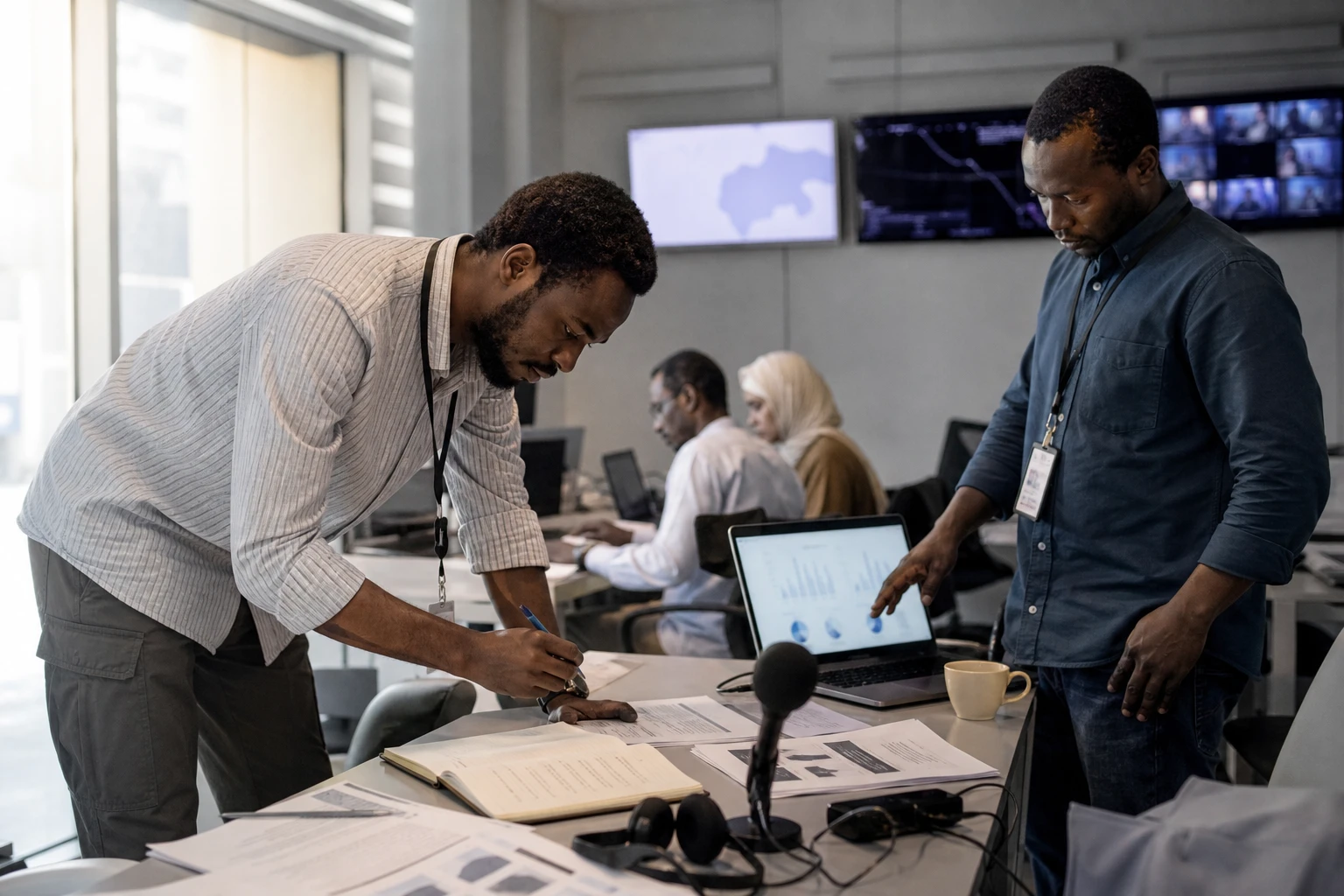
In Sudan, the war is no longer being fought only on the battlefield
As a conflict enters its third year, the question is no longer simply who controls a particular city. It is broader: which red lines have already been crossed, and what remains of the Sudanese state? Since April 2023, the war between the Sudanese Armed Forces and the Rapid Support Forces has made the country the world’s largest displacement crisis, with more than 11 million internally displaced people recorded in early 2025 by the International Organization for Migration.
Against this backdrop, allegations of chemical weapons use are not just another episode. They signal an escalation in the conflict and a further erosion of minimum safeguards for civilian protection. In 2025, Washington imposed sanctions on the grounds that the Sudanese government had used chemical weapons, while Khartoum rejected the allegations and announced a national investigation.
Khartoum, al-Jaili and the battle for control of infrastructure
The heart of the case lies north of Khartoum, near the al-Jaili refinery, a strategic site for the country’s energy supplies and other provisions. Journalistic investigations and documentary evidence published from 2025 onwards described two attacks, on 5 and 13 September 2024, in which chlorine-filled barrels were dropped in an area then controlled by paramilitaries. France 24 said it had authenticated images, videos and material evidence, and subsequent analyses confirmed that the issue went well beyond a wartime rumour.
Documents cited by several international media outlets also suggest a chain of command reaching the top of Sudan’s military establishment. According to this interpretation, the use of chlorine would not have been accidental, but intended as a way to regain the initiative without completely destroying infrastructure that remained highly valuable militarily and economically. This hypothesis is consistent with al-Jaili’s central role in Sudan’s energy system, already weakened by the war and fighting around Khartoum.
A diplomatic crisis compounds the deadlock as mediation efforts mount
Diplomatically, the case adds another layer of tension to a landscape already crowded with initiatives. The African Union, IGAD and the United Nations have stepped up calls for a ceasefire and an inclusive political solution, but have been unable to impose a lasting negotiating process. IGAD convened its special envoys again in March 2025 to coordinate mediation efforts, while the African Union condemned the continuing violence and stressed the need to protect civilians.
The United States, meanwhile, took a tougher line in early 2025 against both military sides in the conflict: first the paramilitaries, then the head of the Sudanese Armed Forces. At the same time, Sudanese officials denounced what they saw as selective foreign pressure and disputed the allegations of chemical weapons use. This sequence illustrates a familiar deadlock in protracted wars: each side seeks military victory before making political concessions, shrinking the space for civilians and weakening mediators.
What such an accusation means for Sudanese people
For residents of Khartoum, al-Jazirah State, Darfur or Kordofan, the problem is not abstract. It means displacement, shortages, disrupted healthcare and cities divided by front lines. In 2025, the UN again described a humanitarian crisis of exceptional scale, with nearly 26 million people in the country and the region in need of assistance, and serious violations of international law documented in several conflict zones.
The risk in a chemical weapons case is also political. If proven, it strengthens the prospect of sanctions, international legal proceedings and further divisions within the Sudanese army itself. If it is simply denied without a credible and transparent investigation, it mainly fuels impunity. Either way, the population pays the immediate price: greater fear, less humanitarian access and greater isolation for areas that change hands.
A Sudanese case, but a wider warning for Africa
Sudan lies at the crossroads of several African and regional balances. Its conflict affects Chad, South Sudan, Egypt and the Horn of Africa, where population movements, arms trafficking and border tensions are increasing pressure on neighbouring states. IGAD has stressed that peace in Sudan cannot be lasting without dialogue among Sudanese and the involvement of civilians, while the African Union continues to treat the issue as a continental crisis, not merely a national one.
This case is also a reminder of a truth familiar across the continent: modern warfare does not only destroy territory; it also erodes institutions, public services and civic trust. In Sudan, the capital, Khartoum, is no longer just a contested centre of power. It has become a symbol of a state still struggling to find a way to protect its citizens, as diplomacy seems unable to produce anything beyond an armed stalemate.